
 Worksheets
Industrial Rev. Pt 2 Review
Total questions: 25
Worksheet time: 13mins
Which of the following technological advances led to increased steel production and contributed to industrialization?
Introduction of mass production
Creation of suspension bridges
Invention of the Bessemer process
Invention of the steam engine drill
By 1910, New York had six Italian-language newspapers, each with a daily circulation of over 10,000. The Yiddish-language daily, The Forward, had 120,000 daily readers. What can be inferred about New York from this information?
Only Italian and Jewish immigrants were literate.
The city had significant populations of Italian and Yiddish-speaking immigrants.
There were not as many Jewish immigrants as Italian immigrants in New York.
Newspaper publishers were less focused on Italian immigrants.
Which statement most accurately defines a tenement during the late 1800s and early 1900s?
A type of luxury housing built for wealthy industrialists
A small, often overcrowded apartment building for working-class families.
A temporary shelter built by immigrants while searching for jobs
A government-funded housing project
What was the main goal of the Chinese Exclusion Act of 1882?
To promote Chinese immigration to Western cities
To limit Chinese immigration and prevent Chinese laborers from becoming citizens
To safeguard Chinese workers from hazardous factory conditions
To boost the number of Chinese immigrants working on railroads
In what way were the “new” immigrants of the late 1800s different from those who immigrated to the United States earlier?
Earlier immigrants usually lived in cities, while “new” immigrants more often chose to settle on farms.
Earlier immigrants mostly came from northern and western Europe, while “new” immigrants often arrived from southern and eastern Europe.
Earlier immigrants had to learn English after arriving, but “new” immigrants already spoke English when they came.
"New" immigrants originated from China.
The majority of immigrants who passed through Angel Island in San Francisco Bay originated from
Britain.
China.
Mexico.
Zimbabwe.
What approach did many major cities take to address crime in the late 1800s?
Many neighborhoods were patrolled by uniformed police officers.
Strict curfews were enforced for all residents by city officials.
Emergency call boxes were installed on most street corners by city planners.
A Sheriff was appointed by city officials.
“All charges made for any service rendered or to be rendered in the transportation of passengers or property as aforesaid, or in connection therewith, or for the receiving, delivering, storage, or handling of such property, shall be reasonable and just; and every unjust and unreasonable charge for such service is prohibited and declared to be unlawful.”
—Interstate Commerce Act, 1887
Transcript of Interstate Commerce Act (1887),
According to this passage, what action did the Interstate Commerce Act take?
It oversaw the business dealings of the railroads.
It eliminated all existing railroad monopolies.
It supervised the prices set by railroads.
It governed every railroad in the country.
According to the passage, what does Andrew Carnegie believe is the obligation of wealthy individuals?
Those with wealth have earned their riches and deserve to keep them.
Wealthy individuals are responsible for contributing to the welfare of society.
Everyone, no matter their social status, should be content with their position in life.
America offers opportunities for anyone to become wealthy through hard work.
“[Rockefeller’s company] eliminated its competitors, in short, by persuading the major railroads to deny them shipping. Vanderbilt is said to have remarked that only one man—Rockefeller—could give him orders.”
—H. D. Lloyd, The Atlantic, 1881
According to this passage, Lloyd explains how John D. Rockefeller established an oil
antitrust.
cartel.
corporation.
trust.
Which of the following is considered a push factor?
religious tolerance
jobs and other economic opportunities
famine
family members who have emigrated
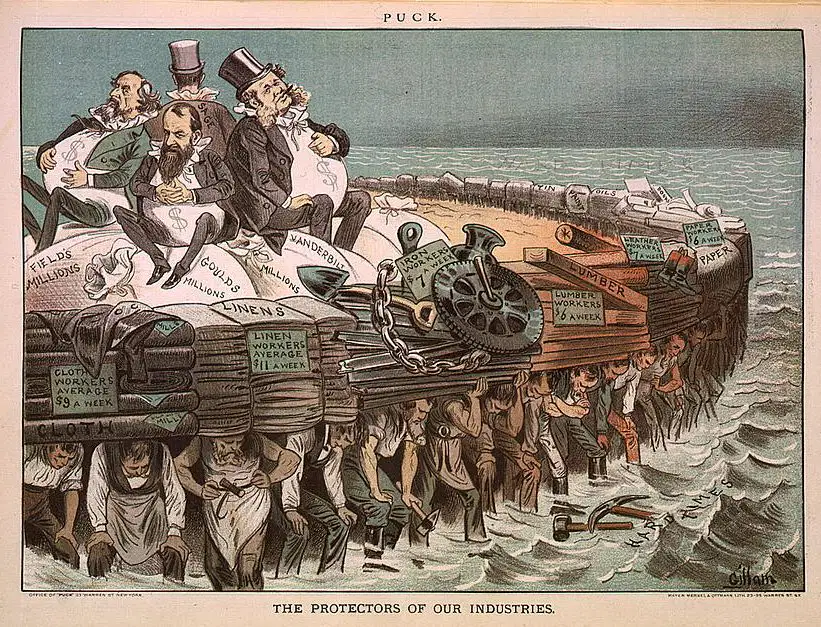
This cartoon suggests that the American “captains of industry” are
cunning.
generous.
greedy
deserving.
In what way did business leaders in the late 1800s apply vertical integration?
They kept control over the production and distribution of their goods.
They kept control over the extraction of raw materials needed for their goods.
They took control of the transportation of their goods.
All of the above.
“When Rockefeller started Standard Oil, kerosene cost 30 cents per gallon. After twenty years, Rockefeller controlled nearly 90 percent of the market and kerosene dropped to just eight cents per gallon. The real beneficiaries were the customers, since Rockefeller’s scale enabled him to lower expenses.”
—Historian Burton W. Folsom Jr.
The Exxon-Mobil Merger: The Lessons of History Burton W. Folsom, Jr., Competitive Enterprise Institute, December 20, 1998
Based on this passage, Folsom would most likely describe John D. Rockefeller as a
robber baron.
trust buster.
philanthropist.
captain of industry.
Which of the following is considered an unlawful act according to the Sherman Antitrust Act?
organizing a large-scale labor strike
employing workers for extended hours at low pay
selling stock in a company that is currently unprofitable
forming a major corporation with the goal of removing competition from the market
Which of the following best shows how immigrants influenced American culture as they adjusted to life in the United States?
Many immigrants learned English after arriving in the United States.
Most immigrants settled in urban areas.
Immigrants introduced new foods to American cuisine.
Immigrants took jobs in clothing factories.
How did economic developments during the Gilded Age contribute to the rise of consumerism?
Americans bought hand-crafted items to display their wealth and status.
Americans purchased new, affordable goods and services that improved daily life for many people.
Americans created companies that sold technological advances abroad.
Americans introduced banking and investment innovations that increased disposable income.
What was one significant impact of the expansion of railroads in the late 19th century?
It resulted in the reduction of urban populations.
It restricted the growth of cities.
It boosted the transportation of goods and people nationwide.
It led to lower levels of industrial output.
Why did many immigrants choose to live in cities during the late 1800s?
Cities had more factory jobs available.
Cities gave free land to immigrants.
Cities required immigrants to reside there.
Cities were less expensive to live in than the countryside.
What was a direct outcome of the adoption of the Bessemer process in the United States?
Fewer railroads were built
Labor unions in the steel sector disappeared
Factories used less electricity
Steel became more affordable and production increased
Which living situation was typical for many immigrants residing in American cities in the late 1800s?
Crowded apartments with inadequate sanitation
Large houses in suburban areas
Single-family homes provided by the government
Upscale high-rise residences
Which legislation was enacted to restrict monopolistic practices and encourage fair competition among businesses during the Gilded Age?
Chinese Exclusion Act
Dawes Act
Sherman Antitrust Act
Homestead Act
Which factor most contributed to the rapid growth of urban populations during the Gilded Age?
Decline in immigration rates
Increase in factory jobs and industrial opportunities
Strict housing regulations
Expansion of agricultural land
What was a common criticism of monopolies formed by industrialists like Rockefeller and Carnegie?
They promoted fair competition among businesses.
They reduced the need for technological innovation.
They limited consumer choices and manipulated prices.
They encouraged small business growth.
Which of the following best describes a pull factor that attracted immigrants to the United States in the late 1800s?
Political persecution in their home country
Natural disasters in their homeland
Availability of jobs and economic opportunities
Mandatory military service abroad

