
NEW
Font size
 Worksheets
Year 9 - House Music Assessment
Total questions: 20
Worksheet time: 10mins
The term “four to the floor” in house music refers to:
A steady kick drum on every beat in 4/4 time
A syncopated snare pattern
A bassline that plays on the off-beats
A melody played with four different instruments
House music uses the ‘four to the floor’ rhythm because:
it creates a steady, danceable beat
it allows for complex melodies
it is traditional in classical music
it emphasizes irregular rhythms
Offbeat hi-hats and percussion add interest to the rhythm by:
creating syncopation and variety
making the rhythm monotonous
slowing down the tempo
removing the groove from the music
What is syncopation?
Syncopation is when the rhythm places emphasis on the weaker beats or in-between beats, instead of just the main strong beats. In house music, this helps to break up the steady 'four to the floor' kick drum and makes the rhythm more exciting and unpredictable.
Syncopation is when the melody is played at a much faster tempo than the rhythm section.
Syncopation is when all instruments play the same note at the same time for emphasis.
Syncopation is when the rhythm only uses the main strong beats and avoids any variation.
In house music, what effect does syncopation have on the rhythm?
Syncopation helps to break up the steady 'four to the floor' kick drum and makes the rhythm more exciting and unpredictable.
Syncopation eliminates the use of basslines in house music.
Syncopation slows down the tempo of the track significantly.
Syncopation removes all percussion elements from the rhythm.
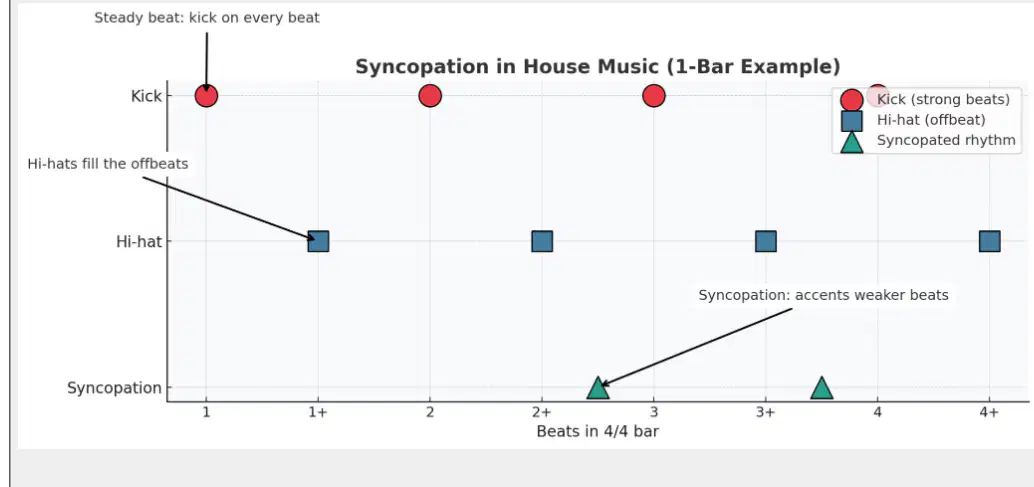
Refer to the diagram 'Syncopation in House Music (1-Bar Example)'. Which beats are accented by syncopation?
The syncopation accents the weaker beats, such as the '2+' and '3' beats in the 4/4 bar.
The syncopation accents only the downbeats, such as '1' and '3' in the 4/4 bar.
The syncopation accents every beat equally in the 4/4 bar.
The syncopation accents only the strong beats, such as '1' and '2' in the 4/4 bar.
What is sixteenth-note swing and why is it important in house music?
Sixteenth-note swing is a way of making a rhythm feel more bouncy and less robotic. It's used to give a track a human or 'funky' feeling, which is super important in house music.
Sixteenth-note swing is a technique for increasing the tempo of a track to make it sound faster and more energetic, which is crucial in house music.
Sixteenth-note swing is a method of adding more instruments to a track to create a fuller sound, which is important in house music.
Sixteenth-note swing is a way of removing all syncopation from a rhythm to make it sound more mechanical, which is important in house music.
The main role of the chords in house music is:
to provide harmonic support and atmosphere
to create complex melodies
to drive the rhythm with percussion
to deliver the main vocal line

According to the diagram, what is the distance between the first and second notes in a major chord?
Three notes
Four notes
Five notes
Two notes
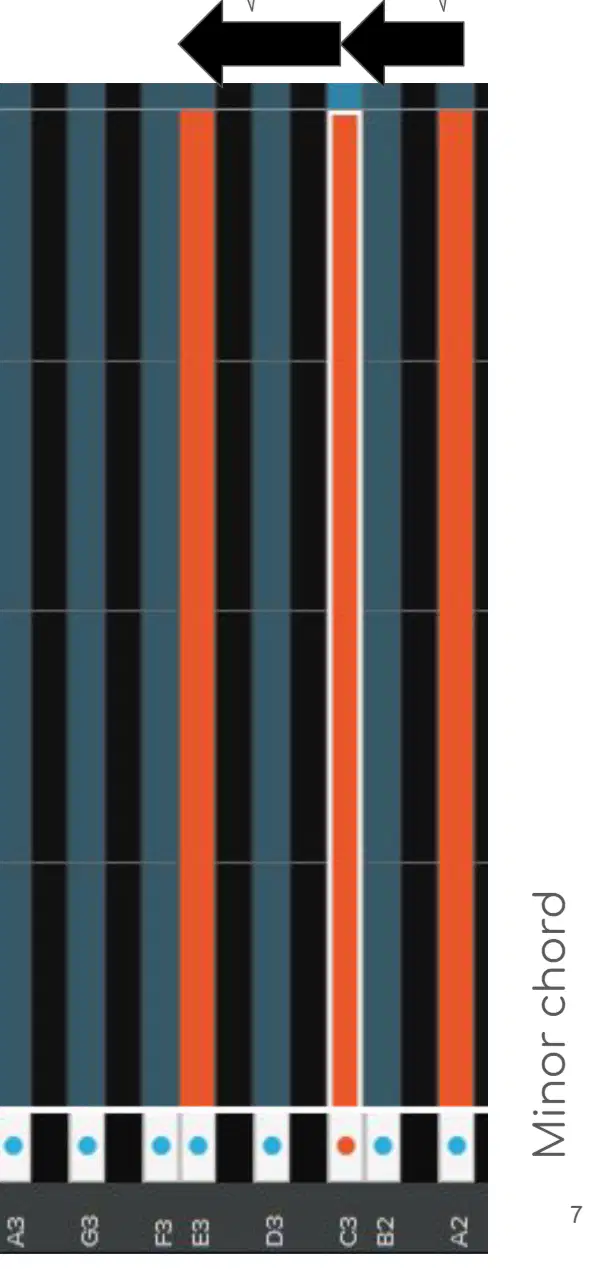
According to the diagram, what is the distance between the second and third notes in a minor chord?
Three notes
Four notes
Five notes
Two notes
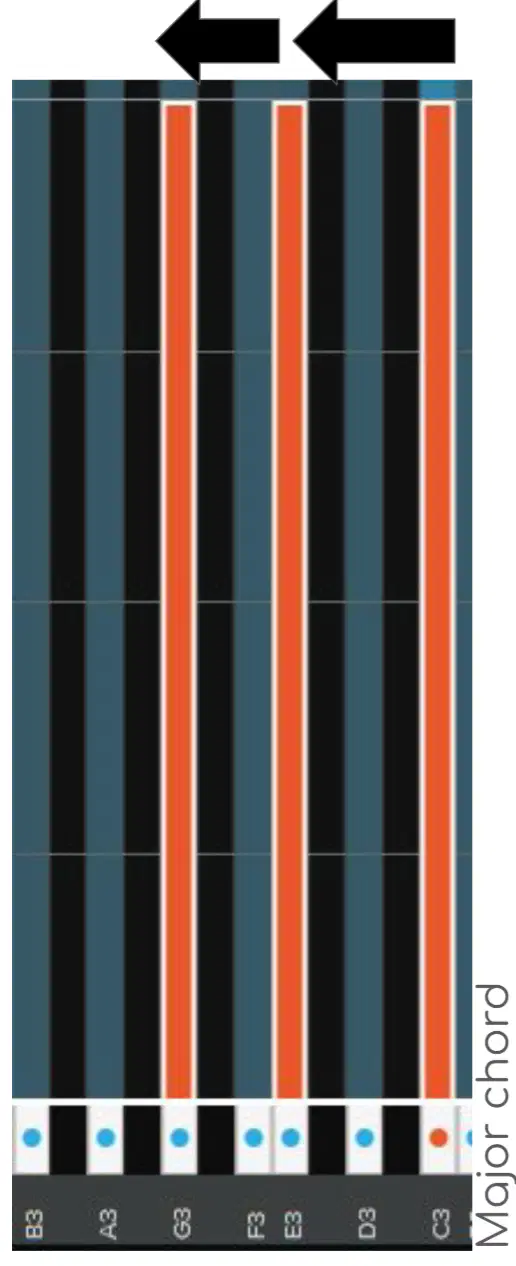
Fill in the blank: In a major chord, the distance between the first and second notes is three notes, and the distance between the second and third notes is ____ notes.
four
three
five
two
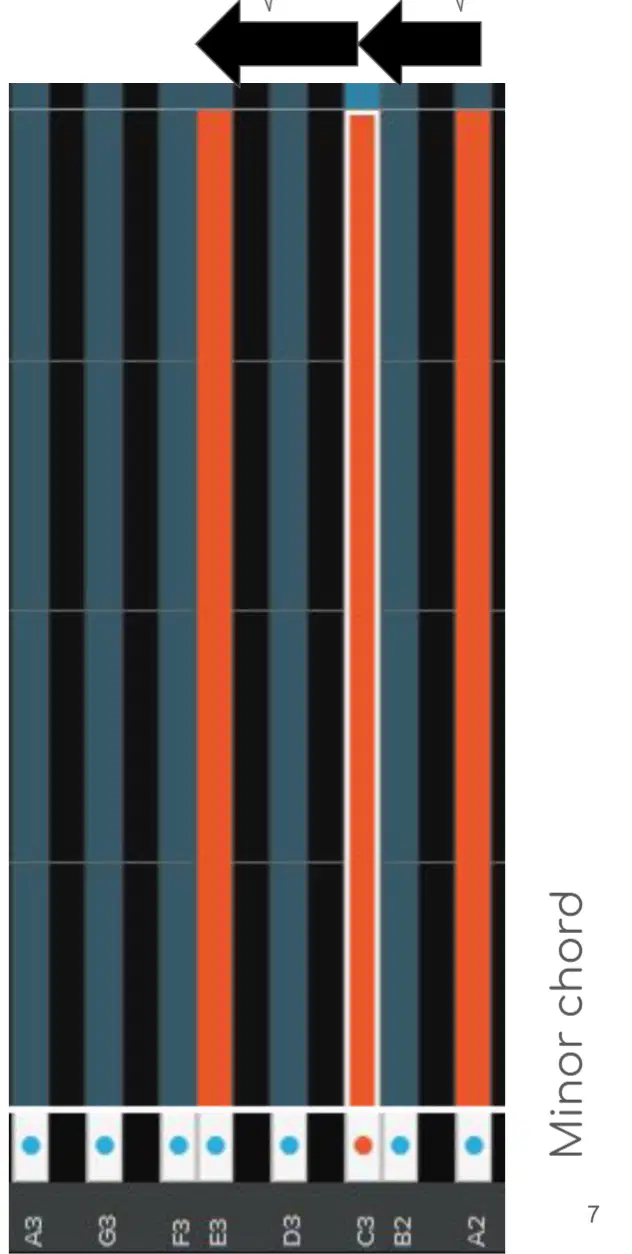
Fill in the blank: In a minor chord, the distance between the first and second notes is four notes, and the distance between the second and third notes is ____ notes.
three
two
four
five
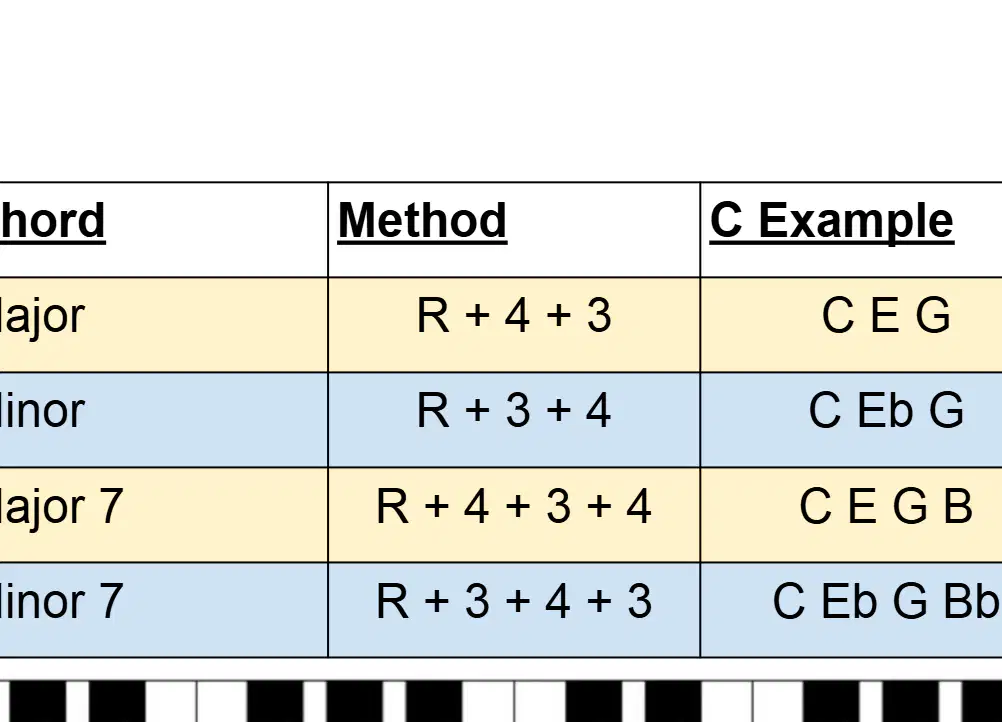
Use the method and keyboard diagram above to identify the notes which are in the chords below. E Minor 7 - ______ ______ ______ ______
E G B D
E G# B D
E A B D
E G B C
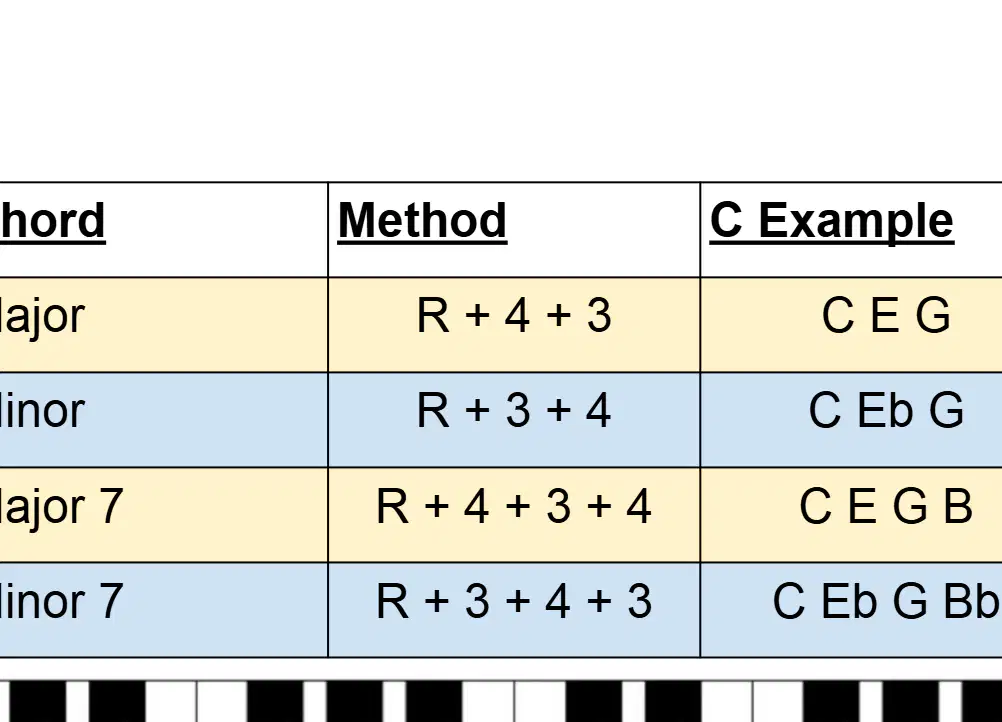
Use the method and keyboard diagram above to identify the notes which are in the chords below. A minor 7 - ______ ______ ______ ______
A C E G
A C F G
A D E G
B C E G
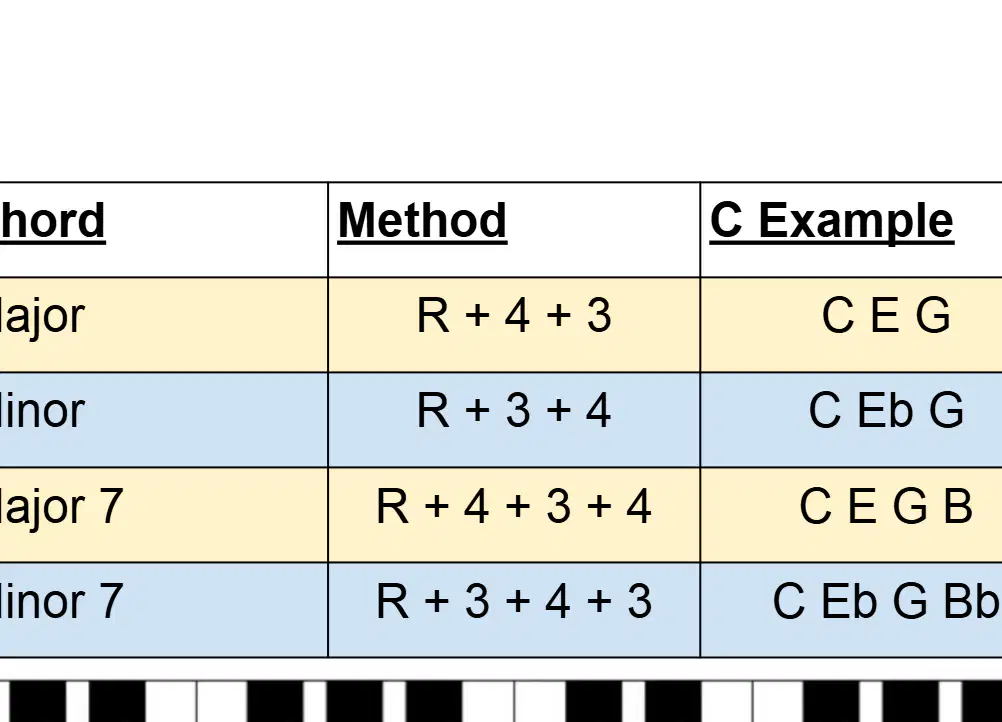
Use the method and keyboard diagram above to identify the notes which are in the chords below. G Major 7- ______ ______ ______ ______
G B D F#
G B D E
G C D F#
A B D F#
A diatonic melody in house music uses which of the following?
Only the notes from a single scale
Notes from multiple unrelated scales
Random notes with no scale
All black keys on a piano
A linear structure is different from a song with verses and choruses because:
A linear structure presents musical ideas in a straight, non-repeating sequence, while songs with verses and choruses repeat sections.
A linear structure repeats the chorus multiple times, while songs with verses and choruses do not repeat any section.
A linear structure is only used in classical music, while verses and choruses are used in pop music.
A linear structure always includes a bridge, while songs with verses and choruses do not.
A riff is:
a repeated sequence of notes or chords in music
a type of musical instrument
a style of dance
a famous music festival
Differentiate between the functions of reverb and delay in house music production.
Reverb creates a sense of space by simulating reflections, while delay repeats the sound at set intervals.
Reverb repeats the sound at set intervals, while delay creates a sense of space by simulating reflections.
Both reverb and delay only increase the volume of the track.
Reverb and delay are used only for tuning instruments.
Automation on a filter's cutoff frequency contributes to the build and drop sections of a track by:
Gradually increasing or decreasing energy to create tension and release.
Changing the tempo of the track dramatically.
Altering the pitch of the main melody.
Adding reverb to all instruments.

