
 Worksheets
Quiz on the Cardiovascular System
Total questions: 40
Worksheet time: 20mins
What is the primary function of the heart in the cardiovascular system?
To produce hormones
To pump blood through the body
To digest food
To filter waste
How much blood does a healthy adult heart pump at rest per minute?
3 liters
5 liters
7 liters
10 liters
What is the role of the right side of the heart?
Pumps blood to the brain
Sends blood to the lungs and back via pulmonary circulation
Pumps blood to the digestive system
Sends blood to the kidneys
What is the function of the pericardium?
To digest nutrients
To anchor and protect the heart
To produce red blood cells
To regulate body temperature
Where is the heart located?
In the abdominal cavity
Between the lungs in the thoracic cavity
In the cranial cavity
In the pelvic cavity

What is the function of the coronary sulcus in the heart?
Separates the atria from the ventricles
Separates the right and left atria
Separates the right and left ventricles
Connects the atria to the ventricles
Which vessels carry blood from the body to the right atrium?
Superior vena cava and inferior vena cava
Pulmonary veins
Aorta
Pulmonary trunk
What is the role of the pulmonary trunk in the circulatory system?
Carries blood from the right ventricle to the lungs
Carries blood from the left ventricle to the body
Carries blood from the lungs to the left atrium
Carries blood from the body to the right atrium
Which heart chamber receives blood from the veins?
Left atrium
Right ventricle
Left ventricle
Right atrium
What is the function of the interventricular septum?
Separates the right and left ventricles
Separates the atria from the ventricles
Connects the atria to the ventricles
Separates the right and left atria
What is the function of the papillary muscles in the heart?
They open the atrioventricular valves.
They close the semilunar valves.
They prevent the atrioventricular valves from opening into the atria.
They pump blood into the ventricles.
Where is the bicuspid (mitral) valve located?
Between the right atrium and right ventricle
Between the left atrium and left ventricle
Between the right ventricle and pulmonary trunk
Between the left ventricle and aorta
What is the role of the cardiac skeleton?
It pumps blood through the heart.
It supports the heart valves and insulates electrical signals.
It stores oxygen for the heart muscle.
It regulates the heart rate.
Which valve is located between the right ventricle and the pulmonary trunk?
Bicuspid valve
Tricuspid valve
Pulmonary valve
Aortic valve
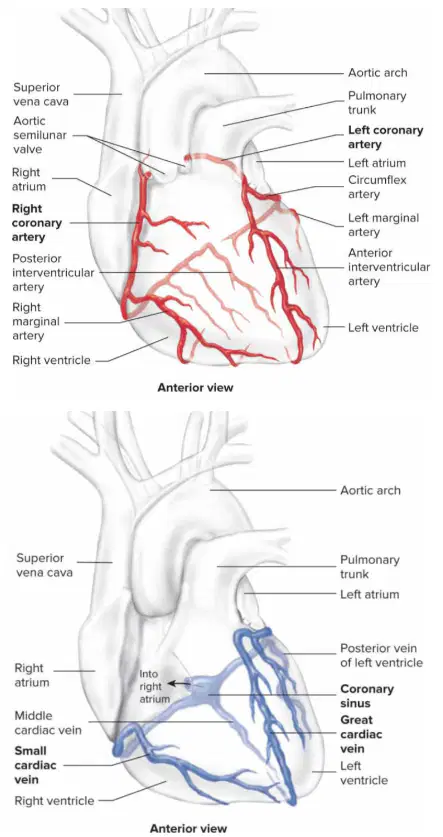
What is the primary function of coronary arteries?
Supply blood to the heart wall
Drain blood from the cardiac muscle
Supply blood to the lungs
Drain blood into the coronary sinus
Where do the coronary arteries originate?
Base of the aorta
Right atrium
Left ventricle
Pulmonary trunk
How many branches does the left coronary artery have?
2
3
4
5
What is the function of cardiac veins?
Supply blood to the heart wall
Drain blood from the cardiac muscle
Supply blood to the lungs
Drain blood into the left atrium
What is the outer surface of the heart called?
Myocardium
Endocardium
Epicardium
Pericardium
Which of the following is a characteristic of cardiac muscle?
Multinucleated cells
Lack of mitochondria
Striated with actin and myosin
No intercalated disks
What is the function of the sinoatrial node (SA node) in the heart?
It contracts the ventricles
It acts as the heart's pacemaker
It prevents backflow of blood
It increases blood pressure
During which phase of cardiac muscle action potential do Na+ channels close and some K+ channels open?
Depolarization phase
Plateau phase
Repolarization phase
Resting phase
Where is the atrioventricular node (AV node) located?
In the left atrium
In the right ventricle
In the lower portion of the right atrium
In the left ventricle
What is the role of the conduction system of the heart?
To produce hormones
To coordinate contraction of the atria and ventricles
To store calcium ions
To filter blood
What is the function of the atrioventricular bundle in the heart?
It repolarizes the ventricles.
It delivers action potentials to the atria.
It divides into left and right bundle branches to the ventricles.
It contracts the atria.
Which component of the ECG represents the depolarization of the atria?
T wave
QRS complex
P wave
S wave
What is the primary role of Purkinje fibers in the heart?
They initiate the heartbeat.
They deliver action potentials to the cardiac muscle of the ventricles.
They repolarize the atria.
They contract the ventricles.
What does the T wave in an ECG represent?
Depolarization of the atria
Repolarization of the ventricles
Contraction of the atria
Depolarization of the ventricles
What is the cardiac cycle?
A record of electrical events in the heart
A summative description of all events during one heartbeat
The contraction of the ventricles
The relaxation of the atria
What is the sound produced by the closure of the atrioventricular valves?
Lubb
Dupp
Thump
Click
What is the volume of blood pumped per ventricle per contraction?
50 milliliters/beat
70 milliliters/beat
90 milliliters/beat
100 milliliters/beat
Which law describes the relationship between preload and stroke volume?
Boyle's Law
Starling's Law
Newton's Law
Ohm's Law
What is the heart rate in beats per minute as mentioned in the document?
60 beats/min
72 beats/min
80 beats/min
90 beats/min
What is the formula for cardiac output?
CO = HR × SV
CO = SV + HR
CO = HR - SV
CO = SV ÷ HR
What does the baroreceptor reflex monitor?
Blood sugar levels
Blood pressure in the aorta and carotid arteries
Oxygen levels in the blood
Heart rate
Which chemicals from the adrenal medulla can increase heart rate and stroke volume?
Dopamine and serotonin
Epinephrine and norepinephrine
Insulin and glucagon
Oxytocin and vasopressin
What is the primary effect of coronary artery disease on the heart?
Increases blood supply to the heart
Decreases blood supply to the heart
Increases heart muscle mass
Decreases heart rate
What is the purpose of a stent in heart procedures?
To remove plaque from arteries
To keep blood vessels open
To reroute blood flow
To measure blood pressure
What happens during a myocardial infarction?
Blood flow is increased to the heart
Coronary arteries expand
Areas of cardiac muscle die due to lack of blood supply
Heart rate decreases significantly
What is the function of a bypass procedure?
Opens blocked blood vessels
Reroutes blood away from blocked arteries
Measures heart rate
Increases stroke volume

