
 Worksheets
Mixtures and Solutions Task Cards
Total questions: 20
Worksheet time: 10mins
Name
Class
Date
1.
1. Which tool or technique would best separate a mixture of gravel and sand?
a)
A. Sieve
b)
B. Paper filter
c)
C. Magnet
d)
D. Evaporation
2.
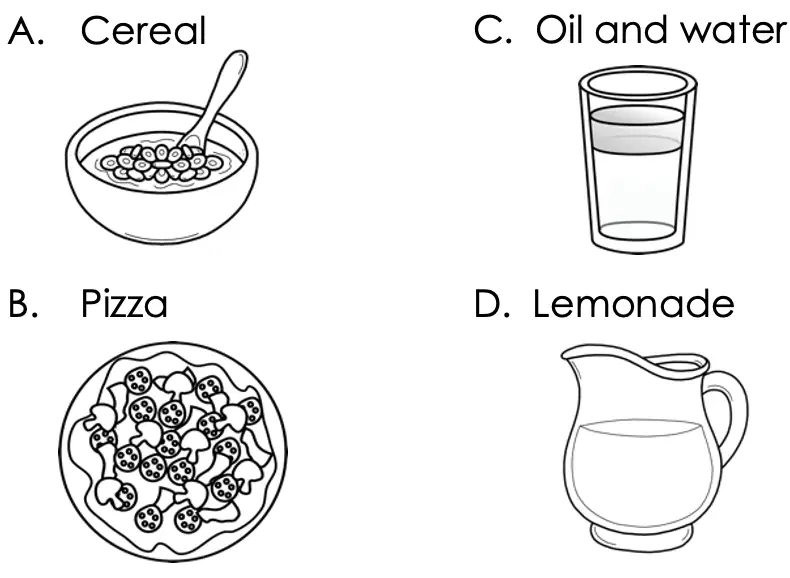
2. Which of the images shows a solution?
a)
A. Cereal
b)
B. Pizza
c)
C. Oil and water
d)
D. Lemonade
3.
3. A mixture of pencils and pens can be separated easily because both pencils and pens—
a)
A. are magnetic.
b)
B. cannot pass through a sieve.
c)
C. are solid.
d)
D. can be evaporated.
4.
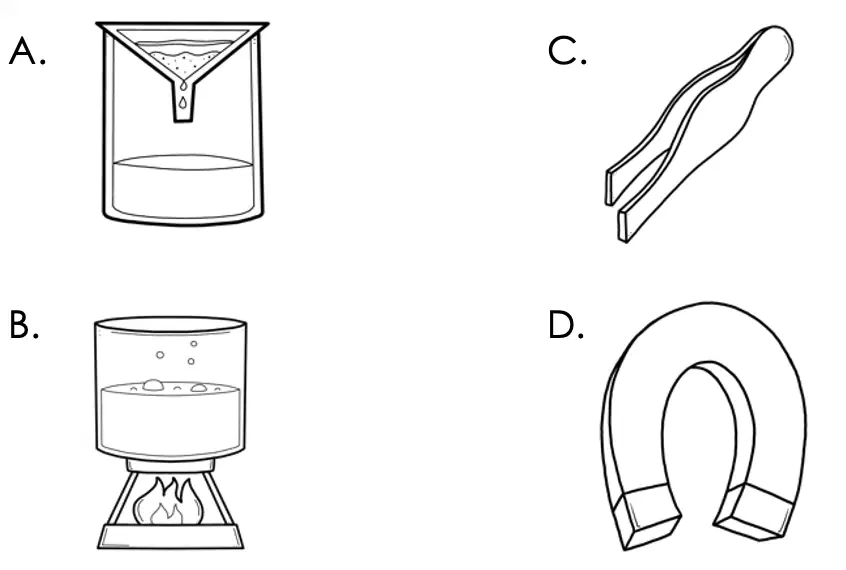
4. Which tool would best separate a mixture of iron filings and salt?
a)
A
b)
B
c)
C
d)
D
5.
5. A student dissolved powdered drink mix in cold water to form a sweet, purple, grape-flavored solution. To make the solution’s taste less strong, the student added more water to the solution.
How did the physical properties of the solution change when more water was added?
a)
A. The purple color of the solution was lighter.
b)
B. The taste of the solution was sweeter.
c)
C, The solution melted.
d)
D. The solution’s volume decreased.
6.

6. Four mixtures are listed below.
Which of the mixtures can be separated using a kitchen strainer?
a)
A. Mixture 3 only
b)
B. Mixture 2 only
c)
C. Mixtures 1 and 4 only
d)
D. Mixtures 1, 2, and 4 only
7.
7. A saltwater solution can be separated easily because—
a)
A. salt evaporates when boiled, leaving behind water.
b)
B. salt can be removed from the solution using tweezers.
c)
C. water evaporates when boiled, leaving behind salt.
d)
D. water passes through a sieve, leaving behind the salt.
8.

8. The table lists the ingredients of four mixtures.
Which mixture cannot be separated by pouring the mixture through a paper filter?
a)
A. Mixture 1
b)
B. Mixture 2
c)
C. Mixture 3
d)
D. Mixture 4
9.
9. A student mixed together 10 grams of salt, 10 grams of sand, and 100 milliliters of water in a beaker. After stirring, the student allowed the mixture to sit for two weeks by a sunny window.
What did the student most likely observe after 2 weeks?
a)
A. The beaker was empty.
b)
B. Only 10 grams of salt remain in the beaker.
c)
C. Only 10 grams of sand remain in the beaker.
d)
D. Only 20 grams of mixed sand and salt remain in the beaker.
10.

10. A student mixes 20 mL of lemon juice and 30 mL of honey into 300 mL of warm water to make a soothing hot drink for her sore throat.
What is the volume of the solution she created?
a)
A. 260 mL
b)
B. 300 mL
c)
C. 320 mL
d)
D. 350 mL
11.

11. Which of the methods would allow you to quickly separate a mixture of steel paper clips and plastic paper clips?
a)
A. Methods 1 and 4 only
b)
B. Method 4 only
c)
C. Methods 1, 3, and 4 only
d)
D. Method 2 only
12.

12. The table lists the ingredients of four mixtures.
In which mixture do the ingredients not change color?
a)
A
b)
B
c)
C
d)
D
13.
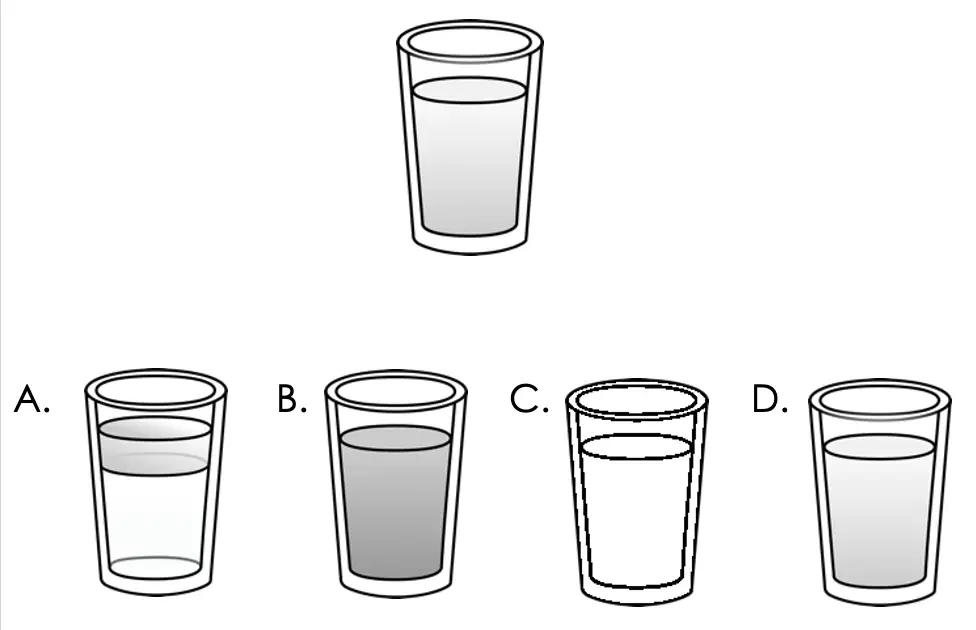
13. A student mixed together an orange solution containing water, orange powdered drink mix, and sugar, as shown in the top image. Then the student dissolved more orange powdered drink mix into the solution.
How did the solution most likely appear after more powdered drink mix was added?
a)
A
b)
B
c)
C
d)
D
14.
14. A student dissolved powdered drink mix in water. The taste wasn’t strong or sweet enough, so the student added more powdered drink mix to the solution.
Which of the following most likely occurred when more powdered drink mix was added?
a)
A. The solution became a solid.
b)
B. The solution was colder.
c)
C. The solution had a smaller volume.
d)
D. The solution had a sweeter taste.
15.
15. A student mixed 5 grams of salt in a beaker containing 100 milliliters of water. The student also mixed 5 grams of sand in a different beaker containing 100 milliliters of water. After stirring, the student allowed the mixtures to sit for half an hour.
What question is the student most likely trying to answer with this investigation?
a)
A. At what temperature do substances dissolve?
b)
B. Are salt and sand soluble in water?
c)
C. How does the amount of water affect dissolving time?
d)
D. How long does it take sand to dissolve?
16.
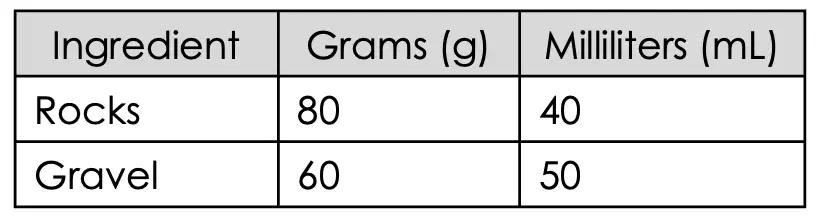
16. A student mixed rocks and gravel. The table shows the mass and volume of each ingredient before they mixed the sample.
Which statement is true about the mixture?
a)
A. The mass of the mixture is 110 grams.
b)
B. The mass of the mixture is 90 milliliters.
c)
C. The volume of the mixture is 140 grams.
d)
D. The volume of the mixture is 90 milliliters.
17.

17. Three mixtures are listed.
Which of the mixtures can be separated by placing the mixture in a beaker of water?
a)
A. Mixture 1 because corks float in water and ping pong balls sink
b)
B. Mixture 2 because plastic beads float and glass beads sink
c)
C. Mixture 3 because iron nails and gravel both sink in water
d)
D.Mixture 1 because corks and ping pong balls both float in water
18.
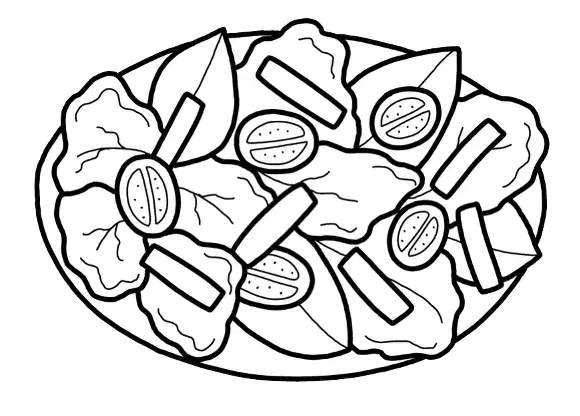
18. A chef mixes 200 grams of lettuce, 100 grams of tomatoes, and 75 grams of carrots.
What is the mass of the entire salad?
a)
A. 175 grams
b)
B. 200 grams
c)
C. 300 grams
d)
D. 375 grams
19.
19. A student dissolved 10 g of powdered drink mix in 500 mL of water to form a sweet, green, lime-flavored solution. Then, the student added 4 ice cubes to the solution and stirred to melt the ice.
Which properties of the solution changed as the ice melted?
a)
A. The physical state of the solution
b)
B. The mass of the powdered drink mix
c)
C. The temperature of the solution
d)
D. The volume of the powdered drink mix
20.
20. A student mixed 5 grams of sugar in a beaker containing 100 milliliters of cold water. The student also mixed 5 grams of sugar in a beaker containing 100 milliliters of hot water. The student stirred the mixtures and recorded the amount of time it took for each to dissolve.
What question is the student most likely trying to answer with this investigation?
a)
A. At what temperature does sugar dissolve?
b)
B. How does the temperature affect the amount of time it takes for the solute to dissolve?
c)
C. How does the mass of a solute affect the amount of time it takes to dissolve?
d)
D. What kinds of substances are soluble in water?
100 %

