Wayground logo

Free Printable Worksheets

Font size

S
M
L
XL
Worksheets

Skeletal System

Total questions: 104

Worksheet time: 52mins

Name
Class
Date
1.

hypocalcemia causes what to release?

a)
Calcitonin
b)

PTH

c)
Thyroid stimulating hormone
d)
Insulin
2.

hypercalcemia causes what to release?

a)
Calcitonin
b)

PTH

c)
Thyroid stimulating hormone
d)
Insulin
3.

Official name for blood cell production?

a)
Homeostasis
b)
Hemolysis
c)
Hematopoiesis
d)
Hemoglobin
4.

muscle to bone?

a)
Marrow
b)
Tendons
c)
Ligaments
d)
Cartilage
5.

not produced naturally occuring in the body

a)
Yellow marrow
b)
Red marrow
c)
Vitamin D
d)
Calcium
6.

body system that directs calcium homeostasis?

a)
Respiratory
b)
Endocrine
c)
Cardiovascular
d)
Integumentary
7.

majority of bones that are in the appendicular skeleton

a)
Irregular
b)
Flat
c)
Long
d)
Sesamoid
8.

the living or organic portion of bone (1/3)
a)
Collagen
b)
Phosphate
c)
Iron
d)
Calcium
9.
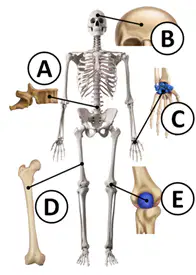
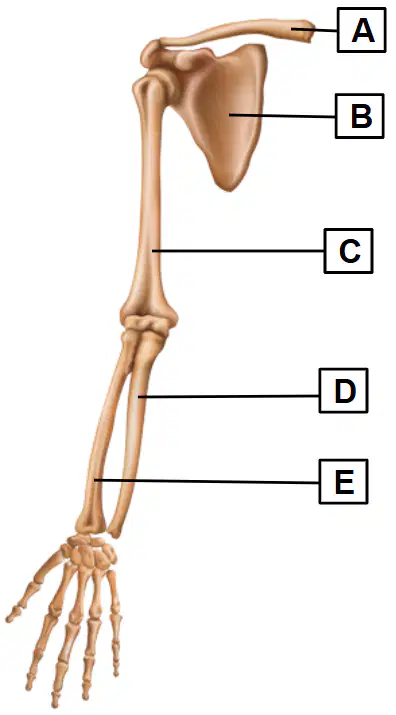
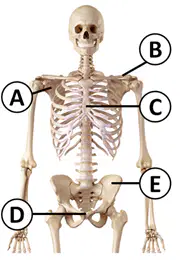
Based on the picture, identify which letter represents the scapula:
a)
A
b)
B
c)
C
d)
D
e)
E
10.

Based on the picture, identify which letter represents the sternum:

a)
A
b)
B
c)
C
d)
D
e)
E
11.

Based on the picture, identify which letter represents the clavicle:

a)
A
b)
B
c)
C
d)
D
e)
E
12.

girdles are apart of?

a)
Spinal column
b)
Axial
c)
Appendicular
d)
Skull
13.

short bone?

a)
A
b)
B
c)
C
d)
D
e)
E
14.

flat bone?

a)
A
b)
B
c)
C
d)
D
e)
E
15.

irregular bone?

a)
A
b)
B
c)
C
d)
D
e)
E
16.

inorganic (2/3) portion of bone tissue?

a)
Magneisum
b)
Collagen
c)
Iron
d)
Calcium phosphate
17.

osteoblast gets trapped in bone matrix and turns into?
a)
Osteogenic cells
b)
Osteoclasts
c)
Osteoblasts
d)
Osteocytes
18.
Which bone type has an irregular organization of collagen fibers and initially / quickly responds to bone injury?
a)
Woven
b)
Lamellar
c)
Compact
d)
Spongy
19.

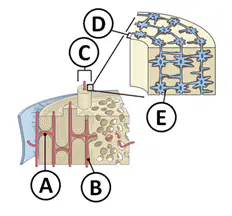
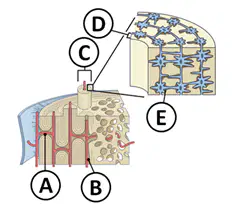
Haversian canal?

a)
A
b)
B
c)
C
d)
D
e)
E
20.

Volkman canal?

a)
A
b)
B
c)
C
d)
D
e)
E
21.
Based on the picture, which letter best represents the Haversian canal?
a)
A
b)
B
c)
C
d)
D
e)
E
22.

osteon?

a)
A
b)
B
c)
C
d)
D
e)
E
23.

bone resorption?

a)
Osteoblasts
b)
Osteoclasts
c)
Osteocytes
d)
Osteogenic cells
24.

yellow marrow found here?

a)
Medullary cavity
b)
Metaphysis
c)
Epiphysis
d)
Spongy bone
25.

red marrow found here

a)
Compact bone
b)
Medullary cavity
c)
Articular cartilage
d)
Spongy bone
26.

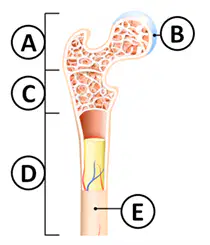
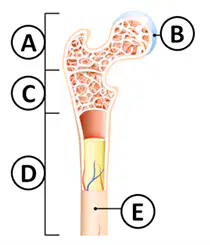
epiphysis?

a)
A
b)
B
c)
C
d)
D
e)
E
27.

metaphysis?

a)
A
b)
B
c)
C
d)
D
e)
E
28.

periosteum?

a)
A
b)
B
c)
C
d)
D
e)
E
29.

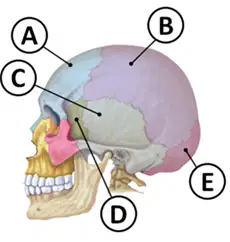
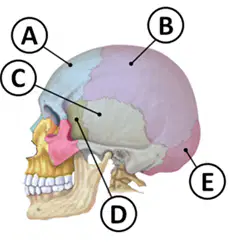
frontal bone?

a)
A
b)
B
c)
C
d)
D
e)
E
30.

occipital bone?

a)
A
b)
B
c)
C
d)
D
e)
E
31.

temporal bone?

a)
A
b)
B
c)
C
d)
D
e)
E
32.

parietal bone?

a)
A
b)
B
c)
C
d)
D
e)
E
33.

provides attachment points for the ribs?

a)
Lumbar spine
b)
Sacral spine
c)
Thoracic spine
d)
Cervical spine
34.

neck mobility, turning head

a)
Lumbar spine
b)
Sacral spine
c)
Thoracic spine
d)
Cervical spine
35.

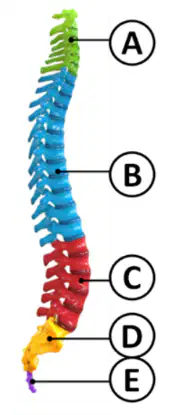
cervical spine?

a)
A
b)
B
c)
C
d)
D
e)
E
36.

thoracic spine?

a)
A
b)
B
c)
C
d)
D
e)
E
37.

lumbar spine?

a)
A
b)
B
c)
C
d)
D
e)
E
38.

sacrum?

a)
A
b)
B
c)
C
d)
D
e)
E
39.

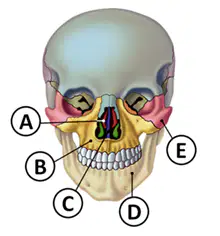
mandible?

a)
A
b)
B
c)
C
d)
D
e)
E
40.

girdles function as?

a)

head rotation

b)

protection

c)

connection of the extremities

d)

stability of entire body

41.

Structurally strongest?

a)
Fibrous
b)
Cartilaginous
c)
Synovial
d)
Amphiarthrosis
42.

Structurally weakest?

a)
Fibrous
b)
Cartilaginous
c)
Synovial
d)
Amphiarthrosis
43.

Functionally, most movement?

a)
Synarthrosis
b)
Amphiarthrosis
c)
Diathrosis
d)
Cartilaginous
44.

Functionally, least movement?

a)
Synarthrosis
b)
Amphiarthrosis
c)
Diathrosis
d)
Cartilaginous
45.

most mobile and weakest synovial joint?

a)
Pivot
b)
Plane
c)
Ball and Socket
d)
Hinge
46.

least mobile and strongest synovial joint?

a)
Pivot
b)
Plane
c)
Ball and Socket
d)
Hinge
47.

decreasing an angle?

a)
Extension
b)
Flexion
c)
Abduction
d)
Adduction
48.

increasing an angle?

a)
Extension
b)
Flexion
c)
Abduction
d)
Adduction
49.

moving away from the midline?

a)
Extension
b)
Flexion
c)
Abduction
d)
Adduction
50.

moving towards the midline?

a)
Extension
b)
Flexion
c)
Abduction
d)
Adduction
51.

projections?

a)
Attachment points for tendons and ligaments, extend above the surface
b)
Allows nerves and blood vessels to pass through
c)
Holds nerves, vessels, tendons, and muscle
d)
A dip or a trench
52.

articulations?

a)
Hole in the bone
b)
A bone that conforms to another bone allowing movement
c)
A dip or a trench
d)
A bone that extends above the surface
53.

openings?

a)
Holes in the bone that allow nerves and blood vessels to pass through
b)
A bone that conforms to another bone allowing movement
c)
A dip or a trench
d)
A bone that extends above the surface for tendons and ligaments
54.

depressions?

a)
Holes in the bone that allow nerves and blood vessels to pass through
b)
A bone that conforms to another bone allowing movement
c)
A dip or a trench
d)
A bone that extends above the surface for tendons and ligaments
55.

bone ossification?

a)
The build-up of soft bone matrix
b)
The development of embryonic skeleton
c)
The process of bone formation
d)
The creation of osteoclasts
56.
Where does a long bone grow in length?
a)
The medullary cavity
b)
The articular cartilage
c)
The epiphyseal plate
d)
The periosteum
57.

results from injury

a)
Rickets
b)
Dislocation
c)
Arthritis
d)
Osteoporosis
58.

injury to ligaments?

a)
Strain
b)
Dislocation
c)
Sprain
d)
Fracture
59.

injury to muscle?

a)
Strain
b)
Dislocation
c)
Sprain
d)
Fracture
60.

joints become inflamed

a)
Arthritis
b)
Rickets
c)
Osteoporosis
d)
Fracture
61.

bones lose mass and become porous

a)
Arthritis
b)
Rickets
c)
Osteoporosis
d)
Fracture
62.

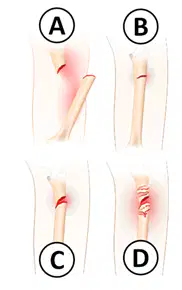
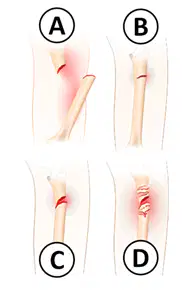
simple fracture?

a)
A
b)
B
c)
C
d)
D
63.

comminuted fracture?

a)
A
b)
B
c)
C
d)
D
64.

compound fracture?

a)
A
b)
B
c)
C
d)
D
65.

greenstick fracture?

a)
A
b)
B
c)
C
d)
D
66.

microscopic anatomy of spongy bone?

a)
Osteons
b)
Havarsain canals
c)
Trabeculae
d)
Volkman canals
67.

microscopic anatomy of compact bone?

a)
Osteons
b)
Havarsain canals
c)
Trabeculae
d)
Volkman canals
68.

An osteocyte is a _______

a)

A bone forming Cell

b)

A bone breaking down cell

c)
muscle cell
d)

Mature bone cell

69.

Name the bone that is labeled with the letter T ​ ​ ​ .​ (a)  

Choose from the below words
metatarsals
phalanges
pelvis
femur
patella
tibia
tibia
tarsals
70.

Name the bone that is labeled with the letter O ​ ​ ​ (a)   .

Choose from the below words
femur
tarsals
patella
fibula
tibia
metatarsals
phalanges
pelvis
71.

Name the bone that is labeled with the letter E.​ (a)  

Choose from the below words
sternum
ulna
radius
carpals
metacarpals
phalanges
ribs
spine
humerus
72.

Name the bone that is labeled with the letter L ​ (a)   .

Choose from the below words
phalanges
carpals
spine
sturnum
ribs
humerus
ulna
radius
metacarpals
73.

Name the bone that is labeled with the letter I. (a)  

Choose from the below words
radius
carpals
metacarpals
phalanges
spine
sturnum
ribs
humerus
ulna
74.

Name the bone that is labeled with the letter K ​ (a)   .

Choose from the below words
metacarpals
carpals
spine
sturnum
ribs
humerus
ulna
radius
phalanges
75.

Name the bone that is labeled with the letter R ​ ​ ​ .​ (a)  

Choose from the below words
fibula
tarsals
metatarsals
phalanges
pelvis
femur
patella
tibia
76.

Name the bone that is labeled with the letter G.​ (a)  

Choose from the below words
humerus
ulna
radius
carpals
metacarpals
phalanges
spine
sturnum
ribs
77.

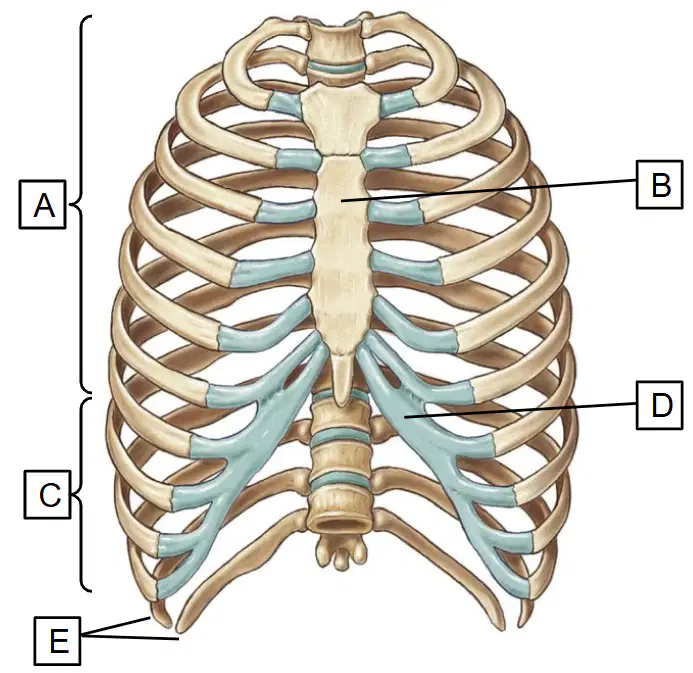
Which letter corresponds to the floating ribs?

a)

A

b)

B

c)

C

d)

D

e)

E

78.

Which letter corresponds to the true ribs?

a)

A

b)

B

c)

C

d)

D

e)

E

79.

Which letter corresponds to the false ribs?

a)

A

b)

B

c)

C

d)

D

e)

E

80.

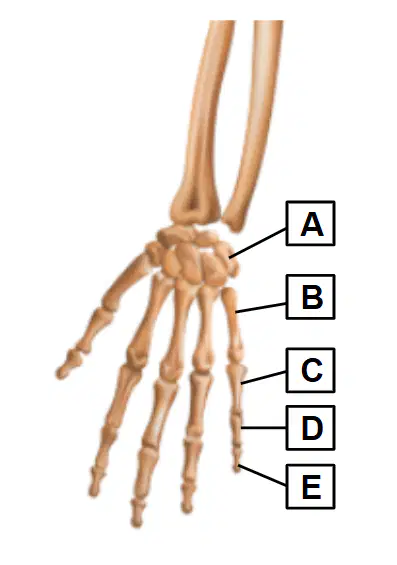
Which letter corresponds to the ulna?

a)

A

b)

B

c)

C

d)

D

e)

E

81.

Which letter corresponds to the clavicle?

a)

A

b)

B

c)

C

d)

D

e)

E

82.

Which letter corresponds to the radius?

a)

A

b)

B

c)

C

d)

D

e)

E

83.

Which letter corresponds to the scapula?

a)

A

b)

B

c)

C

d)

D

e)

E

84.

Which letter corresponds to the carpal?

a)

A

b)

B

c)

C

d)

D

e)

E

85.

Which of the following is an example of a freely moving joint (diarthrosis)?

a)

hip

b)

cranial sutures

c)

costal cartilage

d)

intervertebral discs

86.

Which of the following is an example of a partially moving joint (amphiarthrosis)?

a)

hip

b)

cranial sutures

c)

costal cartilage

d)

carpals

87.
The site of bone growth on a long bone is called
a)
Epiphyseal plate
b)
diaphysis
c)
periosteum
d)
meduary cavity
88.
a)
Zygomatic
b)
Temporal
c)
Parietal
d)
Occipital 
89.
a)

Zygomatic

b)

Frontal

c)

Parietal

d)

Temporal

90.

What are the two skeletal categories?

a)

vertebral and axial

b)

vertebral and pelvic

c)

appendicular and axial

d)

appendicular and vertebral

91.

The ends of the long bone are called

a)

hyaline cartilage

b)

periosteum

c)

epiphysis

d)

diaphysis

92.

The shaft of the long bone are called

a)

hyaline cartilage

b)

periosteum

c)

epiphysis

d)

diaphysis

93.

Bone cells that add or build new bone tissue are called

a)

osteocytes

b)

osteoblast

c)

periosteum

d)

osteoclasts

94.

Bone cells that remove old bone tissue and break it down are called...

a)

osteocytes

b)

osteoblast

c)

periosteum

d)

osteoclasts

95.

What gives bone its strength and resilience?

a)

osteocytes

b)

collagen

c)

elastin

d)

hyaline cartilage

96.

Which of these is true about the homeostasis of bone tissue?

a)

osteoblasts resorb bone matrix, osteoclasts replace it

b)

similar processes of resorption and deposition

c)

osteoclasts resorb bone matrix and and osteoblasts replace it

d)

related process of resorption and deposition

97.

How many cervical vertebrae are there

a)

1

b)

5

c)

7

d)

12

98.

How many thoracic vertebrae are there

a)

1

b)

5

c)

7

d)

12

99.

How many pairs of ribs are true ribs?

a)

1

b)

2

c)

5

d)

7

100.

Shoulder girdles, pelvic girdles and arms and legs make up which skeletal category?

a)

vertebral

b)

axial

c)

pelvic

d)

appendicular

101.
Which type of joint allows free movement in all directions?
a)
ball and socket
b)
hinge
c)
pivot
d)
gliding
102.

Which type of joint allow bones to move a short distance over each other?

a)

ball and socket

b)

hinge

c)

pivot

d)

gliding

103.

This type of fracture is complete and fragments the bone

a)

greenstick

b)

fissured

c)

comminuted

d)

transverse

104.

This type of joint movement is moving a part away from the midline

a)

abduction

b)

adduction

c)

dorsifelxion

d)

extension