
 Worksheets
Science 2.2 Q2
Total questions: 20
Worksheet time: 10mins
Which of the following is a part of a typical cell that can be observed under a microscope?
Cell membrane
Heart
Bone
Muscle fiber
What is the main difference between a unicellular and a multicellular organism?
Unicellular organisms have one cell, while multicellular organisms have many cells.
Unicellular organisms are always plants, while multicellular organisms are always animals.
Unicellular organisms do not need food, while multicellular organisms do.
Unicellular organisms can only live in water, while multicellular organisms live on land.
It is important to use proper techniques when observing cells under a microscope because:
To get clear and accurate observations of cell parts
To make the microscope look clean
To avoid using too much electricity
To make the cell parts bigger than they really are
Why was Robert Hooke’s discovery important for the development of cell theory?
It was the first recorded observation of cells, laying the foundation for future studies.
He proved that all animals are made of cells.
He discovered that cells come from non-living matter.
He invented the microscope.
According to the Cell Theory, what are the smallest units of life?
Organs
Tissues
Cells
Molecules
How do new cells arise according to the Cell Theory?
They form from non-living materials.
They come from pre-existing cells through cell division.
They are created by chemical reactions.
They appear spontaneously.
Which of the following statements is part of the Cell Theory?
All living things are made up of atoms.
All living things are made up of cells.
All living things are made up of tissues.
All living things are made up of organs.
Why is it important to use proper techniques when observing cells with a microscope?
To make the cells look bigger
To accurately identify the parts of a cell such as the cell membrane, nucleus, and mitochondria
To change the color of the cells
To make the microscope work faster
A scientist is using a microscope to study plant cells in a laboratory. Which cell parts might she be identifying?
Bones and muscles
Cell membrane, nucleus, cytoplasm, mitochondria, chloroplasts, and ribosomes
Blood vessels and nerves
Skin and hair
Which of the following statements is part of the Cell Theory?
All living things are made up of atoms.
All living things are made up of cells.
All living things are made up of tissues.
All living things are made up of organs.
According to the Cell Theory, what is the smallest unit of life?
Tissue
Organ
Cell
Molecule
What is the source of new cells according to the Cell Theory?
They form from non-living materials.
They come from pre-existing cells through cell division.
They appear spontaneously.
They are created by chemical reactions only.
Why is the statement "Cells are the smallest units of life" important in biology?
It explains why all living things are made of tissues.
It shows that cells can only be seen with a microscope.
It highlights that all life processes occur within cells.
It means that cells are the largest structures in living things.
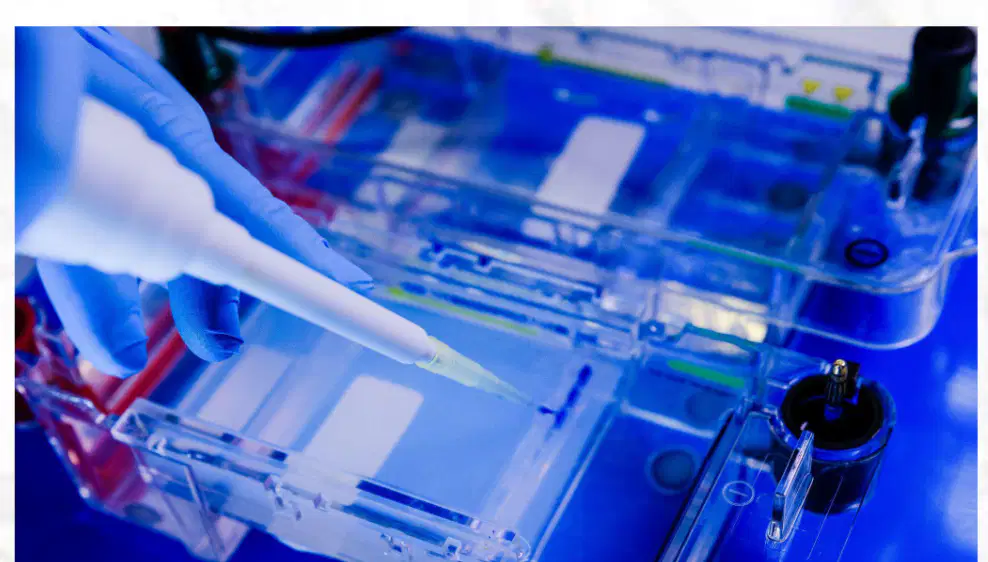
What scientific technique is being shown in the image?
Cell division
DNA fingerprinting
Photosynthesis
Protein synthesis
Which of the following statements is part of the Cell Theory?
All living things are made up of tissues.
All living things are made up of cells.
All living things are made up of organs.
All living things are made up of molecules.
A scientist is observing a sample under a microscope and sees structures like the nucleus and chloroplasts. Which skill is the scientist using?
Cooking
Drawing
Identifying cell parts
Singing
Which of the following is a characteristic of prokaryotic cells?
Has a nucleus
Contains membrane-bound organelles
No nucleus
Larger and more complex
Which structures are found in both prokaryotic and eukaryotic cells?
Mitochondria and chloroplasts
DNA, cytoplasm, cell membrane, ribosomes
Nucleus and membrane-bound organelles
Only ribosomes
What is the main function of the exterior group of cell structures?
Interact with the cell's external environment, protection, and movement
Manage cellular processes like energy production
Store genetic material
Synthesize proteins
A scientist is studying a cell structure that manages energy production and protein synthesis. Which group does this structure most likely belong to?
Exterior group
Interior group
Both groups
Neither group

