
 Worksheets
ToolingU - Essentials of Leadership 100
Total questions: 28
Worksheet time: 14mins
Which of the following best describes ethical leadership in an organization?
Making decisions that prioritize financial gain above all else
Consistently upholding principles of fairness, honesty, and integrity in every action
Overlooking the well-being and perspectives of employees in organizational choices
Directing efforts solely toward achieving immediate objectives without considering long-term impact
How can a leader facilitate change within a team or organization?
By discouraging innovation and maintaining existing routines to avoid disruption
By communicating a compelling vision and actively supporting the team through transitions
By disregarding employee input and making decisions without considering their perspectives
By implementing changes in secrecy, leaving the team uninformed and unprepared
How can a leader demonstrate consideration for their team members according to studies on effective leadership?
By actively listening, showing empathy, and making an effort to understand and support team members’ individual needs
By concentrating solely on achieving organizational objectives, regardless of team members’ personal circumstances
By assigning tasks to team members without engaging in meaningful communication or providing guidance
By remaining detached from team members’ challenges and refraining from offering assistance or involvement
What is an example of initiating structure as described in the context of leadership?
Establishing clear roles and responsibilities while setting measurable objectives for the team
Disregarding the perspectives and feedback of team members during decision-making
Permitting the team to operate independently without providing any framework or expectations
Prioritizing personal achievements and recognition over the collective progress of the group
Which of the following best describes the core capacity of leadership as mentioned in the material?
The capacity to inspire and mobilize others toward a collective vision, fostering collaboration and shared achievement
The capacity to operate autonomously, prioritizing individual contributions over group engagement
The capacity to delegate responsibility for outcomes, minimizing personal accountability within the team
The capacity to concentrate exclusively on assigned personal objectives, disregarding broader team goals
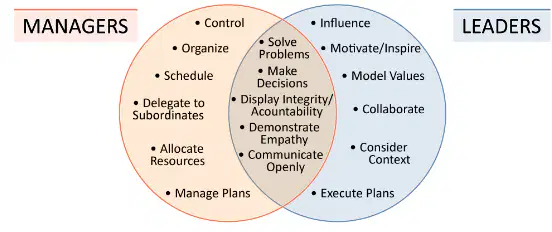
Based on the diagram, which of the following is a responsibility shared by both managers and leaders?
Directing and overseeing the completion of specific tasks
Encouraging others to adopt a particular vision or approach
Addressing challenges and finding effective solutions collaboratively
Organizing and assigning work schedules for team members
According to the material, what is a key aspect of effective leadership that contradicts the myth "Leadership is a solo activity"?
Leaders should rely solely on their own abilities and avoid seeking input from others.
Effective leadership involves fostering collaboration, encouraging teamwork, and leveraging the diverse strengths of those around you.
Leaders are most successful when they make decisions independently and refrain from involving others in the process.
Leadership is primarily about achieving personal goals without the support or contribution of a team.
What can individuals do to overcome the obstacles created by believing in leadership myths?
Embrace the idea that leadership is unattainable and avoid pursuing it altogether.
Challenge commonly held beliefs about leadership and actively seek opportunities to build leadership abilities.
Rely on others to step forward and take initiative, rather than attempting to lead themselves.
Concentrate solely on technical expertise, disregarding the importance of leadership development.

How can effective leaders help reduce employee concerns during times of organizational change?
By withholding information about changes, leaders can maintain control and avoid unnecessary questions from employees.
By fostering open communication and actively involving staff in decision-making, leaders can build trust and address concerns collaboratively.
By disregarding employee feedback and suggestions, leaders can focus solely on their own vision for change without distraction.
By implementing changes without providing clear explanations, leaders can expedite the process and minimize resistance from staff.

Why is it important for leaders to encourage employees to ask questions and provide feedback during periods of change?
It allows leaders to shift accountability away from themselves and onto others, reducing their own involvement in outcomes.
It creates an environment where employees can openly address uncertainties and voice concerns, fostering trust and clarity throughout the transition.
It introduces additional steps that may slow down the change process, making it more challenging for everyone to adapt quickly.
It results in employees feeling less connected and engaged with the change, decreasing their overall participation in the process.
A team member is described as having the ability to charm and influence others easily. Which term from the lesson best fits this description?
Possessing a magnetic charisma that draws people in
Applying logical reasoning to persuade others
Acting in the role of a customer within the team
Demonstrating a strong drive to achieve goals
When making a decision, a manager lists several logical reasons for choosing a particular course of action. Which term from the lesson does this describe?
Logical rationale for supporting a specific decision
Personal motivation driving the manager’s choice
Strong leadership influencing the final outcome
Valued customer shaping the manager’s perspective

A leader who pays special attention to the needs and problems of each individual person is demonstrating which key of transformational leadership?
Demonstrating Inspirational Motivation by energizing others with a compelling vision for the future.
Encouraging Intellectual Stimulation by challenging team members to think creatively and solve problems independently.
Exhibiting Idealized Influence by serving as a role model and earning respect through ethical actions.
Offering Individualized Consideration by recognizing and supporting each person's unique needs and aspirations.

If a leader provides meaning and context to the work of their subordinates, which transformational leadership key are they using?
They are fostering a shared vision and energizing others through Inspirational Motivation.
They are encouraging creative thinking and challenging assumptions through Intellectual Stimulation.
They are serving as a role model and building trust through Idealized Influence.
They are attending to individual needs and supporting personal growth through Individualized Consideration.

Which key of transformational leadership involves behaving in a way that others seek to emulate?
Demonstrating Inspirational Motivation by articulating a compelling vision that energizes and excites followers to pursue shared goals.
Encouraging Intellectual Stimulation by challenging assumptions and fostering creativity among team members to inspire innovative thinking.
Exhibiting Idealized Influence by consistently modeling ethical behavior and strong values that others aspire to replicate in their own actions.
Providing Individualized Consideration by offering personalized support and mentorship to help each follower reach their full potential.
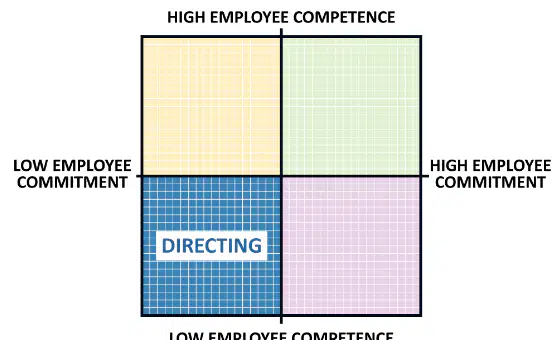
Based on the situational leadership model, what leadership style is most appropriate for employees with low competence and low commitment?
Delegating style, where leaders provide minimal guidance and allow employees to make most decisions independently.
Supporting style, which emphasizes encouragement and shared decision-making to boost employee morale and involvement.
Directing style, characterized by clear instructions and close supervision to guide employees who lack both skills and motivation.
Coaching style, involving a balance of directive behavior and supportive feedback to develop both competence and commitment.
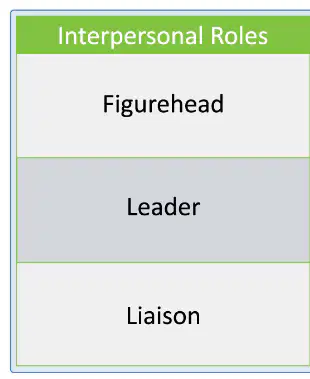
Which of the following best describes the role of a manager as a "Leader" according to the Managerial Roles Theory?
Managers serve as symbolic representatives and participate in ceremonial duties to embody the organization’s values.
Managers inspire, guide, and motivate team members to work collaboratively toward achieving organizational goals.
Managers systematically collect and analyze information from the environment to inform strategic decisions.
Managers act as spokespersons, conveying the organization’s perspectives and interests to external audiences.
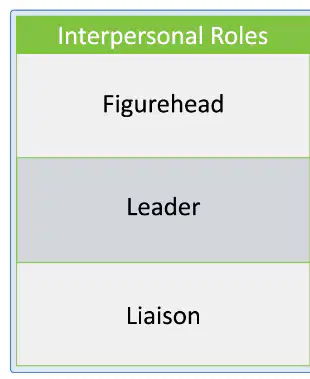
If a manager is responsible for establishing and maintaining relationships with external stakeholders, which interpersonal role are they performing?
Figurehead Role: Representing the organization at ceremonial and symbolic events both inside and outside the company.
Leader Role: Motivating and guiding employees to achieve organizational goals through effective team management.
Liaison Role: Building and nurturing networks of contacts outside the organization to facilitate information and resource exchange.
Spokesperson Role: Communicating key information about the organization to external audiences and stakeholders.
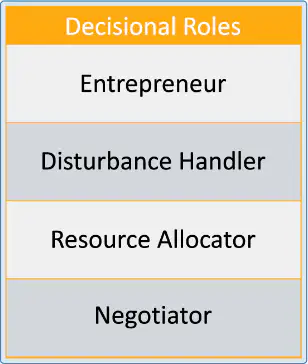
If a manager is working to resolve conflicts and maintain organizational stability during a crisis, which decisional role are they performing?
Acting as a Resource Allocator by distributing resources to address organizational needs during disruptions
Fulfilling the Disturbance Handler Role by addressing unexpected issues and restoring order in times of crisis
Taking on the Negotiator Role by engaging in discussions to reach agreements with internal or external parties
Demonstrating the Entrepreneur Role by initiating innovative changes to improve organizational processes
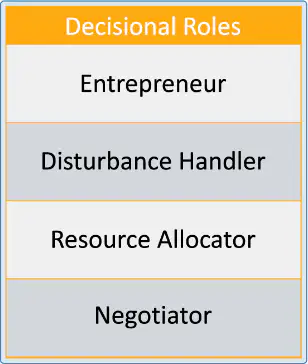
A manager who makes decisions about how to distribute time, money, and personnel for various projects is acting in which decisional role?
Role of Negotiator: Responsible for representing the organization in major agreements and bargaining situations.
Role of Disturbance Handler: Takes charge when unexpected problems or crises threaten the organization’s operations.
Role of Resource Allocator: Makes key choices about how organizational assets such as time, budget, and staff are distributed among competing projects.
Role of Entrepreneur: Initiates and oversees new ideas and innovation to improve organizational effectiveness.
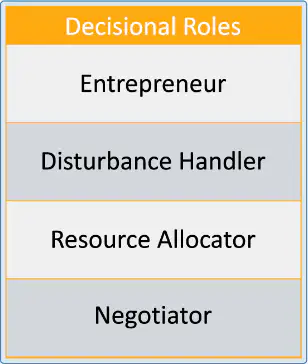
When a manager is working with individuals or groups to reach agreements and make deals that benefit the organization, which decisional role are they fulfilling?
Acting as the Resource Allocator, distributing assets and responsibilities among team members to optimize organizational performance.
Fulfilling the Negotiator Role, engaging in discussions and bargaining to secure advantageous outcomes for the organization.
Demonstrating the Entrepreneur Role, initiating innovative projects and driving organizational change through new opportunities.
Taking on the Disturbance Handler Role, resolving conflicts and addressing unexpected challenges that disrupt workflow.

What is a key responsibility of leaders in a Six Sigma environment?
Advocating for data-driven decisions and fostering a culture of continuous process improvement
Promoting a workplace where intuition is valued over data and process enhancement is not prioritized
Directing efforts solely toward immediate financial gains while overlooking opportunities for process optimization
Discouraging the adoption of Six Sigma methodologies and minimizing the focus on systematic process improvement

How do Total Quality Management (TQM) leaders contribute to meeting customer requirements in an organization?
By fostering a culture where quality is prioritized, establishing transparent standards, and actively engaging all employees in ongoing quality improvement initiatives to align with customer expectations
By concentrating efforts solely on minimizing operational costs, without taking into account the broader organizational goals or the diverse needs of customers and stakeholders
By assigning all decision-making responsibilities to external consultants, thereby excluding internal staff from participating in the quality management process and organizational learning
By disregarding valuable customer feedback and focusing exclusively on refining internal procedures, rather than adapting to the evolving needs and preferences of the market
Explain why knowledge management is particularly relevant to smart manufacturing.
Because it enables organizations to leverage data-driven insights, foster continuous learning, and enhance workforce adaptability in rapidly evolving manufacturing environments.
Because it minimizes reliance on advanced technologies, allowing companies to focus on manual processes and reduce automation in production.
Because it prioritizes established manufacturing techniques, discouraging the adoption of innovative practices and digital transformation.
Because it removes the necessity for ongoing employee education, making skill development and training obsolete in modern manufacturing settings.
Which of the following is an element leaders must possess according to transformational leadership theory?
Exhibiting idealized influence to inspire and motivate followers
Engaging in micromanagement to maintain strict control over team activities
Implementing Six Sigma methodologies to optimize organizational processes
Demonstrating effective delegation skills to empower team members
Which of the following best exemplifies a decisional role, as described in managerial roles theory?
Allocating organizational resources to various projects and departments
Representing the company at official events and ceremonies
Gathering and analyzing information to track organizational performance
Communicating the organization’s achievements to external stakeholders
What is a data-driven methodology aimed at minimizing defects and variations in processes?
Six Sigma method, which utilizes statistical analysis to systematically reduce errors and enhance process consistency
Micromanagement style, where leaders closely monitor every task to ensure strict adherence to procedures
Managerial roles theory, which focuses on defining specific responsibilities and functions within organizational leadership
Situational leadership style, which adapts management approaches based on the needs and maturity of team members
What leadership style works best when employee competence is low but commitment is high, according to situational leadership theory?
Coaching style, which involves guiding and encouraging employees while providing feedback to build their skills.
Directing style, where the leader gives clear instructions and closely supervises tasks to ensure proper execution.
Supporting style, focusing on listening and offering emotional support while sharing decision-making responsibilities.
Delegating style, allowing employees to take responsibility for decisions and work independently with minimal supervision.

