
Font size
 Worksheets
UNIT 2 CSA REVIEW
Total questions: 27
Worksheet time: 16mins
The endosymbiotic theory proposes that certain organelles in eukaryotic cells, such as mitochondria and chloroplasts, originated from free-living prokaryotic cells that were engulfed by a larger host cell. How does the endosymbiotic theory help explain why eukaryotic cells are more complex than prokaryotic cells?
It explains that eukaryotic cells gained specialized structures from prokaryotic cells, allowing for more efficient energy production and other functions.
It shows that eukaryotic cells evolved directly from prokaryotic ancestors, gaining the ability to perform more advanced processes and complex organization.
It proves that prokaryotic cells cannot carry out advanced processes unless they exist as part of a eukaryotic host cell, limiting their independence.
It suggests that prokaryotic cells developed nuclei and other complex internal features after being engulfed by larger, more advanced cells.

On a phylogenetic tree, how do you determine which two organisms evolved the most recently?
What was one of the key findings regarding the survival of lizards with color morphs that match their habitat?
They had 37% higher survival rates.
They had lower camouflage capabilities.
They experienced increased predation.
They showed no difference in survival rates.
Why is the study of rapid genetic adaptation in organisms important for understanding evolution?
It demonstrates how quickly populations can adapt to environmental changes.
It proves that evolution only occurs over billions of years
It shows that all organisms share the same genetics in some way.
It suggests that genetic adaptation is not influenced by the environment.

Which of the following two conclusions can you draw using comparative morphology (anatomy) based on what you see in the image?
All of these organisms use their forelimbs for the same purpose.
The human, dog, bird, and whale all diverged from a common ancestor.
These forelimb structures in the human and the dog are analogous.
All species in this image share homologous forelimb structure.
On a small isolated island, there is a single species of seed-eating birds. Individual birds are able to eat seeds that are within 2 mm (larger or smaller) of their beak depth. The distribution of individuals is shown in the image below. A forest fire caused the plant species that produce seeds from 6mm-11mm to all burn and become extinct. What does the Theory of Natural Selection predict will happen to the population of seed-eating birds over time?
All of the birds will quickly adapt and the birds that ate the medium-sized seeds will learn to eat fish, insects, or other animals, and the population curve will stay the same.
All of the birds will go extinct because there are not enough seeds to support all of the individuals.
All of the birds who have a beak size of 5mm and smaller will survive and reproduce, which will shift the curve to the left.
The birds will diverge into two species: one that eats small seeds and one that eats large seeds, which will change the population curve.
The diagram below shows two populations of bacteria. The black circles represent bacteria that are not resistant to antibiotics, the white circles represent bacteria that are slightly resistant, and the gray circles represent bacteria that are very resistant. Starting in April 2018, small concentrations of antibiotics were applied to the bacteria. Observations of any changes were collected in June of the same year. Which of the following BEST explains the change observed?
Antibiotics became chemically weaker over time and lost effectiveness.
The use of the antibiotics caused the bacteria to become tolerant to them in order to survive.
The antibiotics caused a mutation in the bacteria population. The bacteria survived the antibiotics and reproduced.
A random mutation caused an individual bacteria to be resistant to antibiotics. This bacterium survived the antibiotics and reproduced.
A group of lizards lives on a small island off the coast. For many years, the population showed an even split between green-bodied lizards and brown-bodied lizards. One year, a powerful hurricane swept across the island, destroying much of the vegetation and killing most of the lizards. After the storm, only a handful of lizards remained, and nearly all of them happened to be green. In the years that followed, the lizard population rebounded, but now almost all of the individuals were green, with brown lizards being extremely rare. What is the most likely explanation for the change in the lizard population?
Gene flow, because new individuals migrated to the island and introduced green coloration.
Genetic drift, because chance survival after the storm caused a random shift in allele frequency.
Natural selection, because green lizards were more likely to survive based on camouflage.
Sexual selection, because green lizards were more attractive to mates after the storm.
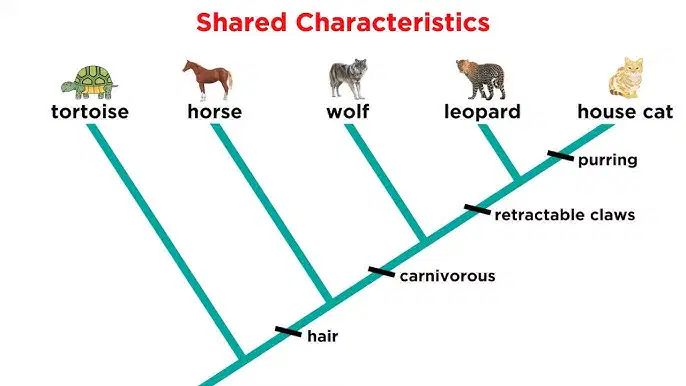
What conclusion can you draw based on this cladogram?
Which of the following scenarios is an example of adaptive radiation?
The finches of the Galápagos Islands evolving into different species rapidly as new niches became available.
The development of different breeds of dogs from wolves over a long period of time.
The evolution of mammals from a common ancestor after the dinosaurs went extinct.
A bee and a flower evolve independently, but their evolution is dependent on one another.
A population of rabbits lives in a grassland environment where predators rely heavily on sight to hunt. Over several generations, scientists notice that more rabbits are born with fur that blends better with the grass. Genetic analysis shows an increase in the frequency of an allele responsible for lighter fur color.
Evaluate the potential long-term evolutionary implications of color variation.
Environmental pressures may continue to drive genetic adaptations.
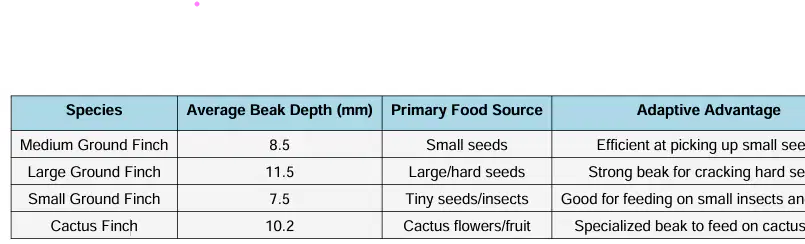
Darwin’s finch populations on the Galápagos show differences in beak size. Which conclusions BEST support natural selection?

The peppered moth, Biston betularia, has two formsa white-bodied form and a dark-bodied form.The graph provided shows data on the populations of the two forms of moth in the same habitat over nearly 20 years.
Which of the periods on the graph could be most reasonably intertrepted to demonstrate variations due to genetic drift?
Years 0 - 4
Years 4 - 8
Years 8 - 13
Years 13 - 19


Lake Victoria in East Africa is home to many species of fish called cichlids. In 1954 the predatory Nile perch was introduced to Lake Victoria. The Nile perch became the dominant fish species in the lake by the mid-1980s. The number of cichlid species in the lake decreased as the Nile perch population increased. The perch preyed heavily on cichlid species that fed on algae and debris on the bottom of the lake. Algae in the lake increased, and oxygen levels decreased. The surface area of the gills of some cichlid species has increased in just over 20 years.
A. Increased gill surface area has allowed the cichlids to change their diet and avoid competing with the Nile perch.
B. Increased gill surface area has allowed the cichlids to better absorb the limited oxygen in the water.
C. Increased gill surface area has allowed the cichlids to be camouflaged and avoid being eaten by the Nile perch.
D. Increased gill surface area has allowed the cichlids to leave Lake Victoria and establish populations in nearby bodies of water.

Finch beak depth was measured before and after a severe drought in 1977. The averaged results are shown in Figure 1. After the drought, there were fewer seeds available for the finches to eat and the seeds that did remain were larger and harder to crack open. Researchers claim that when large, hard seeds are the predominate food source, the average beak depth of these finches tends to increase in subsequent generations.
Using the evidence provided, which of the following best justifies the researchers' claim?
Finch beak depth increased after the drought because the overall numbers of finches decreased, reducing competition for resources.
Finch beak depth increased as a consequence of selective pressure after the drought because the remaining seeds were larger and harder.
Finch beak depth increased after the drought due to intraspecific competition since finches with deeper beaks attract more mates.
Finch beak depth increased after the drought due to increased predation since finches with deeper beaks can fight off predators more effectively.
The combined alleles of all individuals in a population is called the population's
phenothype
gene pool
mutation rate
allele frequency
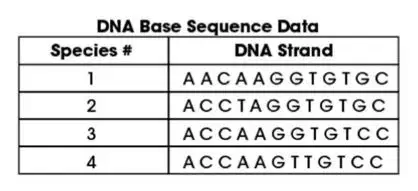
A geneticist examines part of a gene sequence in four different but related species. For each species, the bases in the sequence are indicated in the chart..
She then determines that the common ancestor of these four species has a DNA strand of A C C T A G G T G A G C.
Based on this data, which species is most closely related to the common ancestor?
Define: gene
Segment of DNA that carries the instructions for making a specific protein, which influences a trait.
A is a type of virus that infects bacteria.
A cellular organelle responsible for energy production.
A type of protein found in cells.
Define: Allele
A version of a gene.
Define: Gene Pool
Define: Adaptation
Adaptation is a trait shaped by natural selection that increases an organism’s chance of survival and reproduction in its environment.
Adaptation refers the rapid evolution of traits due to divergent evolution.
Define: Variation
Variation is the random differences in traits among individuals in a population.
Define morphology in evolution
Compare genetic and morphological data in evolutionary pathways.

