
 Worksheets
Section 1: Structures of Skeletal Muscle
Total questions: 50
Worksheet time: 25mins
Which connective tissue surrounds an individual muscle fiber?
Epimysium
Perimysium
Endomysium
Sarcolemma
A fascicle is best described as:
A single muscle fiber
A bundle of muscle fibers
A bundle of myofibrils
A connective tissue covering
Which structure directly surrounds a fascicle?
Endomysium
Perimysium
Epimysium
Sarcoplasmic reticulum
The connective tissue layer that covers the entire skeletal muscle is called:
Endomysium
Epimysium
Perimysium
Fascia
Which organelle in the muscle fiber stores calcium ions needed for contraction?
Sarcolemma
Mitochondria
Sarcoplasmic reticulum
Myofibril
The plasma membrane of a muscle cell is called the:
Sarcomere
Sarcolemma
Sarcoplasm
Endomysium
Myofibrils are composed of repeating units called:
Sarcoplasm
Sarcomeres
Endomysium
Fascicles
Which structure connects muscle to bone?
Tendon
Ligament
Fascia
Blood vessels in muscles are important because they:
Control contraction
Supply oxygen and nutrients
Anchor tendons
Replace damaged fibers
Actin and myosin proteins are located within:
Sarcoplasm
Fascicles
Myofibrils
Epimysium
The fixed attachment point of a muscle is called the:
Insertion
Origin
Joint
Tendon
The movable attachment point of a muscle is called the:
Origin
Insertion
Epimysium
Fascia
Which of the following is true about skeletal muscles?
They push bones to move them
They pull on bones to move them
They contract and relax ligaments
They expand joints directly
A muscle that decreases the angle at a joint is called a:
Extensor
Flexor
Rotator
Stabilizer
Muscles often work in:
Isolation
Antagonistic pairs
Circular systems
Without nerve input
Which of the following provides signals to muscles to contract?
Ligaments
Tendons
Nerves
Blood vessels
The abundant supply of blood vessels in muscles ensures:
Faster bone growth
Efficient nutrient and oxygen delivery
Stronger tendon attachment
Reduced nerve activity
Which of the following is an example of a muscle named for its location?
Biceps brachii
Trapezius
Deltoid
Sartorius
The trapezius muscle is named after its:
Size
Shape
Action
Location
The gluteus maximus is named for its:
Shape
Size
Action
Fiber direction
Which muscle name indicates it has two heads?
Biceps brachii
Triceps brachii
Quadriceps femoris
Deltoid
Which muscle name indicates it has three heads?
Biceps brachii
Triceps brachii
Quadriceps femoris
Rectus femoris
Orbicularis oculi is named for its:
Shape and location
Size and length
Flexor carpi ulnaris is named for its:
Location and action
Shape and size
Origin and insertion
Fiber direction
The sternocleidomastoid muscle is named for:
Action only
Shape and function
Its points of attachment
Fiber arrangement
The deltoid muscle is named after:
Its triangular shape
Its action
Its origin
Its insertion
Temporalis muscle is named based on:
Shape
Function
Location
Fiber direction
A physiatrist is best described as a:
Physical therapist
Rehabilitation physician
Athletic trainer
Orthopedic surgeon
Which of the following can a physical therapist NOT do?
Prescribe medications
Lead exercise programs
Support rehabilitation
Relieve symptoms through therapy
A muscle strain occurs when:
Muscle fibers are overstretched or torn
Bone fractures occur
Ligaments tear
Tendons detach
A “pulled muscle” refers to a:
Ligament sprain
Muscle strain
Bone fracture
Tendonitis
A grade 2 muscle tear usually involves:
Mild overstretching
Partial tearing of fibers
Complete rupture
Only tendon injury
Which muscle did Caleb injure in the case study?
Pectoralis minor
Pectoralis major
Deltoid
Serratus anterior
Symptoms of a muscle tear may include all EXCEPT:
Pain
Swelling
Loss of function
Increased muscle strength
Treatment for muscle tears may include:
Rest, ice, physical therapy
Ignoring the injury
Immediate surgery in all cases
Ligament replacement
With proper treatment, Caleb will most likely:
Never use his chest muscles again
Regain function within months
Require lifelong medication
Lose mobility permanently
Which type of muscle tissue is voluntary and striated?
Smooth
Skeletal
Cardiac
Elastic
Which type of muscle tissue is found in the heart?
Smooth
Skeletal
Cardiac
Elastic
Which type of muscle tissue is non-striated and involuntary?
Smooth
Skeletal
Cardiac
Voluntary
Warming up muscles before activity helps because it:
Weakens tendons
Increases blood flow
Reduces oxygen delivery
Lowers flexibility
The tibialis anterior muscle is located in the:
Upper arm
Chest
Lower leg
Shoulder
Which muscle action would most likely cause injury to the pectoralis major?
Gentle stretching
Heavy weightlifting with the chest
Walking
Writing
Which statement is TRUE about muscle function?
Muscles push bones away from joints
Muscles pull on bones to cause movement
Muscles contract ligaments directly
Muscles move blood vessels
Which Latin root means “large”?
Minimus
Maximus
Longus
Brevis
Which muscle pair is named for shape?
Gluteus maximus & gluteus minimus
Trapezius & rhomboid
Biceps brachii & triceps brachii
Flexor carpi ulnaris & extensor digitorum longus

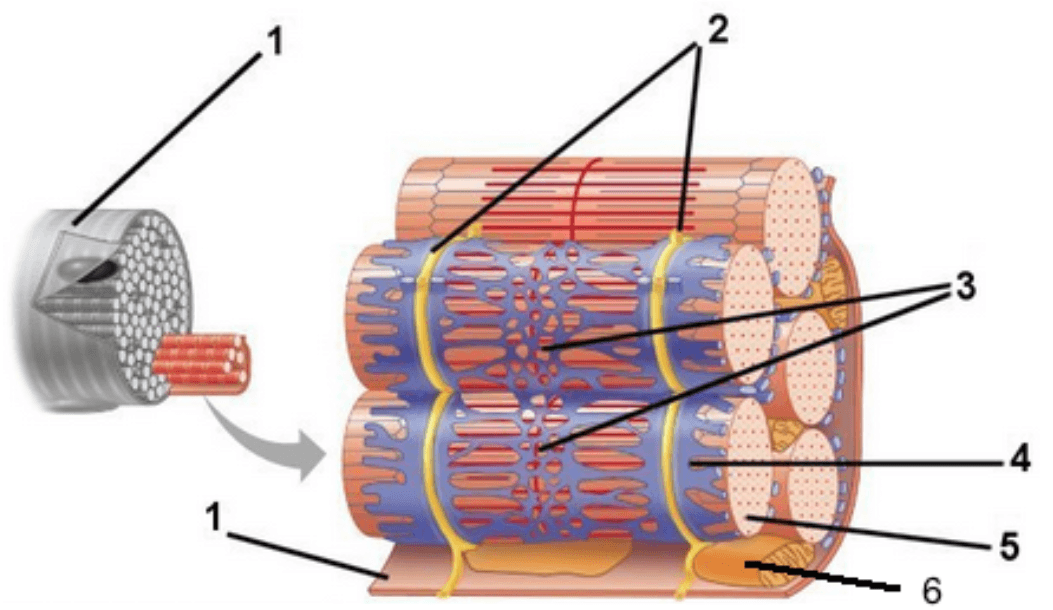
What is shown in the colored part of this diagram?
a whole muscle
five muscle fibers
five muscle fascicles
five myofibrils

Looking at the image in figure 5, what are the tiny rod-like structures that make up skeletal muscle fibers (muscle cells that help with movement)?
myofibrils
endomysium
muscle fibers
fascicles
In a relaxed muscle, blocks the attachment site for the myosin crossbridge, thus preventing contraction
troponin
tropomyosin
Ca++
Mg++
What do all muscle types require for contraction?
Na+
Ca2+
K+
Mg2+

