
 Worksheets
Electromagnetic Theory - Uniform Plane Waves, Part 2
Total questions: 10
Worksheet time: 3mins
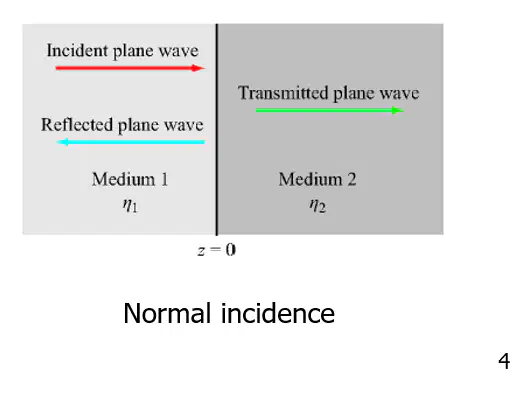
What does the topic of wave reflection and transmission cover in this chapter?
Wave propagation in a single medium
Interaction of waves at the boundary between two media
Wave absorption in a conductor
Wave generation by antennas
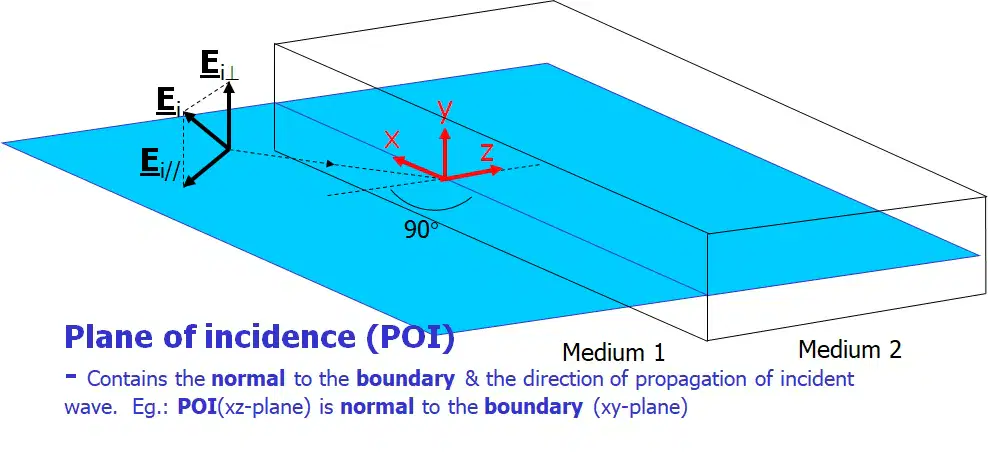
What is the plane of incidence (POI) defined as?
The plane containing the electric and magnetic fields
The plane containing the normal to the boundary and the direction of propagation of the incident wave
The plane perpendicular to the boundary
The plane containing the reflected wave only
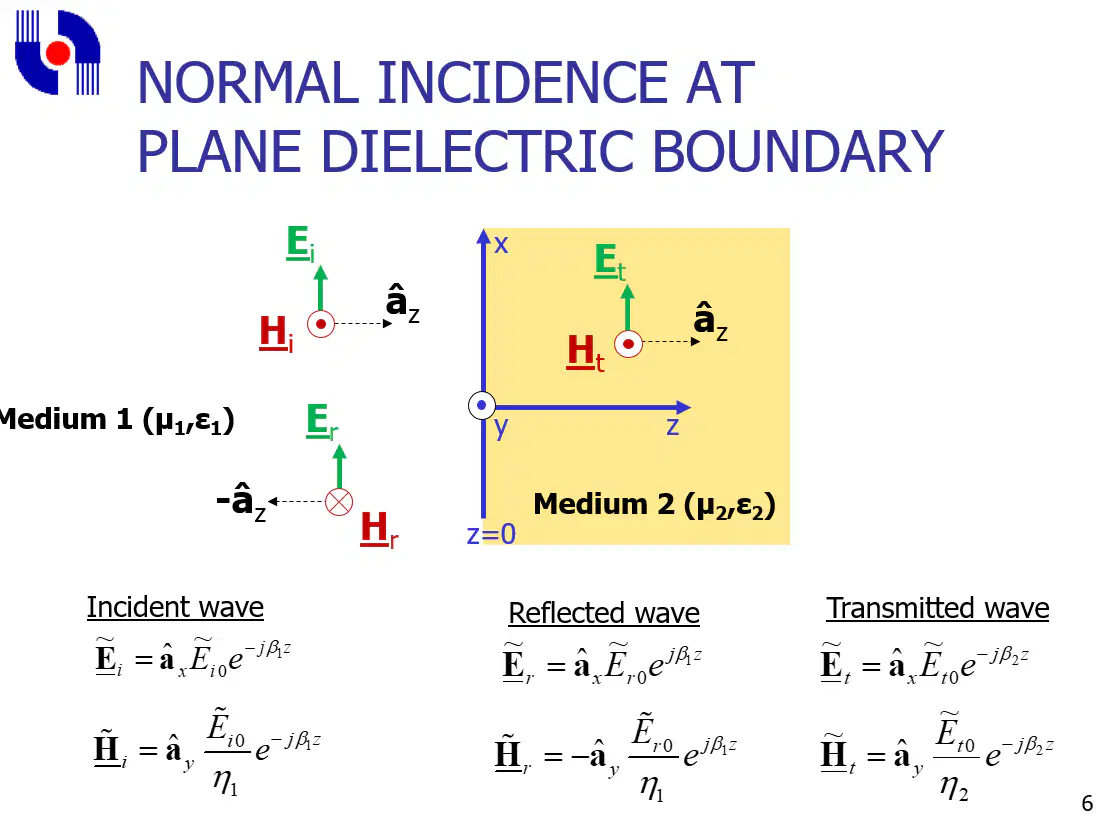
For normal incidence at a plane dielectric boundary, what is true about the incident, reflected, and transmitted waves?
They propagate in different directions
They all propagate along the same axis (e.g., z-axis)
The reflected wave has no magnetic field
The transmitted wave has no electric field
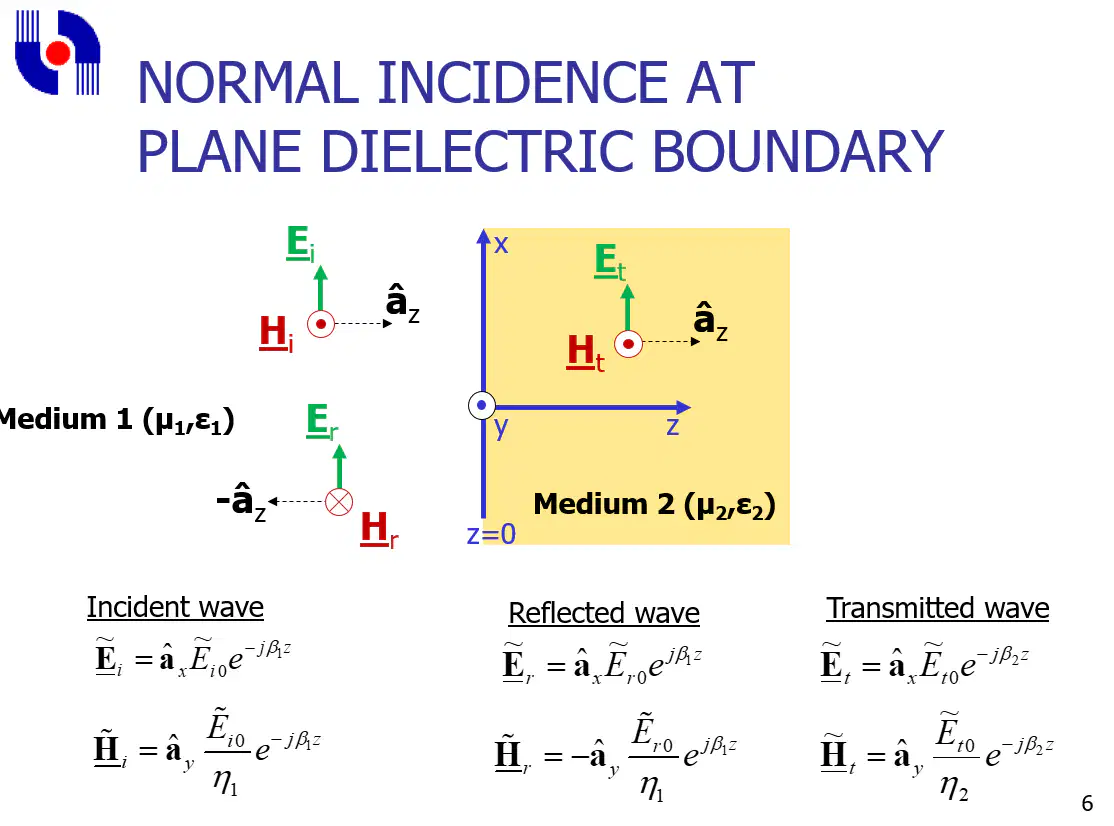
What boundary condition applies to the electric field at a plane dielectric boundary for normal incidence?
The normal component of E is continuous
The tangential component of E is continuous
The electric field is zero at the boundary
The electric field is discontinuous

What is the reflection coefficient (Γ) for normal incidence at a dielectric boundary?
Γ = (η2 − η₁ ) / (η2 + η₁ )
Γ = ( η₁ − η2) / ( η₁ + η2)
Γ = η₁ / η2
Γ = η2 / η₁

What is the transmission coefficient (τ) for normal incidence at a dielectric boundary?
τ = 2 η₁ / ( η₁ + η₂)
τ = 2 η₂ / ( η₁ + η₂)
τ = η₁ / ( η₁ + η₂)
τ = η₂ / ( η₁ + η₂)

What does Snell’s law of refraction relate?
θi = θr
η₁ sin θi = η₂ sin θt
η₁ sin θi = η₁₂ sin θt
θt = θr
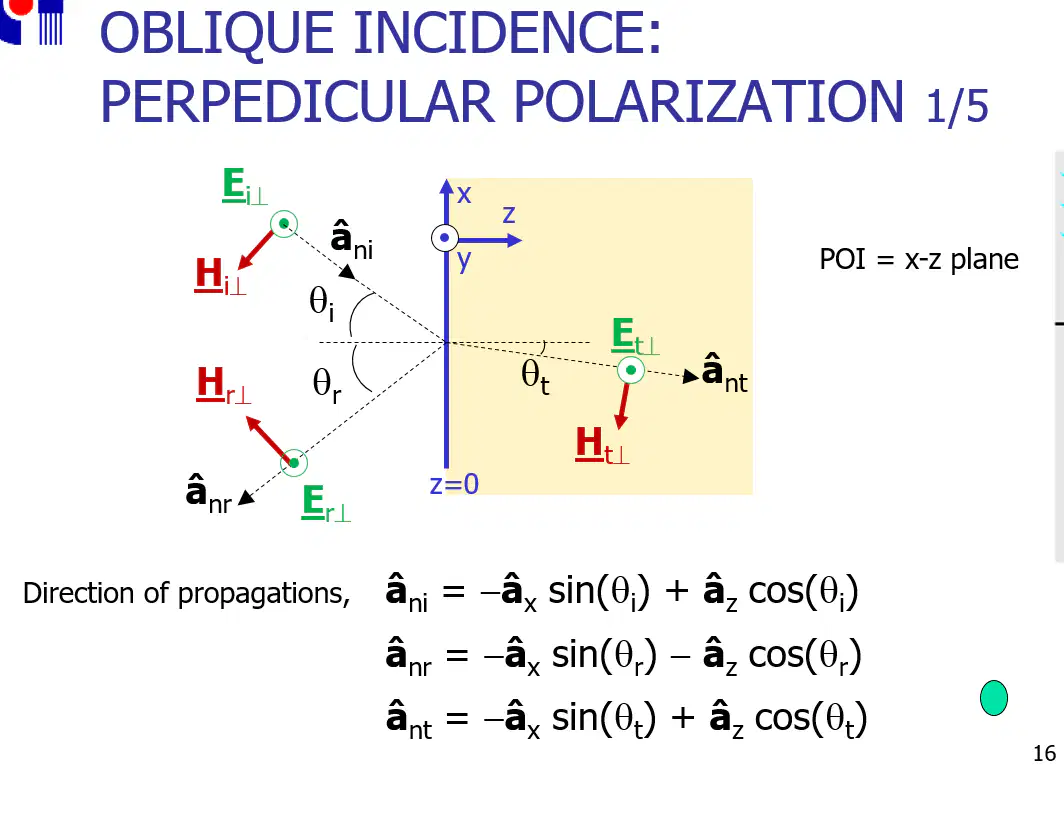
In perpendicular polarization, what is the orientation of the electric field?
Parallel to the plane of incidence
Perpendicular to the plane of incidence
Along the direction of propagation
Parallel to the boundary

In parallel polarization, what is the orientation of the electric field?
Perpendicular to the plane of incidence
Parallel to the plane of incidence
Along the direction of propagation
Perpendicular to the magnetic field

What is the Brewster angle?
The angle where the perpendicular-polarized wave is fully transmitted
The angle where the parallel-polarized wave has zero reflection
The angle where both polarizations are fully reflected
The angle where the wave is absorbed

