
NEW
Font size
 Worksheets
21stCLPW 21st Century Literary Genres
Total questions: 20
Worksheet time: 10mins
What transition have literary works in the 21st century learned to make?
From digital to print
From print to modern technology
From modern technology to print
From oral to written
What is a primary learning tool for a 21st Century Learner?
Books
Technology
Television
Radio
What is a key characteristic of 21st Century Literature?
It is written by authors from the 19th century.
It deals with historical themes and issues.
It reflects a technological culture.
It is composed of works from the early 20th century.
Why is it important for readers to know the genre of the literature they are reading?
To predict the ending of the story.
To understand the message it conveys.
To memorize the author's biography.
To compare it with other genres.
What is an illustrated novel?
A novel with only text and no images
A novel with an extended narrative and multiple images
A novel that is entirely a picture book
A novel with images but no narrative
Can some illustrated novels contain no text at all?
Yes
No
Only in children's books
Only in graphic novels

What is the primary focus of illustrated novels?
To provide a purely textual narrative
To combine visual art with storytelling
To focus solely on character development
To present historical facts
How can Digi-Fiction sometimes be accessed?
Through an online version only.
By purchasing a physical copy.
By attending a live reading.
Through a subscription service.
What is the Japanese word for comics?
Anime
Manga
Manhwa
Cartoon
What type of manga is targeted towards boys?
Shojo
Shonen
Seinen
Josei
Which type of manga is intended for girls?
Shojo
Shonen
Seinen
Kodomo
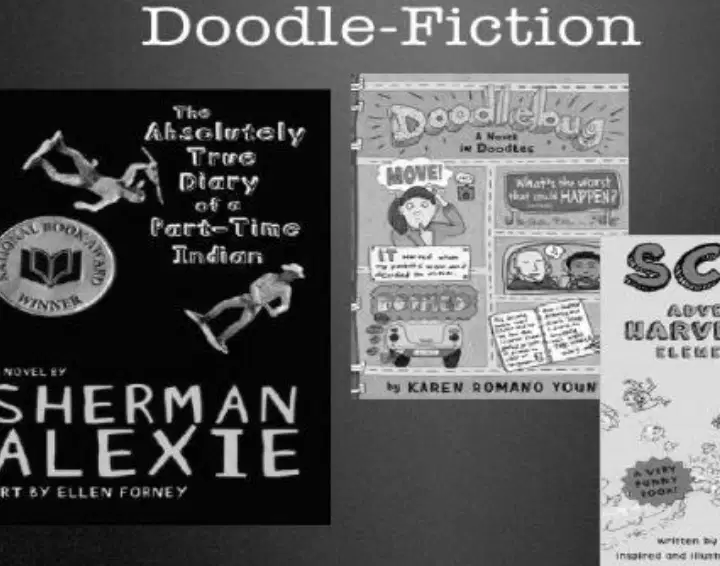
What is a key feature of doodle fiction?
Use of traditional fonts
Incorporation of doodle drawings and handwritten graphics
Absence of illustrations
Focus on realistic storytelling
What is the term for a genre that combines drawings and text to tell a story?
Graphic Novel
Doodle Fiction
Comic Strip
Illustrated Novel
What is the rhyme scheme of a "tanaga"?
ABAB
AABB
ABCD
AAAA
What are the traditional rhyme forms of a modern tanaga?
AABB, ABAB, ABBA
AAAA, BBBB, CCCC
ABAB, BABA, CACA
ABCD, DCBA, EFGH
Which of the following can be considered a form of creative nonfiction?
A science fiction novel
A personal memoir
A fantasy short story
A historical fiction book
Creative nonfiction can be:
Only fictional stories
Only personal narratives
Essays, journal articles, research papers, memoirs, or poems
Only research papers
What is the primary purpose of illustrations in illustrated novels?
To replace the text completely
To distract from the narrative
To provide historical context
To enhance the storytelling experience
Which of the following best describes the format of a graphic novel?
A series of unrelated comic strips
A purely textual narrative
A long-form narrative with sequential art
A collection of short stories
What distinguishes a 'doodle fiction' from traditional novels?
It is only for children
It is always written in verse
It includes doodle drawings and informal graphics
It has no illustrations

