
 Worksheets
Quiz on Light Waves and Atomic Structure
Total questions: 13
Worksheet time: 2mins
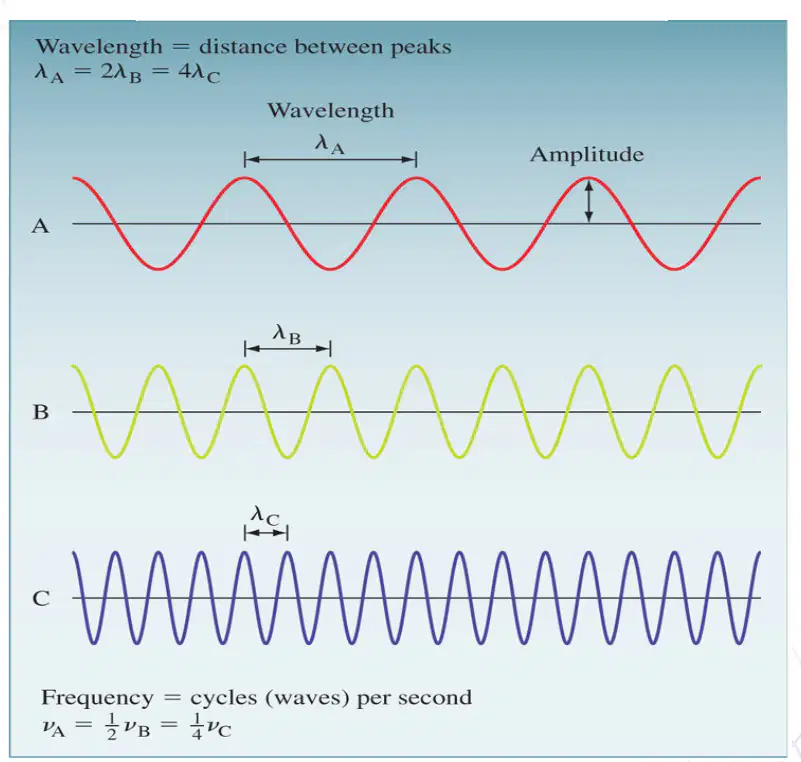
What is the relationship between frequency and wavelength as shown in the diagram?
Frequency increases as wavelength decreases
Frequency increases as wavelength increases
Frequency and wavelength are unrelated
Frequency is always constant regardless of wavelength
How do you convert a wavelength from meters to nanometers (nm)?
Multiply by 10⁶
Divide by 10⁹
Multiply by 10⁹
Add 10⁹
Which experiment's data did Max Planck correlate to develop his quantum theory?
Double-slit experiment
Blackbody experiment
Photoelectric effect experiment
Rutherford gold foil experiment
What major change in thinking did Max Planck's theory introduce about energy?
Energy is continuous
Energy is quantized
Energy cannot be measured
Energy is always lost
What is produced when a potential gradient is created and electrons flow in the circuit during the photoelectric effect?
Photoelectric current
Magnetic field
Thermal energy
Sound waves
What is the term for the minimum energy required to produce the photoelectric effect in different metals?
Work function
Activation energy
Threshold frequency
Ionization energy
What are the energy particles that compose light called, according to Einstein’s explanation of the photoelectric effect?
Electrons
Protons
Photons
Neutrons
What phenomenon occurs when light is shone on a metal surface and electrons are emitted?
Diffraction
Rayleigh scattering
Compton scattering
Photoelectric effect
Which constant is used to relate the energy of a photon to its frequency?
Gas constant
Boltzmann's constant
Avogadro's number
Planck's constant
What is the effect called when light waves bend as they pass through different media?
Refraction
Diffraction
Interference
Reflection
What is the term for the phenomenon where light is absorbed by a material and causes the emission of electrons?
Photoemission
Photoconductivity
Photoionization
Photodissociation
In the context of the photoelectric effect, what happens to the kinetic energy of emitted electrons as the frequency of incident light increases?
It increases
It becomes zero
It decreases
It remains constant
What is the relationship between the energy of a photon and its wavelength?
Energy is equal to wavelength
Energy is directly proportional to wavelength
Energy is independent of wavelength
Energy is inversely proportional to wavelength

