
 Worksheets
2nd MIDTEM EXAM - ICT-Creative Technologies 7 (2D Drawing)
Total questions: 50
Worksheet time: 50mins
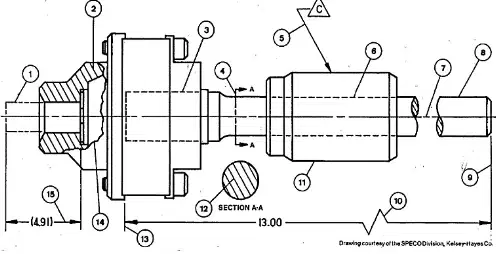
What alphabet of line is numbered by 2 and 12?
Dimension Line
Hidden Line
Section Line
Visible Line
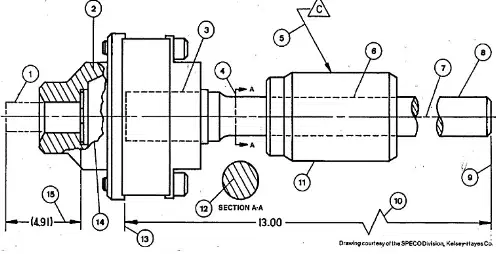
What alphabet of line is numbered by 3?
Center Line
Hidden Line
Section Line
Visible Line
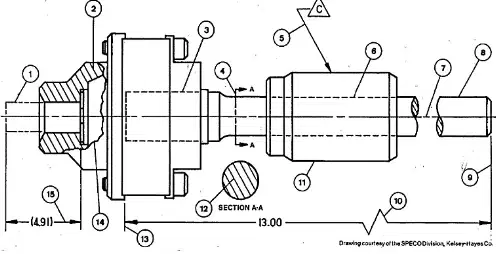
Which alphabet of line is numbered by 7?
Center Line
Dimension Line
Hidden Line
Section Line
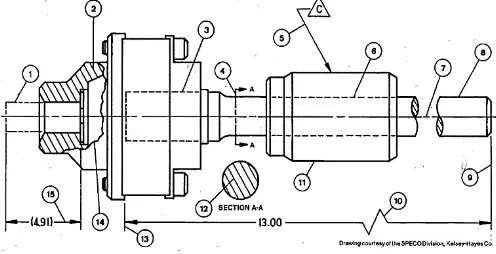
Which alphabet of line is numbered by 8 and 11?
Extension Line
Hidden Line
Section Line
Visible Line
Why is it important to indicate hidden lines in a drawing?
to show the details of the object that cannot be seen
to indicate a part that has been cut
to show the visible details of the object
to indicate the dimension limits
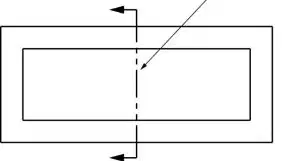
7. What line indicates where an object has been cut to show interior features?
Center Line
Cutting Plane Line
Hidden Line
Section Line
Measurements are important in a drawing to determine the details of the objects’ length, width, and height. Which of the following lines is used to indicate the measurements of the object?
Center Line
Dimension Line
Extension Line
Section Line
A medium thick line composed of short dashes about 2-3 millimeters long with space between dashes about 1-2 millimeters wide is called ________. It is used to represent the surface or edges that cannot be seen.
Center Line
Cutting Plane Line
Hidden Line
Section Line
Every drawing project requires a thick margin to indicate the boundary of drawing area. Which of the following alphabet of lines is used?
Border Line
Center Line
Cutting-Plane Line
Visible Line
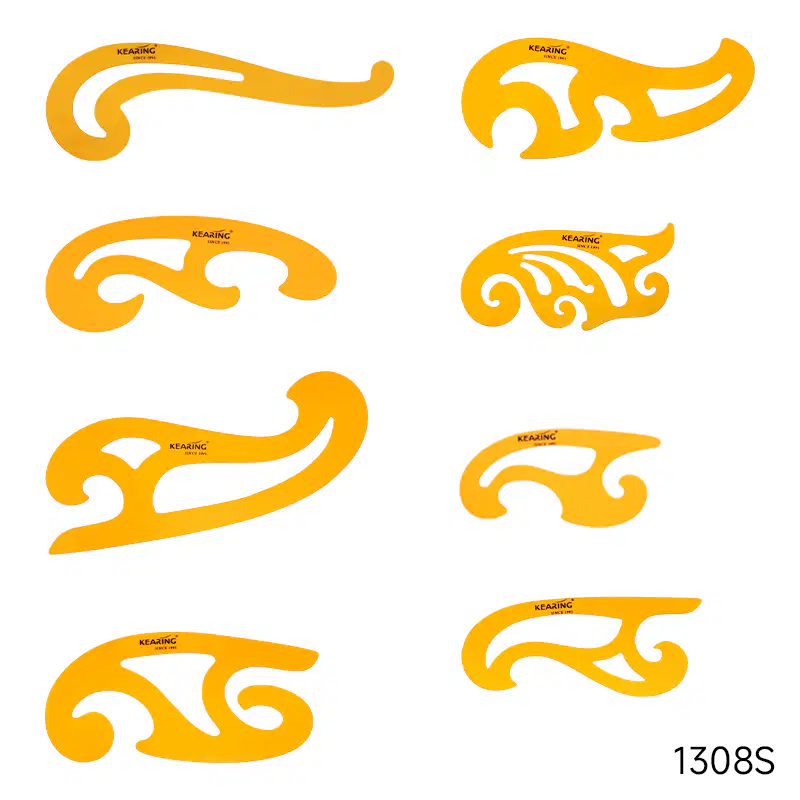
Which drafting tool below matches with the drawing?
Compass
Erasing Shield
French Curve
Protractor
What tool are you going to use if you need to draw a horizontal line measuring 20 inches?
Pull-push Rule
Ruler
T-Square
Triangles
You are constructing an object and you realized that the drawing is too large on the drawing area. What tool are you going to use to reduce the size of the dimensions?
Divider
T-Square
Triangular Scale
Ruler
Hagedorn wants to measure the floor area of her bedroom so that she can estimate how many meters of floor mat she is going to buy. What is the appropriate measuring tool she is going to use?
Meter Stick
Ruler
Pull-push Rule
T-square
A compass is a tool used in geometry and drafting. Which of the following best describes the primary function of a compass?
Used for measuring angles accurately.
Designed to create precise circles and arcs.
This instrument is essential for drawing straight lines and measuring distances.
If 1 foot equals 12 inches, how many feet are there in 60 inches?
5 feet
12 ft
60 ft
720 ft
While working on a school project, Scarlett needs to create a precise angle for her design. She reaches for a measuring tool that is specifically used to layout an angle or an arc.
Compass
Divider
Protractor
Tape ruler
The most popular type of measuring tools, usually 6 or 12 inches in length.
Tape ruler
Triangle
Ruler
Scale
Its main purpose is to reproduce, reduce or enlarge the dimension of size on a drawing.
Tape ruler
Triangle
Ruler
Scale
In a drawing class, Luna needs to create a blueprint that requires precise vertical and oblique lines. Which tool should she use to achieve this?
Ruler
Scale
Triangle
T-Square
It provides an easy means for accurately measuring curved surfaces.
Compass
Divider
Protractor
Tape ruler
These are used for the purpose of measuring dimensions.
Cutting Tools
Measuring Tools
Lining Tools
Testing Tools
This is used as guide in drawing horizontal lines.
Ruler
Scale
Triangle
T-Square
This instrument is used to draw circles, arcs, radii, and parts of many symbols.
Compass
Divider
Protractor
Tape ruler
It is a concave, spring-steel blade ranging from 1/4" to 1" wide and 6 to about 300 feet in length
Meter stick
Pull push rule
Triangle
Ruler
It helps a drafter keep the proportions accurate.
Ruler
Scale
Triangle
T-Square

Based on the isometric drawing shown in the prompt, which answer option is the TOP view of the corresponding orthographic drawing?
The red arrow shows the FRONT view.

2

3

4

5


Which orthographic view is included with the isometric drawing?
Top view
Right side view
Left side view
Bottom view

Based on the multi-view orthographic drawing shown in the prompt, which answer option is the corresponding isometric drawing?


Based on the isometric drawing shown in the prompt, which answer option is the SIDE view for the corresponding orthographic drawing?


A(n) _________ Drawing projects a 3D object on a 2D plane by showing each side separately.
Isometric
Assembly
Orthographic
Systems

In this isometric drawing, if Green is the TOP view and Red is the FRONT view, then Blue is the ______view.
Which views are most commonly included in an orthographic drawing?
front, rear, right
front, top, left
front, top, right
front, top, right, left, rear, bottom

Based on the isometric drawing shown in the prompt, which orthographic view below corresponds to the direction of the arrow?


Based on the isometric drawing shown in the prompt, which orthographic view corresponds to the direction of the arrow?


Based on the isometric drawing shown in the prompt, which answer option is the SIDE view for the corresponding orthographic drawing?


Based on the isometric drawing shown in the prompt, which answer option is the corresponding multi-view orthographic drawing?


Based on the isometric drawing shown in the prompt, which answer option is the FRONT view of the corresponding orthographic drawing?


Where should the side view be placed in an orthographic drawing?
To the left of the front view
To the right of the front view
Directly above the front view
Directly below the front view
What is the BEST front view?
Which multiview drawing correctly represents the object?

Choose the 3 major views of an object.
Top view
Front view
Rear view
Right side view
Bottom view

What will be the top view of the given isometric object?


How many views does EVERY object have?
1
3
4
6
Which orthographic view is the arrow pointing to? Be sure to pay close attention to the direction of the arrow.
Which orthographic view is the arrow pointing to? Be sure to pay close attention to the direction of the arrow.

Which orthographic view is the arrow pointing to? Be sure to pay close attention to the direction of the arrow.


What is the top view?


What is the front view?



