
Font size
 Worksheets
Chapter 24 Sec 4 Other Objects... Quiz
Total questions: 25
Worksheet time: 16mins
What is a comet primarily composed of?
Dust and rock particles mixed with frozen water, methane, and ammonia
Solid iron and nickel
Hydrogen and helium gases
Molten lava and ash
Who was the English astronomer that realized comet sightings every 76 years were of the same comet?
Isaac Newton
Edmund Halley
Galileo Galilei
Johannes Kepler
What is the Oort Cloud?
A collection of asteroids between Mars and Jupiter
A large collection of comets surrounding the solar system
A ring of dust around Saturn
A cluster of stars near the Sun
What did Dutch astronomer Jan Oort propose about comets?
They are remnants of the Big Bang
They originate from the asteroid belt
They lie in a cloud beyond Pluto's orbit
They are formed from volcanic eruptions on Mars
What are the main components of a comet as it approaches the Sun?
Nucleus, Coma, Dust tail, Gas tail
Core, Atmosphere, Ice, Water
Crust, Mantle, Core, Atmosphere
Shell, Core, Dust, Vapor
What happens to the ices of water, methane, and ammonia in a comet as it nears the Sun?
They freeze and form a solid core.
They vaporize due to the Sun's heat.
They condense into liquid form.
They remain unchanged.
What is a meteoroid?
A large asteroid orbiting the Sun.
A small piece of a comet's nucleus or other particles.
A planet's moon.
A star in the galaxy.
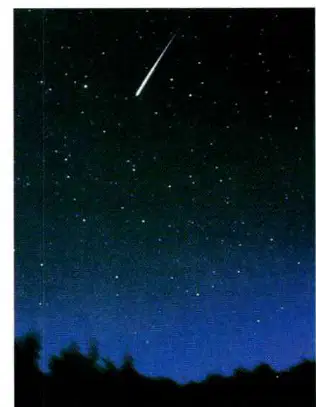
What is a meteor?
A comet that orbits the Sun.
A meteoroid that burns up in Earth's atmosphere.
A planet that has a tail.
A star that explodes.
At what speeds do meteoroids enter Earth's atmosphere?
5 km/s to 10 km/s
15 km/s to 70 km/s
100 km/s to 150 km/s
200 km/s to 300 km/s
What is a meteorite?
A piece of rock that orbits the Sun
A large comet that passes by Earth
A meteoroid that strikes Earth
A star that explodes in space
What is the main cause of a meteor shower?
A planet exploding
Earth passing through a comet's orbit
A star collapsing
The Moon's gravitational pull
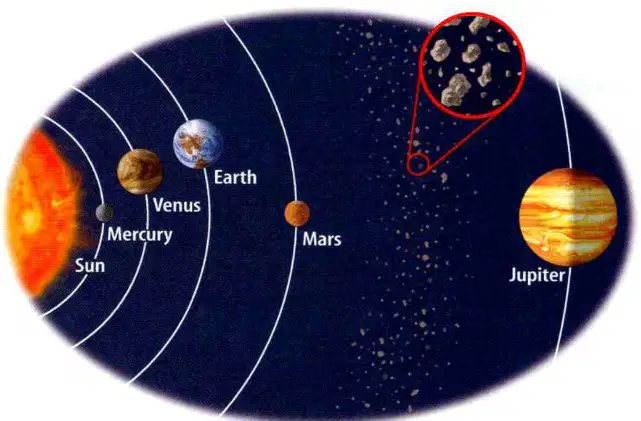
Where is the asteroid belt located?
Between Earth and Mars
Between Mars and Jupiter
Between Jupiter and Saturn
Between Venus and Earth
Why might the gravity of Jupiter have affected the formation of planets in the asteroid belt?
It pushed asteroids towards the Sun
It prevented a planet from forming
It attracted comets to the belt
It caused the belt to move closer to Earth
What are some origins of most meteorites?
The Sun and Mercury
The Moon and Mars
Venus and Saturn
Earth and Jupiter
What is the largest asteroid in the asteroid belt?
Vesta
Ceres
Pallas
Hygiea
What was the mission of the NEAR spacecraft?
To land on Mars
To orbit the Moon
To orbit asteroid 433 Eros
To study comets
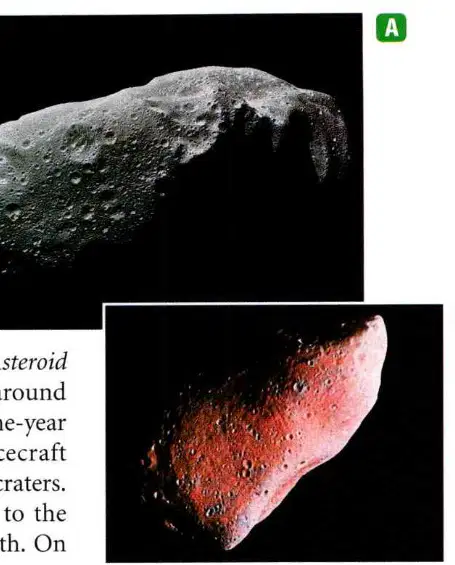
Which asteroid was photographed by Galileo on its way to Jupiter?
Ida and Gaspra
Ceres and Vesta
Pallas and Hygiea
Eros and Ceres
What is the approximate diameter of the largest asteroid in the asteroid belt?
430 km
522 km
940 km
530 km
What type of material are comets, meteoroids, and asteroids composed of?
Material formed recently in the solar system
Material formed early in the history of the solar system
Material from the Earth's core
Material from the Sun's surface

(a) are loose balls of ice and rock that usually have very long, narrow orbits.
Match the following
the largest of the space rocks (left over from the formation of space)
Asteroid
are sometimes called falling or shooting stars. They begin as meteoroids.
Meteors
"Dirty snowball" of space. made of ice & rock
comet
The comet tail that points directly away from the Sun as it is swept by Sun's solar winds is called the (a) tail. The tail that follows the path/orbit of the comet that forms meteor showers when Earth passes through this path is called the (b) tail.

I frozen chunk of ice and gases that orbits the sun in an elliptical pattern.
Meteroid
asteroid
dust
comet

What are comets made of?
Sand
Hydrogen and Helium
metal
Ice, rock, dust

Which of the following best describes the Kuiper Belt?
A region of space between Mars and Jupiter filled with asteroids.
A region of space beyond Neptune filled with icy bodies and comets.
A region of space where the Sun's gravity is weakest.
A region of space where only gas giants are found.

