
 Worksheets
Comms 4
Total questions: 80
Worksheet time: 1hrs 11mins
Carry telephone signals, computer data in LANs, TV and internet signals in cable TV system
(a)
Critical Link in any communication System
(a)
Transmission Line at very high frequency acts as...
Resonant Circuit
Reactive Component
Radiator
Antenna
Transmission Line at short wavelength acts as...
Resonant Circuit
Reactive Component
Antenna
Transmitter
Primary requirement of a Transmission Line
Line introduces minimum attenuation
Line introduces maximum attenuation
Does not radiate any signals as radio energy
Does not radiate any signals as transmitter energy
Material medium that forms all or part of a path from one place to another
(a)
Guided (Wired) Transmission Media
Parallel Wire Lines
Coaxial Cable
Twisted Pair Cable
Fiber Optic Cable
Unguided (Wireless) Transmission Media
Radio Frequency
Microwaves
Infared
Cat5e Cable
Typical application of Transmission Media is to transmit _________ signals over long or short distance with __________
high frequency signals, minimum power loss
high frequency signals, minimum power gain
low frequency signals, minimum power loss
low frequency signals, minimum power gain
Coaxial Cable use in CCTV System
(a)
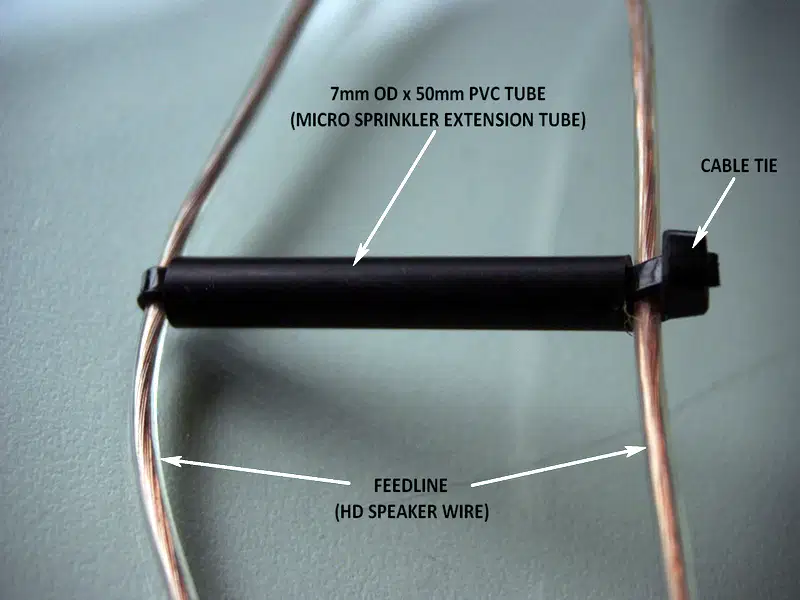
Identify the type of transmission line shown
(a)
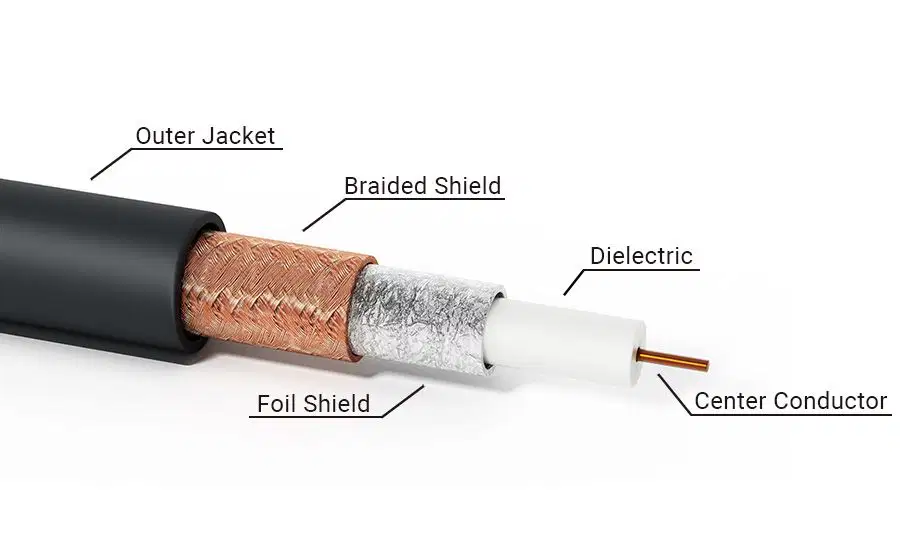
Most widely used type of transmission line
(a)
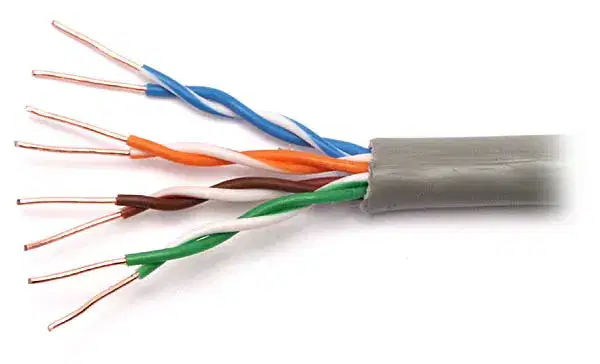
two insulated solid copper wires losely twisted together
(a)
In a twisted-pair cable, twisting cancels (a)
Write the Description
Old: UTP
New: U/UTP
(a)
Write the Description
Old: FTP
New: F/UTP
(a)
Write the Description
Old: F-FTP
New: F/FTP
(a)
Write the Description
Old: S-STP
New: S/FTP
(a)
Write the Description
Old: S-FTP
New: SF/UTP
NOTE: Answer SF only
(a)
Identify the Twisted Pair Termination
G/, G, O/, B, B/, O, Br/, Br
(note: G/=Striped Green, Green White)
(a)
Identify the Twisted Pair Termination
O/, O, G/, B, B/, G, Br/, Br
(note: G/=Striped Green, Green White)
(a)
Lines wherein neither of the wire is connected to the ground
(a)
Classification of a Line wherein same current flows in each wire with respect to the ground
(a)
A balanced line cancels noise picked up through a
(a)
In a balanced line, the direction of the current in one wire is _____ degrees out of phase
180
90
270
360
Classification of a Line wherein one conductor is connected to the ground
(a)
Type of Line that is susceptible to picking up noise
(a)
Named based on "Balanced-Unbalanced"
(a)
converts balanced to unbalanced (vice versa)
(a)
Used to sort out flow of AC signals and make necessary impedance transformation
(a)
Select the correct answers
Coaxial Cable = Low Impedance
Balanced Load = High Impedance
Balanced Load = Low Impedance
Coaxial Cable = High Impedance
At (a) Frequency, Transmission Line acts as carrier of AC Voltage
Length or distance of one cycle of an AC Wave
(a)
Value of Speed of Light (c)
3 x 10^6 m/s
3 x 10^8 m/s
3 x 10^8 km/s
299 792 458 m/s
Speed of signals _______ once it passes transmission line
Slows down
Speeds up
equalize
transmits
Oppose change in electrical current flow
(a)
collect and store energy in form of electrical charge
(a)
expresses the ease with which electric current flows through materials like metals and nonmetal
(a)
Speed of signal in Transmission Line is (a) than the speed of signal in free space
The velocity of propagation of a signal in a cable is less than the velocity of propagation of light in free space by a fraction
(a)
A signal applied at one end of a line appears sometime later at the other end of the line
(a)
A transmission line used specifically for the purpose of achieving delay is called
(a)
The amount of delay time is a function of a line’s
inductance and capacitance.
resistance and inductance
resistance and impedance
resistance and capacitance
The primary specifications of Transmission Line
characteristic impedance
attenuation
Voltage
Length
The (a) is the power lost per 100 ft of cable expressed in decibels at 100 MHz.
(a) is directly proportional to cable length and increases with frequency.
However, the_____the cable, the _____ the loss.
Larger, Lower
Smaller, Lower
Larger, Higher
Coax cables operate over a wide frequency range. Their main disadvantage is their (a) attenuation
When a signal is applied to a transmission line, it appears at the other end of the line sometime later because of the
(a)
resistive load = characteristic impedance e, the signal is absorbed by the load and power is dissipated as (a)
If the load is an antenna, the signal is converted to (a) and radiated into space.
reflected voltage adds to the forward or incident generator voltage and forms a composite voltage that is distributed along the line. This pattern of voltage and its related current constitute what is called
(a)
(a) waves are not desirable. The reflection indicates that the power produced by the generator is not absorbed by the load
open transmission line will, of course, produce a ______ and ______
Reflection
Transmitter
Standing Wave
Sine Wave
a wave that bounces off of a boundary or obstacle, and changes direction as a result.
(a)
When a wave encounters a surface, it can reflect back in the opposite direction, creating a (a)
a wave that appears to be standing still, because it is actually the result of two waves traveling in opposite directions interfering with each other
(a)
The power sent down the line toward the load is called ______ or _______
forward
incident power
impedance
resistance
the power not absorbed by the load is called
(a)
In the ideal case, there are no standing waves, then SWR=_
(a)
_____ _____ is use to reduce chance of error in transmission line calculation
(a)
Who created the Smith Chart
(a)
Shunt capacitance was determined due to:
Conductors were closed to each other
The length and diameter of the conductors
Flux linkage
Flux linkage
The distributed parameters of the transmission line are: the series resistance; the series inductance; the shunt capacitance and the shunt conductance. What parameter was determined due to dielectric losses?
(a)
A system of conductors used to convey electric power or signal between two or more points
(a)
If a change in the dielectric material decreases the capacitance, the characteristic impedance is:
(a)
The characteristic impedance of balance wire varies from
150 to 600 Ω
40 to 150 Ω
75 to 400 Ω
75 to 600 Ω
The characteristic impedance of a transmission line is determined by:
Its operating frequency
Its length
Its physical size and arrangement
The signal applied at the input terminal
A measure of the mismatch between line and load impedance is called as
(a)
The ratio of reflected voltage to the forward or incident voltage is termed as
(a)
These conductors are uniformly spaced by insulators. They have low losses at low and medium frequencies and are economical to construct and maintained.
Coaxial cables
Open-wire transmission lines
Optical cables
Waveguides
The term “balance line” means that
Both conductors carry currents that flow in opposite directors
Conductors present equal capacitance to ground
One conductor is connected to ground
Can be placed at either end of a transmission line to convert between 72-Ω unbalanced line to a 300-Ω balance line
(a)
The value remains constant for any length of wire
(a)
An electronic equipment used to measure standing wave ratio.
Reflectometer
Wavemeter
Altimeter
Multimeter
What is the reflection coefficient of an open-circuited transmission line?
(a)
Is a narrow, flat conductor on a single dielectric board whose opposite face is metallized, much like an ordinary printed-circuit board. It is also used in microwave circuits
Coax
Waveguide
Microstrip
Stripline
Who profounded electromagnetic radiation theory?
(a)
Refers to the direction of the electric field vector in space
(a)
What is the unit of electric field strength?
(a)

