
 Worksheets
Client-Server Interaction: Network Communication Fundamentals
Total questions: 62
Worksheet time: 31mins
What is the foundational paradigm for network communication that enables countless applications and services we use daily?
Peer-to-peer model
Client-server model
Ring topology
Mesh network
In the client-server model, who initiates communication by requesting services?
The client
The server
The database
The network
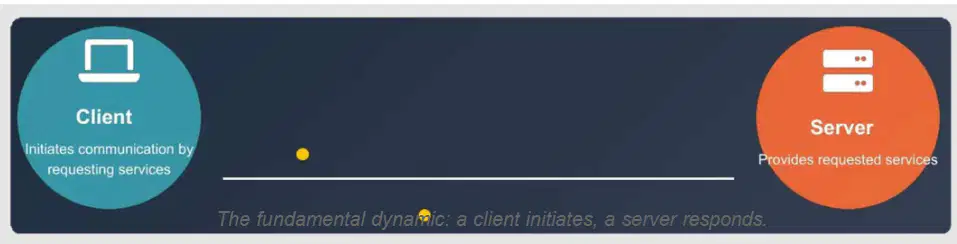
The fundamental dynamic in a client-server interaction is that a client initiates and a server responds.
True
False
In any client-server interaction, the ______ is the initiator of communication, while the ______ is the responder, listening for and fulfilling requests.
client, server
server, client
host, peer
user, administrator
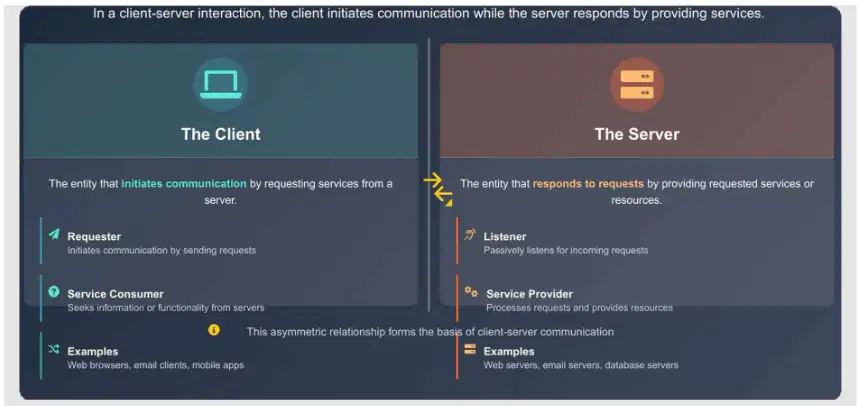
What is the main role of the client in a client-server interaction?
To respond to requests by providing services
To initiate communication by requesting services from a server
To process valid requests and return data
To passively listen for incoming requests
Which of the following is an example of a client?
Web server (like Apache)
Email server (like Exchange)
Web browser (like Chrome, Firefox)
Database server (like MySQL)
Fill in the blank: The entity that responds to requests by providing the requested services or resources is called the _______.
Server
Client
Router
Database
Which of the following best describes a 'Requester' in the context of a client?
Passively listens for incoming requests
Processes valid requests and returns data
Actively sends requests to a server to obtain information or trigger an action
Seeks information or functionality from servers
Which of the following is NOT an example of a server?
Web server (like Apache)
Email client (like Outlook)
Database server (like MySQL)
Email server (like Exchange)
What is the role of a 'Listener' in the context of a server?
Actively sends requests to a server
Passively listens for incoming requests on specific network channels
Seeks information from servers
Provides examples of web browsers
What does an IP address (Internet Protocol address) serve as in a computer network?
A) A type of software
B) A unique numerical label assigned to each device
C) A physical cable
D) A wireless signal
Which of the following is NOT a function of an IP address?
A) Unique Identification
B) Data Routing
C) Communication Foundation
D) Virus Protection
Fill in the blank: IP addresses act as unique ________ for devices on a network, distinguishing one computer from another.
identifiers
locations
passwords
routers
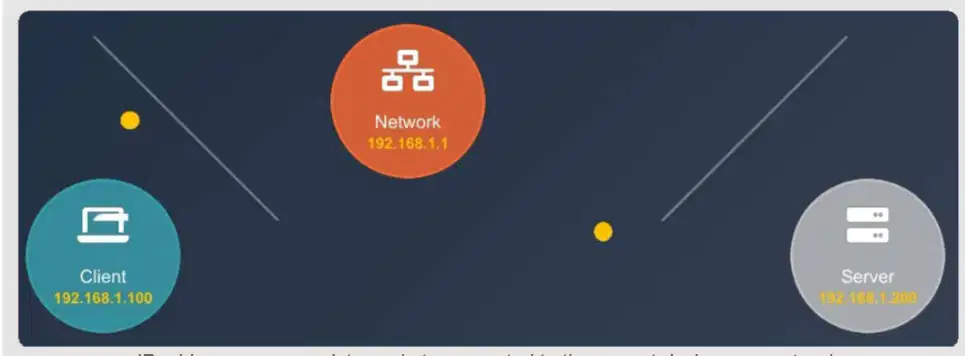
What is the IP address of the client device shown in the network diagram?
192.168.1.100
192.168.1.1
10.0.0.5
172.16.0.10
What is the main function of a port number in a network connection?
It identifies the device on the network
It acts as a virtual channel to direct data to the correct application
It provides internet access
It encrypts data packets
What does the Virtual Channel Concept enable a server to do?
Host only one service at a time
Host multiple services on different ports using the same IP address
Only run web services
Only run database services
Which of the following is NOT a transport protocol mentioned under Connection Types?
TCP
UDP
FTP
None of the above
Fill in the blank: Ports are crucial for directing incoming network traffic to the specific ______ or application that is meant to receive it.
process
protocol
device
router
True or False: An IP address alone is enough to uniquely identify a specific network endpoint for an application.
True
False
A socket address is the combination of an IP address and a ________.
port number
subnet mask
MAC address
gateway
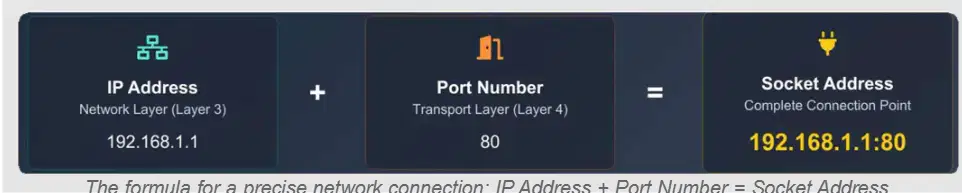
According to the formula for a precise network connection, what two components are combined to form a socket address?
A) IP Address and MAC Address
B) IP Address and Port Number
C) Port Number and Protocol
D) Protocol and MAC Address
Which layer in the OSI Model is responsible for applications such as HTTP, FTP, and SMTP?
Layer 7: Application
Layer 4: Transport
Layer 2: Data Link
Layer 3: Network
Which layer in the TCP/IP Model is responsible for IP addresses?
Layer 2: Internet
Layer 1: Network Access
Layer 3: Transport
Layer 4: Application
At which layer do IP addresses operate in the OSI Model?
Layer 3: Network
Layer 1: Physical
Layer 2: Data Link
Layer 4: Transport
At which layer do port numbers operate in the TCP/IP Model?
Layer 3: Transport
Layer 1: Network Interface
Layer 2: Internet
Layer 4: Application
In the OSI Model, the Presentation layer is Layer 6.
True
False
In the TCP/IP Model, the Application layer is Layer 1.
True
False
What is the first step in establishing a client-server connection?
Connection Initiation
DNS Resolution
Client-Side Port Allocation
Socket-to-Socket Connection
Fill in the blank: The process often begins with a human-readable domain name (e.g., www.example.com). The client's first step is to use the _______ to translate this domain name into the server's numerical IP address.
Domain Name System (DNS)
Hypertext Transfer Protocol (HTTP)
File Transfer Protocol (FTP)
Simple Mail Transfer Protocol (SMTP)
What does the client do after obtaining the server's IP address?
Allocates a port
Initiates a connection request
Forms a socket-to-socket connection
Translates the domain name
Fill in the blank: To receive the server's response, the client's operating system must open a return channel by assigning a temporary, high-numbered port from the _______ range (49152-65535).
dynamic/private
well-known
reserved
system
What defines the complete, two-way communication channel in a client-server connection?
Only the server's port
Only the client's IP
Two sockets: the client socket (Client IP:Dynamic Port) and the server socket (Server IP:Well-Known Port)
The DNS system
Socket addresses effectively bridge the _______ and _______ layers to create a complete, application-specific endpoint.
Transport and Network/Internet
Application and Data Link
Physical and Presentation
Session and Physical

What is formed between the client's dynamic port and the server's well-known port?
A socket-to-socket connection
A firewall rule
A DNS resolution
A MAC address mapping
Let's walk through a practical example. When you type a website address like https://www.example.com into your browser, a complex but rapid sequence of events occurs to establish a secure connection between your client (browser) and the server hosting the website.
1. DNS Resolution
Your browser sends a request to a DNS server to resolve www.example.com. The DNS server responds with the corresponding IP address, for instance, _________.
93.184.216.34
172.217.3.110
151.101.1.69
104.244.42.1
When you type a website address like https://www.example.com into your browser, a complex but rapid sequence of events occurs to establish a secure connection between your client (browser) and the server hosting the website. Because the URL uses ________, your browser knows to connect to the secure web port. It initiates a TCP connection to the server's IP address (93.184.216.34) on port 443.
http
https
ftp
smtp
When you type a website address like https://www.example.com into your browser, a complex but rapid sequence of events occurs to establish a secure connection between your client (browser) and the server hosting the website. 3. Client-Side Port Allocation Your computer's operating system assigns a temporary, high-numbered port for this specific browser tab's connection. Let's say it assigns port _________. This port acts as the "return address" for the server's responses. Which of the following is the correct port number assigned in this scenario?
49152
80
22
443
Which port is used by the server socket?
49152
80
443
8080
Which port number is used for File Transfer Protocol (FTP) for data and control channels?
A) 22
B) 25
C) 20, 21
D) 80
Which service uses port number 22 for secure remote access and management?
FTP
SSH
SMTP
DNS
What is the description of the service that uses port number 25?
File Transfer Protocol (for data and control channels)
Simple Mail Transfer Protocol (for sending email)
Domain Name System (for translating domain names to IP addresses)
Hypertext Transfer Protocol (for standard web browsing)
Fill in the blank: Port number 53 is used for the __________ service.
DNS
FTP
SMTP
HTTP
Fill in the blank: The Hypertext Transfer Protocol (HTTP) uses port number __________ for standard web browsing.
80
21
443
25
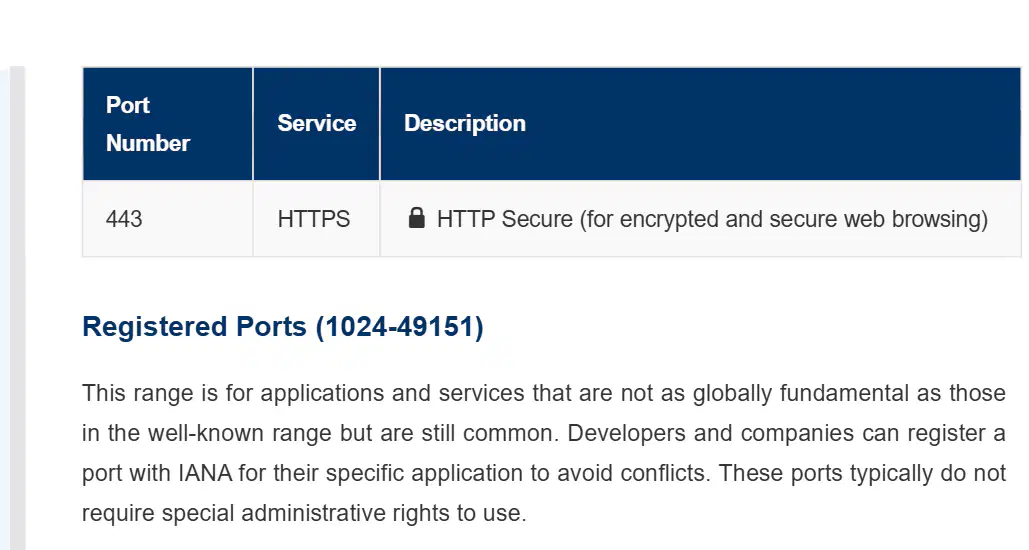
Which port number is used for HTTPS (HTTP Secure for encrypted and secure web browsing)?
80
21
443
3306
MySQL database servers listen on which registered port for incoming TCP connections from clients?
3306
1433
1521
5432
Microsoft's Remote Desktop Protocol (RDP) uses which port to enable remote graphical connections to Windows machines?
3389
21
80
443
What is the range of registered ports?
0-1023
1024-49151
49152-65535
80-443
Dynamic/Private ports are also known as ephemeral ports.
True
False
Each connection uses a unique dynamic port from the client to the server.
True
False
Which protocol is connection-oriented and built for reliability?
TCP
UDP
Which protocol uses a 'three-way handshake' to establish a reliable connection before any data is sent?
TCP
UDP
Which protocol guarantees that data packets are delivered, arrive in the correct order, and are error-checked?
TCP
UDP
ICMP
ARP
Which protocol is best for applications where data integrity is paramount, such as Web Browsing (HTTP/HTTPS), Email (SMTP), and Secure Shell (SSH)?
TCP
UDP
ICMP
ARP
Which protocol is connectionless and built for speed?
TCP
UDP
Which protocol sends data immediately without a handshake, minimizing latency?
UDP
TCP
HTTP
FTP
Which protocol is best for time-sensitive applications where speed is more important than perfect reliability, such as DNS lookups, live Video Streaming, VoIP, and online gaming?
UDP
TCP
HTTP
FTP
Which protocol does NOT retransmit lost packets and requires error handling to be built into the application if needed?
TCP
UDP
What is the process called when attackers scan a target's IP address for open ports to identify running services and search for known vulnerabilities associated with that service to attempt an exploit?
Port Scanning
Phishing
Social Engineering
Brute Forcing
Which type of attack involves flooding a specific port with an overwhelming number of requests, consuming the server's resources and rendering the legitimate service unavailable to users?
Denial of Service (DoS) Attacks
Phishing Attacks
SQL Injection
Man-in-the-Middle Attack
If communication over a port is unencrypted, an attacker can position themselves between the client and server to intercept, read, or even modify the data being transmitted. What is this type of attack called?
Man-in-the-Middle (MitM) Attacks
Denial of Service (DoS) Attacks
Phishing Attacks
Brute Force Attacks
Using services on unencrypted ports (like FTP on port 21 or HTTP on port 80) transmits data, including credentials, in plaintext, making it easily readable if intercepted. What is this vulnerability called?
Weak or No Encryption
Buffer Overflow
SQL Injection
Cross-Site Scripting
Fill in the blank: The complete endpoint (______), ensuring precise, application-level communication.
IP + Port
MAC Address
Subnet Mask
Gateway

