
 Worksheets
Periodic Table Test Review 25-26
Total questions: 40
Worksheet time: 33mins
What is the name of group number 2?
transition metals
halogens
metaloids
alkaline earth metals
where are the metaloids found
far left, vertical
stair step/diagonal
far right horizontal
at the bottom
What group number are the halogens found?
18 (8A)
1
2
17 (7A)
A grouping of elements based on similar chemical properties, arranged by columns in the periodic table; also known as a group
family
period
row
isotope
Nonmetals (select all that apply)
are found on the right side of the periodic table.
are found on the left side of the periodic table.
are good conductors of heat and electricity.
are brittle.
can be solid, liquids, or gases at room temperature.
Which halogen is found in period 4?
Krypton (Kr)
Xenon (Xe)
Bromine (Br)
Iodine (I)
Which element has similar chemical properties as sodium but has 7 energy levels?
Francium (Fr)
Cesium (Cs)
Rubidium (Rb)
Potassium (K)
Elements that have the same number of energy levels are said to be in the same ______.
group
period
family
classification

Highly reactive
Alkali metal
Noble gases
Rare earth metals
Neon
Which of the following is an inert gas?
Hydrogen
Helium
Oxygen
Carbon dioxide
Noble gases are inert because
They are highly reactive
They are unreactive
They are noble
They have 8 electrons in their outer most energy level


What are valence electrons?
The total number of electrons in an atom
The number of electrons in the outermost shell
The number of electrons in the second shell
The number of protons in the outermost shell

1s22s22p63s23p6
4s23d104p6
[Xe] 6s2 4f14 5d9

The vertical (up and down) columns in the periodic table are called
groups
towers
periods
atomic numbers
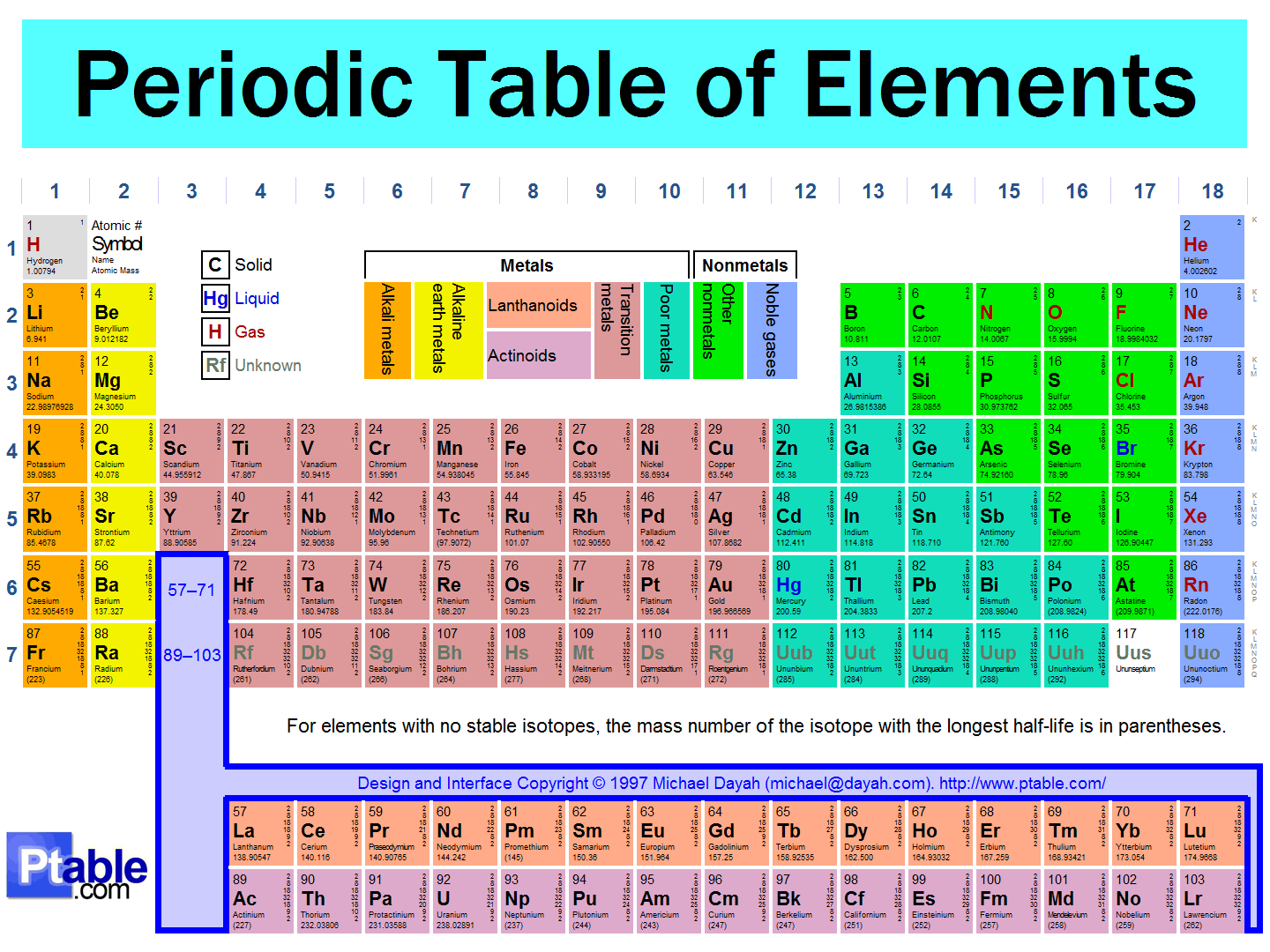
The horizontal (side to side) rows in the periodic table are called
groups
families
periods
atomic numbers
The scientist ____ is credited with the idea of arranging the elements in the periodic table according to their physical and chemical properties.
Mendeleev
Dobereiner
Newlands
Dalton
Mendeleev predicted that the empty spaces in his periodic table represented ____.
isotopes
radioactive elements
permanent gaps
undiscovered elements

Which of the following halogens has the greatest electronegativity?
Chlorine (Cl)
Bromine (Br)
Iodine (I)
Astatine (At)

Which group of elements has the lowest ionization energies?
Alkali Metals (Group 1)
Alkaline Earth Metals (Group 2)
Halogens (Group 17)
Noble Gases (Group 18)

What is a measure of the tendency of an atom to attract a bonding pair of electrons when the atom is in a compound?
ionization energy
electropositivity
electronegativity
electron energy
Ionization energy is ....
the energy required to add an electron to an atom
the energy required to shield the outer electrons from the nucleus
a measure of the ability of an atom to attract electrons
how much energy it takes to remove an electron from an atom
Which is larger:
P or P-3 ?
P because it is the neutral atom.
P-3 because it lost 3 electrons.
P-3 because it gained 3 electrons.
They are the same size since they are both P.
A sodium atom (Na) loses an electron to form a sodium ion (Na+1). Which statement is correct in regards to describing the ionic radius.
The sodium ion (Na+1) has a larger radius than the neutral sodium atom (Na).
The sodium ion (Na+1) has a smaller radius than the neutral sodium atom (Na).
The sodium ion (Na+1) and the neutral sodium atom (Na) are the same size because they are both sodium.
The sodium ion (Na+1) has twice the radius of the neutral sodium atom (Na).

