
 Worksheets
Week 5 Quiz
Total questions: 15
Worksheet time: 8mins
Name
Class
Date
1.
Who is credited with the first modern periodic table?
a)
Dimitri Mendeleev
b)
Robert Boyle
c)
Albert Einstein
d)
Ernest Rutherford
2.
Which of the following lists contains only metals?
a)
Cu, Pb, F
b)
Be, Na, Cs
c)
Ne, Rn, Pb
d)
Ca, Rb, C
3.
What part of the atom was discovered first (by Rutherford)?
a)
Proton
b)
Neutron
c)
Electron
d)
Nucleus
4.
The nucleus of an atom, according to Rutherford’s gold foil Experiment, is:
a)
negatively charged and has a low density.
b)
negatively charged and has a high density.
c)
positively charged and has a low density.
d)
positively charged and has a high density
5.
The number of neutrons in the nucleus of an atom can be calculated by
a)
adding together the numbers of electrons and protons.
b)
subtracting the number of protons from the number of electrons.
c)
subtracting the number of protons from the mass number.
d)
adding the mass number to the number of protons.
6.
All atoms of the same element have the same:
a)
number of protons.
b)
number of neutrons.
c)
mass number.
d)
Mass.
7.
Which pair represents atoms that are isotopes?
a)
C-14 and N-14
b)
I-131 and Te-131
c)
C-12 and C-14
d)
Rn-222 and Ra-222
8.
This element has a mass number of 209, contains 83 electrons, and 83 protons. Which of the following is it?
a)
Tin-207
b)
Bismuth- 83
c)
Lead- 207
d)
Bismuth- 209
9.
How do the isotopes hydrogen-2 and hydrogen-3 differ?
a)
Hydrogen-3 has one more proton than hydrogen-2.
b)
Hydrogen-3 has two neutrons.
c)
Hydrogen-2 has three protons.
d)
Hydrogen-2 has no protons.
10.
The number 85 in the name Rubidium-85 represents
a)
the atomic number.
b)
the atomic mass.
c)
the sum of protons and electrons.
d)
none of the above
11.
An electrically neutral atom of an element with atomic number 38 and mass number 89 contains
a)
38 protons, 38 electrons, and 51 neutrons.
b)
89 protons, 38 electrons, and 38 neutrons.
c)
89 protons, 38 electrons, and 51 neutrons.
d)
89 protons, 89 electrons, and 38 neutrons.
12.
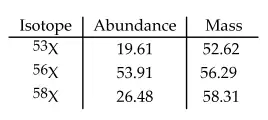
The element X has three naturally occurring isotopes. The atomic masses (amu) and % abundances of the isotopes are given in the table below. The average atomic mass of the element is _________ amu.
a)
57.23
b)
33.33
c)
56.11
d)
55.74
13.
Which subatomic particle determines the identity of an element?
a)
Proton
b)
Neutron
c)
Electron
d)
Photon
14.
An atom of calcium-40 has how many neutrons?
a)
10
b)
60
c)
40
d)
20
15.
Which of the following statements about isotopes is correct?
a)
Isotopes have the same number of protons but different numbers of neutrons.
b)
Isotopes have different numbers of protons and electrons.
c)
Isotopes have the same mass number.
d)
Isotopes have different chemical properties.
100 %

