
 Worksheets
Fitness Lesson Quiz
Total questions: 27
Worksheet time: 14mins
What is physical fitness primarily about?
Looking good
Feeling strong, healthy, and confident
Performing daily activities without energy
Getting overly tired
What does physical fitness enable your body to do?
Perform daily activities with energy and without getting overly tired
Look good in front of others
Avoid all physical activities
Sleep for long hours
What is the main function of cardiorespiratory endurance?
To improve flexibility
To help your heart, lungs, and blood vessels deliver oxygen during sustained activity
To build muscle strength
To increase bone density
Which of the following is NOT an example of an activity that improves cardiorespiratory endurance?
Running
Swimming
Weightlifting
Cycling

What is one benefit of improving cardiorespiratory endurance?
Stronger bones
Stronger heart
Increased muscle size
Improved hand-eye coordination
How many minutes of moderate-to-vigorous activity do adolescents need daily?
30 minutes
45 minutes
60 minutes
90 minutes
Which of the following is an example of a vigorous activity?
Walking
Basketball
Watching TV
Reading
What is the definition of muscular strength?
The ability to run long distances without getting tired
The maximum amount of force your muscles can produce in a single effort
The flexibility of your joints and muscles
The speed at which you can perform a task
Which of the following is an example of an activity that improves muscular strength?
Jogging
Push-ups
Yoga
Swimming
What is one benefit of improving muscular strength?
It helps you breathe better
It improves your memory
It leads to stronger bones and better posture
It increases your ability to solve math problems
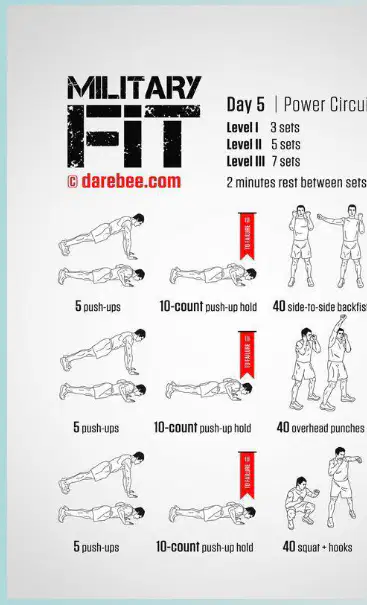
Which of the following exercises are included in the 'Military Fit' routine as shown in the diagram?
Push-ups, Sit-ups, Burpees, Squats
Yoga, Pilates, Running, Cycling
Bench Press, Deadlift, Pull-ups, Lunges
Swimming, Rowing, Jump Rope, Plank
What is muscular endurance?
The ability of your muscles to perform repeated contractions over time without getting tired
The ability to lift the heaviest weight possible once
The ability to run fast for a short distance
The ability to stretch your muscles to their maximum length
Which of the following is an example of an activity that improves muscular endurance?
Doing multiple sit-ups
Lifting a very heavy weight once
Sprinting 100 meters
Jumping as high as possible
How is muscular endurance different from strength?
Muscular endurance is about lasting power, not maximum power
Muscular endurance is about lifting the heaviest weight possible
Muscular endurance is about running faster than others
Muscular endurance is about flexibility and stretching
What is the difference between doing one really hard push-up and doing 20 regular push-ups?
One hard push-up tests strength, while 20 regular push-ups test muscular endurance
One hard push-up tests flexibility, while 20 regular push-ups test speed
One hard push-up tests balance, while 20 regular push-ups test coordination
One hard push-up tests endurance, while 20 regular push-ups test strength
Which of these exercises is considered a bodyweight exercise?
Squats
Bench Press
Deadlift
Weightlifting
What does flexibility refer to?
The strength of your muscles
The range of motion available at your joints
The speed at which you can run
The ability to lift heavy objects
Which of the following is an example of flexibility?
Lifting weights
Running a marathon
Touching your toes
Riding a bicycle
What is one benefit of improving flexibility?
Increased muscle tension
Reduced injury risk
Decreased posture
Slower performance
Which activity is NOT an example of flexibility?
Yoga poses
Stretching after exercise
Reaching overhead
Sprinting
What is a benefit of flexibility?
Better posture
Increased muscle tension
Higher risk of injury
Reduced performance
Which of the following statements about body composition is true?
Healthy bodies only come in one size.
Body composition is only influenced by physical activity.
Body composition is about health, not appearance.
Body composition is determined solely by genetics.
What factors influence body composition?
Genetics, nutrition, and physical activity
Sleep and hydration only
Age and height only
The type of clothes you wear
What happens when one of the five components of fitness is improved?
It only improves that specific component.
It helps improve other components as well.
It has no effect on other components.
It weakens other components.
Which activity is an example of improving cardio while also building leg strength and endurance?
Yoga
Running
Swimming
Weightlifting
What does yoga help improve besides flexibility?
Leg strength
Core strength
Endurance
Cardio
What is the key to making big improvements in all five fitness components?
Doing intense workouts once a month
Small, consistent efforts
Focusing on only one component
Avoiding physical activity altogether