
 Worksheets
Introduction to Matter
Total questions: 25
Worksheet time: 17mins
A student is modeling the structure of the salt crystal NaCl. The following steps describe how the atomic composition of the salt crystal (NaCl) structure can be modeled and how the arrangement of atoms can help us describe the properties of the structure.
The steps are in random order. 1. Describe the observable features of the salt crystal, such as its shape, size, and the pattern of atoms.
2. Outline the arrangement of sodium and chlorine atoms in a repeating pattern to form the crystal.
3. Identify the types of atoms involved in the salt crystal structure, which are sodium (Na) and chlorine (Cl) atoms.
4. Analyze and explain how the arrangement of atoms leads to real-world properties like strength or brittleness.
5. Draw or construct the model to represent the repeating pattern of sodium and chlorine atoms in the extended structure.
Which of these options orders the steps based on what information you need to know before you can move to the next step? The first step should be listed first, and the last step should be listed last.
A. 1, 2, 5, 3, 4
B. 3, 2, 5, 1, 4
C. 4, 2, 5, 3, 1
D. 2, 5, 3, 4, 1
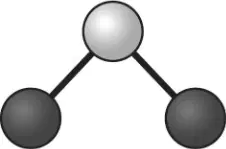
Which elements make up a water molecule?
Oxygen and Hydrogen
Carbon and Hydrogen
Sodium and Chlorine
Oxygen and Carbon
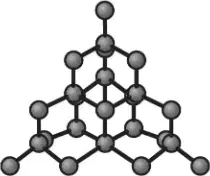
Which substance is made up of carbon atoms?
Water
Diamond
Table salt
Liquid water
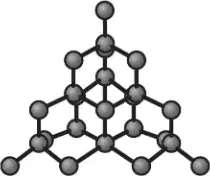
Fill in the blank: The observable property of diamond is _________?
hard, clear, fixed shape
soft, opaque, liquid
brittle, colored, flexible
dull, rough, amorphous
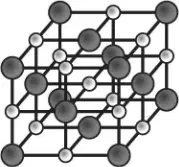
Which substance dissolves in water?
Diamond
Table salt
Water
Oxygen

Liquid water flows and takes the container’s shape.
True
False
Liquid water and table salt both contain oxygen or chloride atoms that can form bonds. Which statement best explains why liquid water flows easily while table salt maintains a rigid crystal shape?
Individual salt molecules do not have a uniform composition, and liquid water molecules have a uniform composition.
Individual liquid water molecules can move freely past each other, while salt atoms bond together in an extended crystal structure that stays rigid.
Individual liquid water molecules are made of crystals that move freely, and salt atoms are made of molecules that are in no fixed arrangement.
Individual salt molecules have a single, solid bond, while liquid water atoms bond together in an extended structure that helps them move freely.

Observe the structure and properties of diamond. Which of the following explains why diamond is a hard solid based on its structure?
The carbon atoms are far apart from each other.
The carbon atoms are locked together in a repeating pattern.
The carbon atoms form individual molecules.
The carbon atoms move freely past each other.
Identify the description as a structural feature of the water models or a structural feature of the table salt and diamond models. Write W for water models or T for table salt and diamond models. __________ Shows molecules that can separate from each other
W
T
Both W and T
Neither W nor T
Identify the description as a structural feature of the water models or a structural feature of the table salt and diamond models. Write W for water models or T for table salt and diamond models.
__________ Shows many atoms connected in an extended network
T
W
Neither
Both
Identify the description as a structural feature of the water models or a structural feature of the table salt and diamond models. Write W for water models or T for table salt and diamond models. __________ Shows two to three atoms joined as one unit
W
T
D
S
Identify the description as a structural feature of the water models or a structural feature of the table salt and diamond models. Write W for water models or T for table salt and diamond models. __________ Shows the same atomic pattern repeated over and over
T
W
S
D
Identify the description as a structural feature of the water models or a structural feature of the table salt and diamond models. Write W for water models or T for table salt and diamond models. __________ Shows one continuous pattern of atoms
T
W
Both W and T
Neither W nor T
Identify the description as a structural feature of the water models or a structural feature of the table salt and diamond models. Write W for water models or T for table salt and diamond models. .......Shows individual molecular units
W
T
Both W and T
Neither W nor T
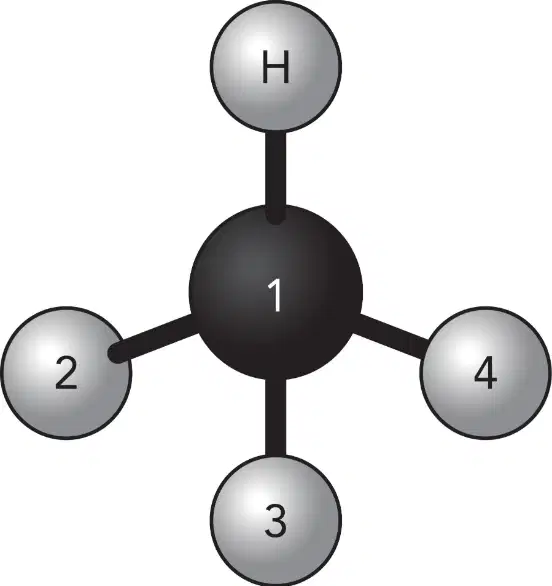
A class is studying how atoms combine to form different fuels. Information about methane, the main component of natural gas, is shown. The model shows an incomplete ball-and-stick model of a methane molecule. Next to each numbered location, write the correct atom (C or H) to complete the model. Which of the following correctly completes the model?
1. C 2. H 3. H 4. H
1. H 2. C 3. H 4. H
1. H 2. H 3. C 4. H
1. H 2. H 3. H 4. C
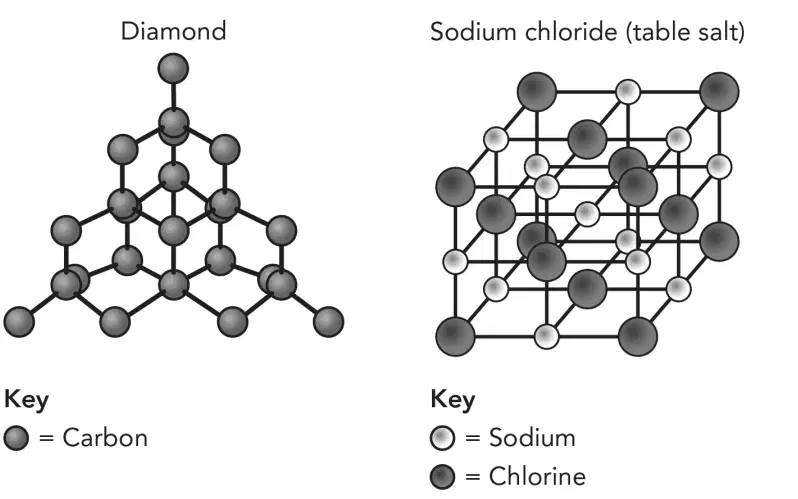
Based on the models, what can you conclude about the structures of diamond and sodium chloride?
Diamond and sodium chloride both have extended structures because their atoms are arranged in a nonuniform, random pattern.
Diamond and sodium chloride are both molecules because they each have two atoms that are connected by a single bond.
Diamond and sodium chloride both have extended structures because their atoms are arranged in a highly ordered, repeating pattern.
Diamond and sodium chloride are both molecules because they each have three atoms that are connected by a single bond.
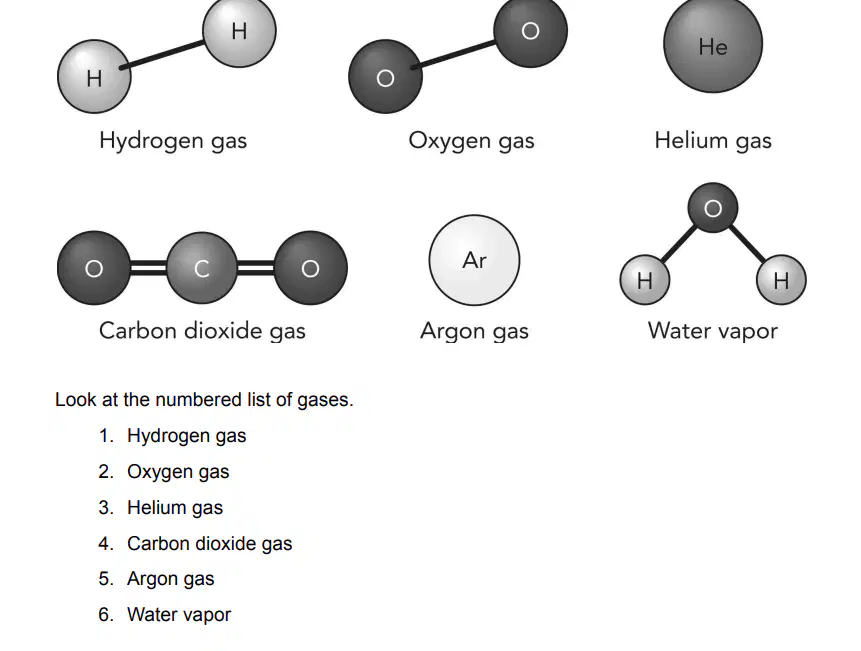
Based on the image, which gases from the list have the same type of atoms joined together?
1 and 2
3 and 4
3 and 5
4 and 6
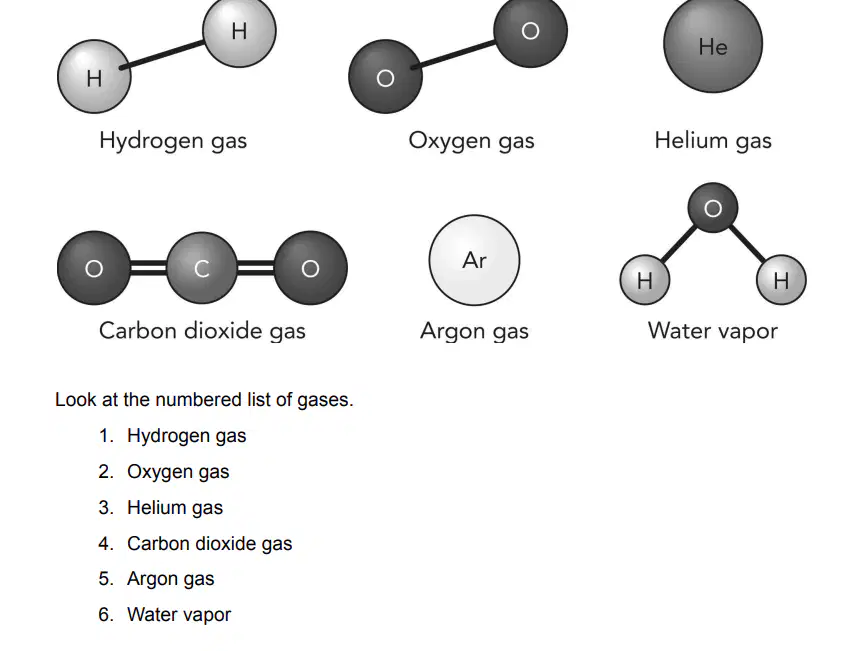
Based on the image, which gases from the list have individual atoms not joined together?
1 and 2
3 and 4
3 and 5
4 and 6
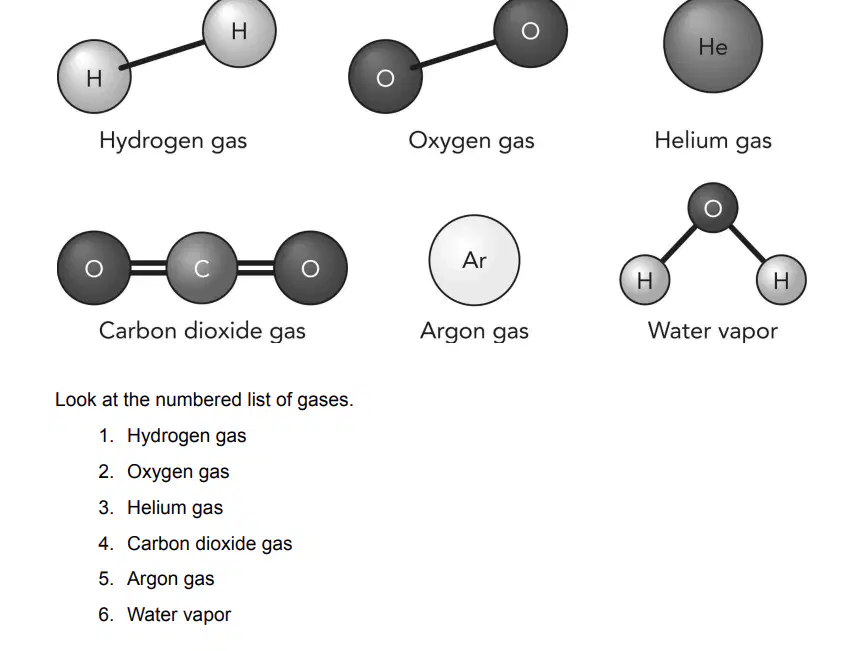
Based on the image, which gases from the list have the different types of atoms joined together?
1 and 2
3 and 4
3 and 5
4 and 6


One of the fundamental states of matter with a definite volume but no definite shape.
Solid
Gas
Liquid
Mass

