
NEW
Font size
 Worksheets
Gear & Ratio understanding
Total questions: 32
Worksheet time: 16mins
Gears are essential to the operation of any vehicle. Where are gears primarily found on a vehicle?
In the wheels
In the engine, transmission, and drive axle
In the seats
In the exhaust system
What is the basic function of a gear?
To transfer torque and motion from a rotational input to a rotational output.
To convert electrical energy into mechanical energy.
To store energy for later use.
To measure the speed of rotation.
Gears can be used to gain mechanical advantage to either increase output power, increase output speed, or simply to transfer torque and motion unchanged.
True
False
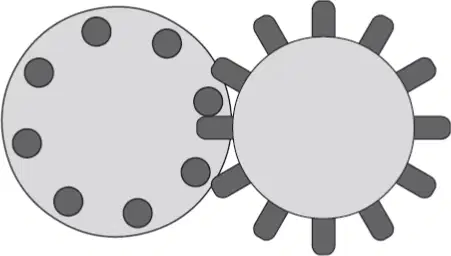
In wooden peg gears, how are the pegs installed on one wheel of wood?
Parallel to its axis
Perpendicular to its axis
At an angle to its axis
Randomly
The intermeshed pegs of the driving wheel caused the driven wheel to turn. Motion could be transferred in this way.
True
False
In medium- and heavy-duty vehicles, gears are typically made from ______ or cast ductile iron.
steel
aluminum
plastic
copper
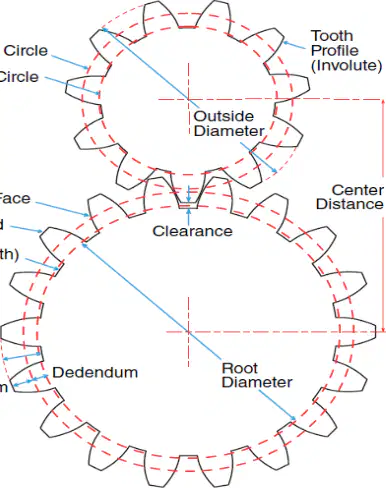
What is the term for the distance from the base of one gear tooth to the base of the opposite tooth?
Whole Depth
Pitch Circle
Addendum
Dedendum
The upper portion of the tooth contact area is called the ________ and the lower portion of the contact area is called the dedendum.
addendum
pendulum
modulus
spectrum
The root diameter of a gear is the smallest circle of the gear measured at the ________ radius, or root, of the teeth.
fillet
pitch
addendum
dedendum
The pitch circle is the theoretical point where the sliding motion coming into mesh stops and only ________ motion exists.
rolling
vibrating
oscillating
translating
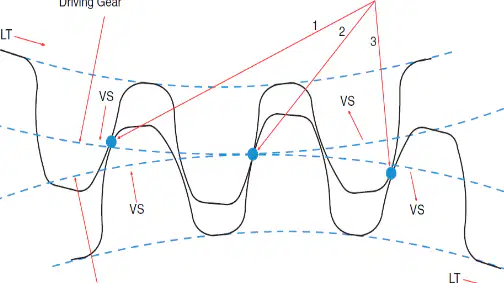
Modern gears are designed with a special tooth shape called an involute. What is the main function of the involute shape in gear design?
To make the gear lighter
To compensate for the changing point of contact between the gears as they rotate through mesh
To reduce the number of teeth
To increase friction
On an involute tooth, the dedendum (the lower part of the tooth) is _______ than the addendum (the upper part of the tooth).
thicker
thinner
shorter
longer

What do the blue dots represent?
Pitch diameters
Reference points of contact
Addendum points
Dedendum points
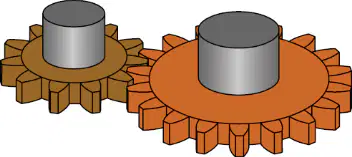
When two external toothed gears are in mesh with each other, what happens to the direction of the driven gear compared to the drive gear?
It turns in the same direction
It turns in the opposite direction
It stops moving
It turns faster
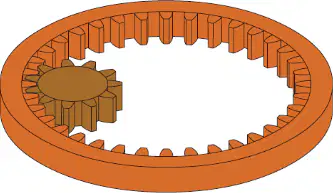
When a gear with external teeth is in mesh with a ring or internal gear, what happens to the direction of the driven gear compared to the drive gear?
It rotates in the same direction
It rotates in the opposite direction
It stops moving
It rotates slower
What is backlash in gears? Backlash is the clearance between the ______ of gears in mesh.
teeth
shafts
bearings
housings
Why is backlash important in gears?
It prevents gears from rotating
It allows for a thin layer of lubricant and for expansion of gears due to heat
It increases friction between gears
It reduces the strength of gears
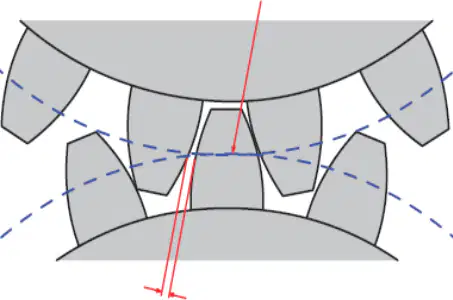
What does the term 'Backlash' refer to in the diagram?
The pitch circles
The clearance between the teeth of gears in mesh
The thickness of the gear
The diameter of the gear
What is a lever? Fill in the blank:
A lever is a simple machine that allows a larger object to be moved with less force or something to be moved a greater distance than the input distance.
A lever is a complex machine that increases the weight of an object.
A lever is a device used to measure temperature.
A lever is a tool that only works with liquids.
Only when two or more circular levers or gears are used together can we gain ________.
mechanical advantage
electrical energy
thermal expansion
chemical reaction
Gears of the same diameters can be used to transfer ________ and ________ unchanged.
speed, torque
power, direction
force, energy
motion, friction
What is the relationship between the sizing of gears called?
Gear ratio
Torque
Speed
Power
In the example provided, the two gears have a gear ratio of 2:1. How many turns of the driving gear equal one turn of the driven gear?
Two turns of the driving gear equal one turn of the driven gear.
One turn of the driving gear equals two turns of the driven gear.
Three turns of the driving gear equal one turn of the driven gear.
Half a turn of the driving gear equals one turn of the driven gear.
The ratio is always compared to one revolution of the driven gear. Therefore, the two revolutions of the driving gear becomes a ratio of two to one and is expressed as:
1:2
2:1
1:1
2:2
Steps to calculate gear ratio: What should you do after multiplying the number of teeth on each of the driven gears together?
A) Divide the product by the number of idler gears
B) Multiply the number of teeth on each of the drive gears together
C) Add the number of teeth on all gears
D) Subtract the number of drive gears from the driven gears
Steps to calculate gear ratio: Idler gears do not need to be included when calculating gear ratios because they cancel themselves out in the calculation.
True
False
Which of the following is a characteristic of spur gears?
They are complex and expensive to manufacture
They produce axial thrust during operation
They are simpler and less expensive to manufacture
Their teeth are cut at an angle to the axis of rotation
Spur gears do not produce any axial thrust when they are in operation.
True
False
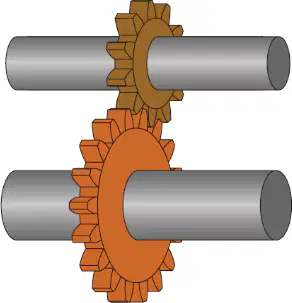
Which type of gear is shown in the diagram?
Spur gear
Bevel gear
Worm gear
Helical gear
Which type of gears have teeth that are cut at an angle to their axis of rotation?
Spur gears
Helical gears
Bevel gears
Worm gears
Helical gears are much _______ in operation than spur gears.
quieter
noisier
slower
weaker
Helical gears are manufactured with either a _______ helix or a _______ helix.
left-hand, right-hand
top-hand, bottom-hand
front-hand, back-hand
up-hand, down-hand

