
 Worksheets
Chapter 1: Business Manager Roles and Theories
Total questions: 114
Worksheet time: 1hrs 5mins
"The business manager carries out activities to establish a close relationship between the enterprise and state agencies". What is the role of the business manager?
The role of spokesperson
The role of operator/controller
The role of liaison
The role of disseminating information
Which title corresponds to a senior manager?
Chief Financial Officer (CFO)
Human Resources Manager
Project Manager
Chief Executive Officer (CEO)
Which role is NOT a role of information for business administrators?
The role of monitor
The role of disseminating information
The role of negotiator
The role of spokesperson
"Managers must regularly collect, receive and process information related to the organization and its activities." What is the role of business managers?
The role of monitor
The role of disseminating information
The role of negotiator
The role of spokesperson
Which statement is NOT CORRECT about the functions of business administration?
Managers at all levels engage all management functions.
Top-level managers spend most of their time planning and organizing.
Lower-level managers spend most of their time leading and controlling subordinates.
The functions of business administration are closely related and the coordination of time and effort at all management levels is equivalent
Which role is NOT a role related to the human aspect of corporate management?
Spokesperson role
Figurehead role
Leadership role
Liaison role
"The manager, on behalf of the company, provides official information to departments within and outside the company." What is the role of a corporate manager?
Monitor role
Figurehead role
Liaison role
Spokesperson role
Which management theory emphasizes the role of human psychological, emotional, and social relationships in work?
Contingency management theory
Classical scientific management theory
Administrative management theory
Behavioral management theory
Complete the statement about technical skills in business management: "Technical skills..."
...are related to the ability to organize, motivate, and control personnel.
...require the ability to analyze the relationships between departments and issues.
...are very important skills for senior managers.
...are usually formed from learning, training, and accumulating experience.
Choose the statements that are appropriate to the essence of business management:
All 4 statements
2 and 4
1, 3 and 4
1 and 3
Fill in the blank regarding the functions of business management: "... is the process of identifying the objectives of the enterprise and proposing the best solutions to achieve those objectives."
Leading
Planning
Organization
Controlling
Which scientist represents the typical view of the administrative management theory?
Mary Parker Follett
Douglas McGregor
Henry Fayol
Frederick W. Taylor
"The manager can act on behalf of the company to sign economic contracts with external agencies." What is the role of a corporate manager?
Figurehead role
Negotiator role
Liaison role
Leadership role
Which role is NOT a decision-making role of a corporate manager?
Figurehead role
Entrepreneur role
Monitor role
Negotiator role
Match the names of the activities in the organizing function (1,2,3) with the main content of those activities (a,b,c):
1-a, 2-b, 3-c
1-b, 2-a, 3-c
1-c, 2-b, 3-a
1-b, 2-c, 3-a
"To become a manager, one must have a professional aptitude, a desire to make money, a passion for the profession, and a professional conscience." What characteristic of business management does this reflect?
Business management is an art
Business management is a profession
Business management is a scientific discipline
Which management theory requires consideration of all inputs, production processes, and outputs in factors?
Classical scientific management theory
The open - systems view
Quantitative management theory
Process management theory
What is the main viewpoint of which management theory? "...study the relationship between individual workers and machines in factories,...to improve efficiency and reduce waste."
The open - systems view
Behavioral management theory
"To become a manager, one must learn, be trained in the profession, such as knowledge, skills, experience..." What characteristic of business management does this reflect?
Business management is an art
Business management is a profession
Business management is a scientific discipline
Fill in the blank regarding the necessary management skills: "...is the ability to provide the right policy direction to deal effectively with uncertainties from the business environment for the development of the enterprise."
Conceptual skills
Technical skills
Interpersonal skills
Fill in the blank with the necessary management skills: "...is a special ability of a manager in dealing with others to create favorable conditions and promote the completion of common work."
Conceptual skills
Technical skills
Interpersonal skills
"The manager establishes and initiates new improvement projects in the production and business organization to bring higher economic efficiency to the enterprise." What is the role of a corporate manager?
Leadership role
Entrepreneur role
Resource allocator role
Monitor role
"Business administration requires managers to apply modern quantitative measurement methods, scientific and technical achievements such as forecasting methods, processing tools, storage, and communication." reflects what characteristic of business managers?
Business administration is a profession.
Business administration is scientific.
Business administration is an art.
What characteristic of business administration reflects the diversity and variety of objects and phenomena in economics, business, and management
Business administration is an art.
Business administration is a profession.
Business administration is scientific.
"The law of management relationships in the operation of the enterprise includes laws on economic, business, technical, and social aspects reflecting what characteristic of business administration?"
Business administration is scientific.
Business administration is a profession.
Business administration is an art.
Which statement is NOT correct about necessary management skills?
Managers at lower levels focus more on technical skills than higher-level managers.
The level of each skill depends on the managerial level, responsibilities, and role.
Higher-level managers require more emphasis on critical thinking skills.
Managers do not necessarily need to have all three types of technical, interpersonal, conceptual skills.
What is the main view of which business management theory? "In different situations, different management methods must be applied, and management methods must be suitable for important variables."
Behavioral management theory
The open – systems view
Contingency management theory
Quantitative management theory
What is the main view of which business management theory? "... Study the relationships between individual workers and machines in the factory,... to improve productivity and cut waste."
The open – systems view
Behavioral management theory
Administrative management theory
Classical scientific management theory
Fill in the blank about the necessary management skills: "...is the necessary ability to perform a specific job, demonstrating the professional expertise of the manager."
Technical skills
Conceptual skills
Interpersonal skills
The law of management relationships in the operation of the enterprise includes laws on economic, business, technical, and social aspects reflecting what characteristic of business administration?
Business administration is scientific.
Business administration is an art.
Business administration is a profession.
Which scientist is NOT a typical representative of classical scientific management theory?
Henry L. Gantt
Henry Fayol
Frank and Lilian Gilbreth
Frederick W. Taylor
Fill in the blank about the functions of business management: "... is the process of actively monitoring and overseeing activities to make them more effective, while detecting errors and deviations to take timely corrective measures to ensure that business activities are properly executed."
Planning
Organizing
Leading
Controlling
When comparing the achieved results with the costs of activities, what does it refer to in business management?
Effectiveness of activities
Conformity to laws and social customs of activities
Method of operating activities
Purpose of the enterprise
Which management theory focuses on developing general management principles for an entire organization and emphasizes compliance with rules and procedures?
Administrative management theory
System management theory
Behavioral management theory
Classical scientific management theory
Which statement is NOT correct about the requirements for managers to have interpersonal skills?
Need to understand human psychology
Need to understand the complexity of the environment
Effective communication is necessary
Must know how to recruit, arrange the right job, and use the ability of subordinates
Which statement is correct about the necessary management skills?
The importance of each skill depends on the level of each manager in the enterprise.
Higher-level managers require more emphasis on interpersonal skills than lower-level managers.
Managers do not necessarily need to have all three types of technical, human, and critical thinking skills.
Managers at lower levels focus more on conceptual skills than higher-level managers.
"The role of a business manager is to solve difficult problems, fluctuations, and disruptions in the enterprise." What is the role of a business manager?
The role of an entrepreneur
The role of a monitor
The role of resources allocator
The role of a leader
Fill in the blank about the functions of business management: "...is the purposeful process of the manager's impact on members in the enterprise so that they voluntarily and enthusiastically strive to complete assigned tasks well."
Controlling
Organization
Planning
Leading
"Starting from the essence of business administration, ultimately, it is the process of purposive influence of the business manager on the members in the enterprise so that they voluntarily and enthusiastically strive to complete assigned tasks well." What are the characteristics of a business administrator?
Business administration is a profession.
Business administration is an art.
Business administration is a science.
Match the correct explanation for the role of business administration: "Business administration activities help businesses determine what to produce, how much to produce, in what way, and for whom..."
...to take advantage of opportunities and limit negative impacts from the environment.
...to fully utilize the capabilities of all members, innovate and improve techniques to enhance the efficiency of business operations for the enterprise.
...because correctly identifying business tasks is one of the factors that lead to the success of the business.
...helping businesses continually reduce costs to contribute to the profitability of the business.
Choose the statement that is NOT true about the effectiveness of business administration activities
Not knowing how to manage can also achieve results, but it requires too much cost, leading to inefficiency.
Business activities in a competitive market economy must find ways to limit results and increase costs to help businesses enhance efficiency.
Efficiency is high when results achieved are more than the costs.
Efficiency is low when the results achieved are lower than the costs incurred
Which role does NOT belong to the interpersonal role of a business administrator?
The role of figurehead
The role of the leader
The role of spokesperson
The role of liaison
Match the levels of management in a company (1, 2, 3) with the job titles in the company (a, b, c).
1-a, 2-c, 3-b
1-c, 2-b, 3-a
1-c, 2-a, 3-b
1-b, 2-c, 3-a
Which business management theory emphasizes the use of mathematical models with computer support to make decisions about the optimal management strategy?
"Business management also depends on the individual qualities of the manager, such as innate talent, knowledge, experience, relationships, resources, and luck." What characteristic of business management does this statement reflect?
Business management is an art
Business management is a profession
Business management is a science
Which of the following theoretical business management approaches is not a "modern management trend"?
Innovative management
Process-based management
Quantitative management
Total quality management
"Managers must directly oversee and coordinate the activities of subordinates to achieve the organization's goals." What is the role of a business executive?
Liaison role
Figurehead role
Resource allocator
Leader role
What is the characteristic theory of X and Y theories of which school of business management theory?
Administrative management school
Perfect management theory
Contingency management school
Behavioral management school
Which business management theory focuses on studying the operations and use of workers' time?
System management school
Administrative management school
Behavioral management school
Classical scientific management school
Fill in the blank regarding the functions of business management: "...is the process of binding delegation and coordinating many people to work together to achieve the common goals of the enterprise."
Planning
Leading
Controlling
Organization
Which of the following is NOT correct regarding the requirements for a manager to have conceptual skills?
Need to have a systematic, synthesized thinking method
Understand the relationships between departments and issues
Effective communication must be known
Understand the complexity of the environment
What is the basis for classifying enterprises into financial and non-financial enterprises?
Form of capital ownership
Supply and demand of capital in the economy
Scale of enterprise
Main business objectives
Which types of enterprises below can have only one owner?
Private enterprise, partnership company
Private enterprise, partnership company, limited liability company
Private enterprise, limited liability company
Private enterprise, state-owned enterprise, limited liability company
Which types of enterprises below are only allowed to be individuals and not organizations?
Private enterprise
Private enterprise, partnership company
Private enterprise, single-member limited liability company, partnership company
Private enterprise, single-member limited liability company
Which subjects must be liable with all their assets for the obligations of the enterprise?
Owner of private enterprise, members of partnership company, owner of single-member limited liability company
Owner of private enterprise
Owner of private enterprise, capital-contributing members of partnership company
Owner of private enterprise, members of partnership company
In which types of enterprises below does the owner NOT bear responsibility for debts within the scope of capital contributed to the company?
Private enterprise, single-member limited liability company
Joint stock company
Private enterprise
Private enterprise, partnership company
Choose which types of enterprises have legal status in 5 types below: 1/ Private enterprise; 2/ Partnership company; 3/ Limited liability company with two or more members; 4/ Single-member limited liability company; 5/ Joint stock company.
(a)
Which type of enterprise does not limit the number of owners?
Single-member limited liability company
Limited liability company with two or more members
Joint stock company
Partnership company
Which type of enterprise must have at least 3 owners according to regulations?
Partnership Company
Single-member Limited Liability Company
Limited Liability Company with two or more members
Joint Stock Company
Which type of enterprise is not allowed to exceed 50 owners according to regulations?
Partnership company
Limited liability company with two or more members
Which type of enterprise is NOT allowed to issue any securities?
Private enterprise
Partnership company, single-member limited liability company
Private enterprise, partnership company, single-member limited liability company
Private enterprise, partnership company
Choose which types of enterprises are NOT allowed to issue shares:
1, 2, 3 and 4
3, 4 and 5
All 4 characteristics
1, 3 and 4
Choose which types of enterprises are allowed to issue bonds to raise capital:
1, 2, 3 and 4
3, 4 and 5
All 4 characteristics
1, 3 and 4
Choose the characteristics of departments and units in the organizational structure of enterprise management:
All 4 characteristics
1, 3 and 4
1, 2, 3 and 4
3, 4 and 5
Which characteristics below are characteristics of departments and units in the organizational structure of enterprise management:
1, 3 and 4
All 4 characteristics
1, 2, 3 and 4
3, 4 and 5
Which statement below is NOT correct about the impact of factors on the organizational structure of enterprise management?
Which statement below is NOT correct about the impact of factors on the organizational structure of enterprise management?
The larger the scale of the enterprise, the more locations it is located in, the more complex the production structure, the more levels and units the organizational structure will include compared to small-scale enterprises.
Enterprise strategies are built and selected based on an analysis of strengths and weaknesses in internal environment including current organizational structure of enterprise management
The organizational structure of enterprise management is only affected by internal environmental factors within specific circumstances.
The organizational structure of enterprise management must be suitable for production technology and management technology of enterprises.
Which statement below is NOT correct about the impact of factors on the organizational structure of enterprise management?
Enterprises must build and choose a suitable organizational structure to effectively implement strategic objectives
The larger the scale of the enterprise, the more locations it is located in, the more complex its production structure, then its organizational structure will include more levels and units than small-scale enterprises.
Enterprise strategies are built and selected based on an analysis of strengths and weaknesses in internal environment including current organizational structure of enterprise management
When business environment is diverse, inconsistent and constantly changing, enterprises need to build and apply a rigid centralized power model.
Which statement below is NOT correct about impact factors on organizational structure in business administration?
The larger scale an enterprise has, the more locations it has, the more complex its production structure, the more levels and units its organization will have compared to small-scale enterprises.
The higher level managers have, the fewer levels and units in business administration organization.
Enterprise strategies are built and selected based on an analysis of strengths and weaknesses in internal environment including current organizational structure of enterprise management
The organizational structure of enterprise management must be suitable for production technology and management technology of enterprises.
Which factor below is NOT a factor that affects the organizational structure of enterprise management?
External environment
Development level of technology
Enterprise strategy
Attitude and perspective of the media.
Choose the characteristics of a simple organizational structure:
1, 3, and 4.
All 4 characteristics
1, 2, 3 and 4
3, 4 and 5
Choose the characteristics of a simple organizational structure:
All 4 characteristics
1, 3 and 4
1, 2, 3 and 4
3, 4 and 5
“In departments, people with similar expertise and similar fields will work in the same unit,” which form of organizational structure in enterprise management is this?
“According to this type of structure, all activities related to production and business of a product in an area are concentrated in one unit,” which form of organizational structure in enterprise management is this?
Product structure
Structure by geographic region
Matrix structure
Client structure
Which form of organizational structure in enterprise management is based on the process of producing each type of product with different steps, requirements and characteristics?
Functional structure
Product structure
Client structure
Structure by geographic region
Choose the characteristics of a matrix organizational structure: 1/ Creates overlapping authority, leading to dual authority; 2/ Often applied to enterprises that must adapt to rapid changes in the business environment; 3/ Maximizes strengths and minimizes weaknesses of functional structures, structures by product, customer and geographic region; 4/ Has relatively high flexibility.
All 4 characteristics
1, 2 and 3
1 and 4
2, 3 and 4
Choose the advantages of a functional structure: 1/ Promotes the expertise of experts and specialists; 2/ Employees have the ability to understand expertise at all stages of production and consumption of products; 3/ Creates good conditions for specialization of activities; 4/ Clearly divides tasks according to individual training.
1, 3, and 4
1 and 2
2, 3, and 4
All 4
Which characteristic is NOT a characteristic of a product-based structure?
Departments may have to accept cumbersome machinery, redundant staff due to overlapping functional departments in different departments
Applied to large-scale enterprises operating in many different fields and industries producing many types of products
Can create for employees the ability to understand expertise at all stages, the stages of creating and consuming a product
Creates good conditions for specialization activities.
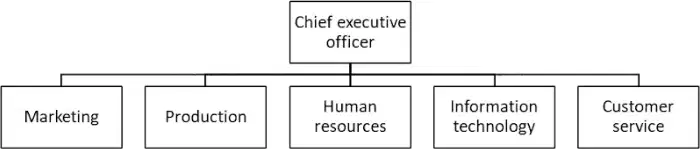
Which form of organizational structure in management does the diagram below fit?
Client structure
Functional structure
Structure by geographic region
Product structure
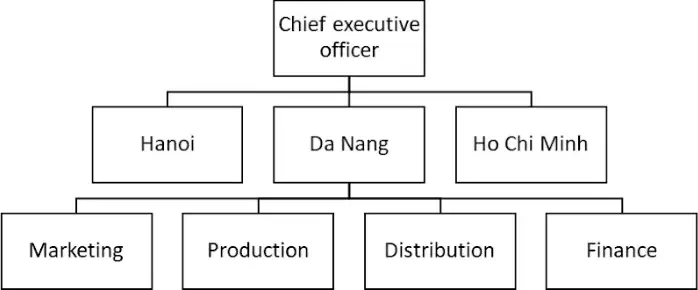
Which form of organizational structure in management does the diagram below fit?
Matrix structure
Structure by geographic region
Client structure
Product structure
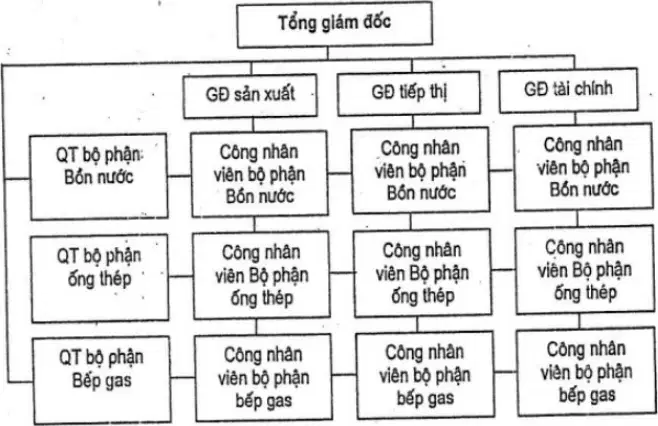
Which form of organizational structure in management does the diagram below fit?
Functional structure
Matrix structure
Product structure
Structure by geographic region
Fill in the blank: "... is a set of internal and external factors of an enterprise that affect the ability to survive and develop of the enterprise."
Macro business environment of the enterprise
Business environment of the enterprise
Internal environment of the enterprise
Specific business environment of the enterprise
Fill in the blank: "... includes factors outside the enterprise, affecting a wide range and long-term impact on all activities of the enterprise."
Macro business environment of the enterprise
Internal environment of the enterprise
Business environment of the enterprise
Specific business environment of the enterprise
Fill in the blank: "... includes factors in the industry directly related to achieving the goals of the enterprise."
Internal environment of the enterprise
Business environment of the enterprise
Specific business environment of the enterprise
Macro business environment of the enterprise
Which statement is NOT correct about characteristics of business environment?
Business environment and its constituent factors form an open system
Business environment has a holistic nature including many constituent factors, factors have relatively independent relationships with each other.
Business environment exists objectively, beyond subjective will of enterprises
Business environment and its constituent entities are always moving and changing
Choose appropriate statements about characteristics of business environment: 1) When one factor in business environment changes, it can lead to one or several other factors in system changing accordingly; 2) Factors in business environment are affected by larger business environments such as national and international business environments; 3) Movement of factors in business environment is influenced and governed by objective laws in economy; 4) All enterprises exist in a certain business environment.
All 4 statements
Only statements 1 and 2
Only statements 2 and 3
Only statements 3 and 4
Only statements 1, 3 and 4
Choose appropriate action to fill in blank: "To control and cope with arising issues from business environment, enterprise managers need to .... business environment."
Analyze, evaluate and forecast.
Evaluate
Forecast
Analyze
Macro business environment is also called...
Specific business environment
External environment
Internal environment
Client environment
“Growth rate and stability of economy; purchasing power; stability of prices, currency, inflation, interest rates; exchange rates,… belong to which business environment below?
Technological Environment
Political and Legal Environment
Cultural and Social Environment
Economic Environment
Government factors, role and perspective of Government, legal system, political trends,… belong to which business environment below?
Technological Environment
Economic Environment
Political and Legal Environment
Cultural and Social Environment
Behavior, hobbies, customs, traditional culture, taste, social trends,… belong to which business environment below?
Political and Legal Environment
Technological Environment
Economic Environment
Cultural and Social Environment
The main factors when analyzing the economic environment include:
Government, role and perspective of Government, legal system, political trends,…
Natural resources, natural events and phenomena
Behavior, habits, customs, traditional culture, taste, social trends,…
Growth rate and stability of the economy; purchasing power; stability of prices, currency, inflation, interest rates; exchange rates,…
The main factors when analyzing the cultural environment include:
Growth rate and stability of the economy; purchasing power; stability of prices, currency, inflation, interest rates; exchange rates,…
Behavior, habits, customs, traditional culture, taste, social trends,…
Government, role and perspective of Government, legal system, political trends,…
Natural resources, natural events and phenomena
The main factors when analyzing the political and legal environment include:
Growth rate and stability of the economy; purchasing power; stability of prices, currency, inflation, interest rates; exchange rates,…
Natural resources, natural events and phenomena
Government, role and perspective of Government, legal system, political trends…
Behavior, habits, customs, traditional culture, taste, social trends,…
The main factors when analyzing the natural environment include:
Growth rate and stability of the economy; purchasing power; stability of prices, currency, inflation, interest rates; exchange rates,…
Government role and perspective of Government legal system political trends…
Behavior habits customs traditional culture taste social trends…
Natural resources natural events and phenomena
Specific business environment is also called…
Sector environment
Macro business environment
Internal enterprise environment
General business environment
Which group of customers are consumers usually interested in?
Price quality product design color product accompanying services…
Discount rate payment method shipping method…
Price quality product payment method product differentiation enterprise reputation
Price discount rate product design color payment method…
Discount rate payment method shipping method… are concerns of which customer group below:
All options
Consumers
Organizations buying products from enterprises
Distributors
Pressure from suppliers on enterprises will increase if:
Input factor is less important to buying enterprise
Input factor of enterprise is difficult to replace.
Buying enterprise input factor is important customer to supplier
There are many suppliers for input factor of enterprise
Competition between enterprises in industry is often affected by factors:
Competitive structure of industry capital demand and economies of scale
Competitive structure of industry cost disadvantage and product differentiation
Competitive structure of industry level of demand and barriers to exit industry
Competitive structure of industry product differentiation and economies of scale
Fill in blank about sector business environment factor: “… are current enterprises not yet competing in industry but capable and will join industry.”
Existing competitors
Suppliers
Substitute products
Potential competitors
Fill in blank about sector business environment factor: “… includes all enterprises operating in same business sector and same market area as enterprise.”
Potential competitors
Substitute products
Barriers to potential competitors to enter a new industry include:
Economies of scale, cost disadvantages, product differentiation, capital requirements, distribution channels of current enterprises, switching costs and government policies
Economies of scale, cost disadvantages, product differentiation, machinery and equipment difficult to use in other industries, high direct exit costs
Machinery and equipment difficult to use in other industries, high direct exit costs, rapid bonding with local community, strategic relationships between business units
Machinery and equipment difficult to use in other industries, high direct exit costs, economies of scale, product differentiation
An enterprise being able to reduce costs if it increases production quantity will reflect:
The production efficiency of that enterprise
The economies of scale of that enterprise
The cost disadvantage of that enterprise
The switching cost of that enterprise
Choose appropriate statements about substitute products: 1/Development of science and technology is basis for substitute products to be born; 2/Substitute products often have superior advantages in distinct characteristics; 3/The more developed the economy, the more it limits the emergence of substitute products; 4/Need to analyze scientific and technological progress to reduce pressure from substitute products.
1, 2 and 4
1 and 3
2 and 3
1, 2, 3 and 4
"The handling of decision situations requires skillful adaptation to changing environments, avoiding stereotypes and machinery." Is this a requirement for business management decision-making?
Objective and evidence – based
Consistent
Concise and understandable nature
Flexibility
"The decisions issued at different times should not contradict, oppose or negate each other." What is the requirement for business management decision-making?
Flexibility
Objective and evidence – based
Consistency
Legal
"The final decision does not come from the highest benefit of the enterprise, but from compromise, negotiation to balance the interests of all parties." Which factor hinders the effectiveness of business management decision-making?
Decision-makers mistake the problem with the solution
Conservatism
The personal cognitive bias that distorts the issue will be identified
Compromise of interests
"Successes or failures in the past are considered as the basis for future actions" are what subjective factors influencing the business management decision-making process?
Creativity
Judgment
Quantitative ability
Experience
Which of the following is NOT a disadvantage of the group decision-making method?
More time-consuming compared to individual decision-making
Easily influenced by one or several individuals in the advisory board or research group
Does not ensure the democratic nature of the organization
Unclear decision-making responsibility
The mathematical quantitative method has effective effects on the process of making planning decisions because:
There is a certain distance between practicing managers and professional mathematicians
Applying mathematical models helps people make quantitatively clear grounds in analysis and decision-making method selection
Mathematical ability may allow building models that are accurate with reality
Most important management decision-making factors are still uncertain
Which of the following factors is NOT the cause of the information shortage that hinders the effectiveness of business management decision-making?
The process of searching for high-quality information does not take much time and money
The amount of information collected does not ensure accuracy
Many managers tend to only look for readily available information rather than focusing on their quality
The information processing ability of each individual is limited
"... not making decisions arbitrarily, detached from reality". What is the requirement for business management decision-making?
Objectivity and evidence – based
Optimization
Legality
Systematic (unification)
"Decisions made by individuals or the collective must not contradict the law." Is that a requirement for business management decisions?
Objectivity and evidence – based
Consistency
Legality
Flexibility

