
 Worksheets
Quiz on Learning Module
Total questions: 74
Worksheet time: 37mins
Who is the author of the learning module titled "Pengelolaan Surat" for MA Darussalam?
Rizki Tania Putri, S.A.P
MA Darussalam
Konsentrasi Manajemen Perkantoran
Fase F
Apa fokus utama dari modul pembelajaran yang ditunjukkan dalam gambar?
Pengelolaan Surat
Manajemen Keuangan
Manajemen Sumber Daya Manusia
Strategi Pemasaran
Which educational institution is associated with the module "Konsentrasi Manajemen Perkantoran"?
MA Darussalam
Rizki Tania Putri, S.A.P
Fase F
Pengelolaan Surat

Berdasarkan gambar, apa tujuan kemungkinan dari objek yang ditunjukkan dalam diagram?
Mengorganisir dan menyimpan dokumen kantor
Menampilkan buku untuk dijual
Menyimpan barang makanan
Menampung peralatan olahraga
Who is the author of the module "Pengelolaan Surat"?
Rizki Tania Putri, S.A.P
MA Darussalam
Manajemen Perkantoran
Kelas XI
What is the main subject of the module described in the document?
Konsentrasi Keahlian
Pengelolaan Surat
Penanganan Surat
Perjalanan Dinas
At the end of the learning phase, what are students expected to understand regarding correspondence?
Only English correspondence
Only Indonesian correspondence
Both Indonesian and English correspondence at a basic level
Advanced correspondence in both languages
Which of the following is NOT listed as a learning objective for "Perjalanan Dinas"?
Understanding business traveling arrangement
Understanding daily agenda management
Understanding document handling for official trips
Understanding financial management
If a student is tasked with handling incoming and outgoing letters, which module element are they applying?
Korespondensi
Penanganan Surat
Perjalanan Dinas
Daily Agenda
Suppose you are planning a business trip for your supervisor, including accommodation and transportation. Which learning objective does this activity fulfill?
Understanding general administration management
Understanding correspondence in English
Understanding business traveling arrangement
Handling incoming and outgoing mail
A student is asked to create a daily agenda for a manager. Which skill are they demonstrating according to the module?
Handling correspondence
Managing incoming and outgoing mail
Managing the leader’s schedule (daily agenda)
Arranging business travel
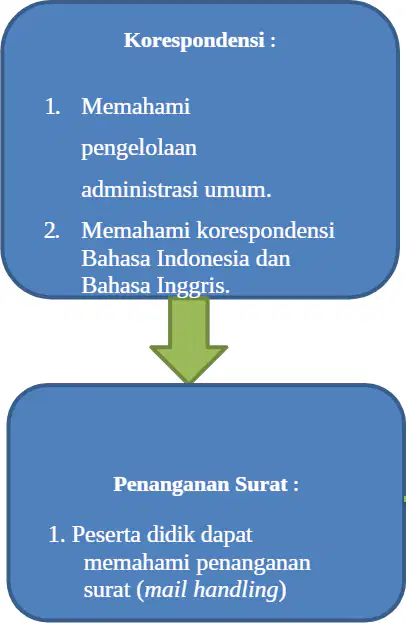
Which of the following is a key objective in the "Korespondensi" (Correspondence) unit?
Understanding general administration management
Managing daily agenda for leaders
Handling business travel documents
Arranging transportation for business trips
What skill should students develop in the "Penanganan Surat" (Mail Handling) section?
Understanding mail handling
Arranging business travel
Managing correspondence in English
Scheduling daily activities
In the "Perjalanan Dinas" (Business Travel) unit, which of the following is an important concept students should understand?
Business travelling arrangement
General administration management
Mail handling procedures
Indonesian correspondence
Why is it important for students to understand both Bahasa Indonesia and English correspondence in the context of administrative management?
It enables effective communication in both local and international contexts.
It helps in scheduling daily agendas for leaders.
It is necessary for handling mail only.
It is only required for business travel arrangements.
How does understanding the management of a leader's daily agenda contribute to effective business travel arrangements?
It ensures that travel plans align with the leader’s schedule and responsibilities.
It helps in learning general administration management.
It is unrelated to business travel arrangements.
It only applies to mail handling procedures.
What is the main learning objective mentioned in the document?
Understanding mail handling
Learning mathematics
Studying history
Practicing sports
According to the criteria for achieving the learning objective, what should students be able to do regarding incoming and outgoing mail?
Understand and manage incoming and outgoing mail
Ignore incoming mail
Only send outgoing mail
Only receive incoming mail
Which of the following is NOT listed as a dimension of Pancasila students in the document?
Honest
Mandiri
Barnalar Kritis
Kreatif
How might a student demonstrate the skill of "Barnalar Kritis" in the context of mail handling?
By critically analyzing the process of sorting and distributing mail
By ignoring the mail handling process
By memorizing the names of mail carriers
By sending mail without checking its contents
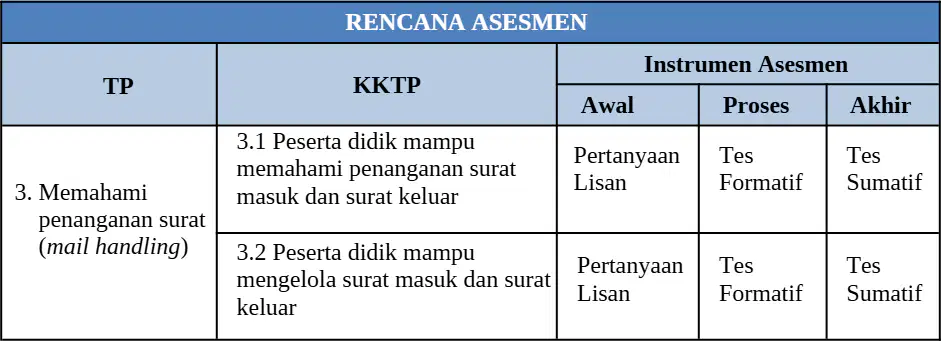
Which of the following best describes the main focus of 'Memahami penanganan surat (mail handling)' in the assessment plan?
Understanding and managing incoming and outgoing mail
Writing formal letters
Designing mail envelopes
Delivering packages
Which assessment instrument is used at the beginning (Awal) stage for evaluating students' understanding of mail handling?
Pertanyaan Lisan (Oral Questions)
Tes Formatif (Formative Test)
Tes Sumatif (Summative Test)
Written Assignment
At which stage of the assessment plan is the 'Tes Sumatif' (Summative Test) conducted for mail handling?
Akhir (End)
Awal (Beginning)
Proses (Process)
Middle
If a student is required to manage both incoming and outgoing mail, which competency (KKTP) are they demonstrating according to the assessment plan?
3.2 Peserta didik mampu mengelola surat masuk dan surat keluar
3.1 Peserta didik mampu memahami penanganan surat masuk dan surat keluar
2.1 Peserta didik mampu menulis surat resmi
4.1 Peserta didik mampu mengirim paket
Why is it important to use both formative and summative tests in the assessment of mail handling skills?
To evaluate both ongoing progress and final mastery of skills
To make the assessment longer
To confuse students
To avoid oral questioning
What is the main purpose of greeting and praying at the beginning of the learning activity?
To instill the habit of self-development in students.
To check the attendance of students.
To explain the topic of the lesson.
To distribute learning materials.
Which activity involves the teacher confirming the presence of students?
The teacher greets and prays with students.
The teacher confirms student attendance.
The teacher explains the topic and objectives.
The teacher writes the lesson title on the board.
What is the benefit of proper mail handling?
It ensures efficient and organized management of correspondence.
It increases the number of incoming mails.
It reduces the need for communication.
It eliminates the need for record keeping.
How can you distinguish between incoming and outgoing mail?
By identifying whether the mail is received or sent.
By checking the color of the envelope.
By looking at the sender's handwriting.
By counting the number of stamps.
What is the function of an agenda book for incoming and outgoing mail?
To record and organize all incoming and outgoing correspondence.
To decorate the office.
To send emails automatically.
To store unused envelopes.
Which step involves students identifying and sorting incoming and outgoing mail?
Students identify and sort incoming and outgoing mail.
Students greet and pray.
Students write the lesson title.
Students listen to the teacher's explanation.
Why does the teacher conduct an initial assessment about mail handling?
To determine students' prior knowledge and plan learning strategies.
To distribute agenda sheets.
To explain the topic.
To check attendance.
What is the teacher's role in explaining the use of the agenda book?
To explain how to fill in the agenda book for incoming and outgoing mail.
To collect the agenda book from students.
To send out all the mail.
To write the lesson title on the board.
Which of the following is NOT a criterion listed in the assessment sheet for agenda surat masuk dan keluar?
Ketepatan
Ketelitian
Kerapihan
Kreativitas
What is the purpose of the final assessment (asesmen akhir) conducted by the teacher in the process of filling out the agenda format for incoming and outgoing letters?
To evaluate students' ability to write essays
To assess the process of filling out the agenda for incoming and outgoing letters
To grade students' oral presentations
To test students' mathematical skills
Which of the following is a component found in the 'AGENDA SURAT MASUK' table?
Nama & Alamat Tujuan
Tanggal Pencatatan
Lampiran
Ketelitian
In the assessment sheet, what action is suggested for students who are not yet competent?
They are given extra homework
They are ignored until the next assessment
They are guided by the teacher or competent peers
They are asked to leave the class
If a student is filling out the 'AGENDA SURAT KELUAR' table, which of the following information would they NOT need to provide?
Tanggal Pengiriman
Nomor Surat
Kode Arsip
Nama & Alamat Tujuan
Which of the following best defines "surat masuk" in the context of mail handling?
A. Letters sent out by an organization to others
B. Letters received by an organization from others
C. Letters written by employees for personal use
D. Letters stored in the organization's archives
What is the first step in the procedure for handling incoming mail according to the agenda book system?
A. Sorting the mail
B. Distributing the mail
C. Receiving the mail
D. Archiving the mail
Which of the following is NOT a task of the mail receiver in the "Penerimaan surat" process?
A. Collecting and counting incoming mail
B. Checking the accuracy of addresses
C. Signing proof of receipt
D. Writing replies to the mail
When sorting incoming mail, what is the main criterion used for grouping the documents?
A. The color of the envelope
B. The sender's name
C. The destination address
D. The date of receipt
If a letter is classified as "surat dinas," what further categorization might it undergo before processing?
A. Urgent, confidential, or personal
B. Official, casual, or archived
C. Ordinary, important, or secret
D. Received, sent, or pending
Why is it important for the mail handler to stamp the agenda after recording the data of a letter?
A. To decorate the letter
B. To prove the letter has been officially read and registered
C. To indicate the letter is confidential
D. To show the letter is ready to be sent out
Imagine you are a mail handler and receive a letter with an unclear address. What should you do according to the procedures described?
A. Discard the letter immediately
B. Return the letter to the sender without checking
C. Do not sign the proof of receipt and clarify the address before accepting
D. Forward the letter to any available recipient
Which of the following best describes the function of a "lembar disposisi" in the process of handling incoming letters?
It is used to record all instructions and decisions from the leader regarding the next steps for the letter.
It is a form used to send letters to external parties.
It is a document for archiving letters only.
It is a receipt for letter delivery.
What is the main purpose of "Pengarahan Surat" in the management of incoming letters?
To determine who is responsible for processing the letter based on the issues raised in it.
To archive the letter for future reference.
To send the letter to external parties.
To approve the concept of the letter.
After the leader writes instructions on the "lembar disposisi," what is the next step in the distribution process?
The letter and disposition sheet are handed over to the designated personnel.
The letter is immediately archived.
The letter is sent to external parties.
The letter is destroyed.
Which book is used to document the distribution and delivery of letters within an organization?
Buku Ekspedisi Intern
Buku Ekspedisi Ekstern
Buku Agenda Surat
Buku Arsip Surat
What is the difference between Buku Ekspedisi Intern and Buku Ekspedisi Ekstern?
Buku Ekspedisi Intern is for internal documentation, while Buku Ekspedisi Ekstern is for external documentation.
Buku Ekspedisi Intern is for archiving, while Buku Ekspedisi Ekstern is for sending letters.
Buku Ekspedisi Intern is for outgoing letters, while Buku Ekspedisi Ekstern is for incoming letters.
Buku Ekspedisi Intern is for financial records, while Buku Ekspedisi Ekstern is for personnel records.
Which of the following is NOT a system used for archiving letters?
System of colors
System of subject
System of region
System of date
Arrange the following steps in the correct order for the procedure of handling outgoing letters according to the agenda book system: 1) Pencatatan surat, 2) Pengarsipan surat, 3) Penandatanganan dan stempel surat, 4) Pengiriman surat.
1, 3, 4, 2
1, 4, 3, 2
1, 2, 3, 4
1, 3, 2, 4
Why is the concept of a letter ("konsep surat") important in the process of creating outgoing letters?
It serves as the basis for preparing a more complete and formal outgoing letter.
It is used only for archiving purposes.
It is a receipt for letter delivery.
It is used to record the approval of the letter.
Which of the following is the correct sequence of steps for handling incoming letters in an organization, according to standard procedures?
Receive the letter, record instructions on the lembar disposisi, distribute to designated personnel, document in the appropriate expedition book, and archive using a suitable system.
Receive the letter, immediately archive it without any documentation.
Receive the letter, send it to external parties, and destroy the original.
Receive the letter, approve the concept, and send it without documentation.
To ensure proper distribution and documentation when a letter needs to be processed by more than one person, what should be done?
Make copies of the letter for each individual and ensure each receives a duplicate.
Only give the letter to one person and ignore others.
Archive the letter before distribution.
Send the letter to external parties without documentation.
Which of the following is the main function of a "buku agenda surat keluar" (outgoing mail agenda book)?
To record incoming mail only
To list outgoing mail and facilitate future searches
To store confidential company documents
To manage employee attendance
What is the purpose of the "penandatanganan surat dan stempel" (signing and stamping of a letter)?
To decorate the letter
To confirm approval and show official identity
To make the letter look formal only
To indicate the recipient of the letter
After a letter is typed and signed, what is the next step in the process according to the document?
Archiving the letter
Sending the letter to the intended recipient
Destroying the letter
Translating the letter
Why is it important to have a good filing system for letters in an organization?
To make the office look organized
To facilitate searching and accessing information when needed
To increase the number of letters sent
To reduce the cost of postage
Which type of agenda book is described as practical because all information can be found in one place?
Buku agenda berpasangan
Buku agenda kembar
Buku agenda tunggal
Buku agenda harian
In the process of handling outgoing mail, why must the typing of the letter be done carefully and accurately?
To avoid mistakes that can affect the content and meaning of the letter
To make the letter look beautiful
To impress the recipient
To reduce the cost of printing
Suppose an organization receives and sends a large volume of mail daily. Which agenda book system would best help them efficiently track both incoming and outgoing mail in one place?
Buku agenda tunggal
Buku agenda berpasangan
Buku agenda kembar
Buku agenda harian
The activity of collecting, counting incoming mail, checking the accuracy of the address, and signing the receipt that the mail has been received is called
Acceptance
Sorting
Recording
Scheduling
Direction
After the letter is recorded, stamped, and the accuracy of the type or number of attachments that must be received is checked, the next step is …
Sorting
Recording
Direction
Delivery
Storage
After the letter is received from the receptionist, the letter is then separated based on the intended address. If the letter is an official letter, it is separated into the category of ordinary, important, or confidential official letters for further processing. This activity is included in the activity of …
Acceptance
Sorting
Recording
Direction
Distribution
The format used to record instructions from the leadership regarding the follow-up process of letters received from other parties is called
Control card
Internal expedition
External expedition
Agenda book
Disposition sheet
Which book is used to record the delivery/distribution of mail within the organization/company itself?
Buku ekspedisi ekstern
Buku ekspedisi intern
Buku agenda surat masuk
Buku agenda surat keluar
What is the benefit of handling incoming mail properly?
It causes confusion in the office
It ensures mail is lost
It helps organize and track correspondence efficiently
It delays the delivery of mail
What kind of information should be recorded in the incoming mail agenda book?
Only the sender's name
Date received, sender, subject, and recipient
Only the date received
Only the recipient's name
What is the difference between a single agenda book and a twin agenda book?
Single agenda book records only outgoing mail, twin agenda book records both incoming and outgoing mail
Single agenda book is used for personal notes, twin agenda book is for official records
Single agenda book is digital, twin agenda book is physical
Single agenda book is for financial records, twin agenda book is for mail records
After a letter is processed, what should be done with the original letter?
It should be thrown away
It should be handed to the administration section for filing or archiving using a specific system
It should be sent back to the sender
It should be displayed on a notice board
What is the main focus of enrichment (pengayaan) material for students?
Basic arithmetic
Concepts of Office Management and Business Services
Sports activities
Art and music
What is the purpose of remedial material for students?
To provide advanced topics for high-achieving students
To help students with low to medium achievement understand the material
To teach students new languages
To prepare students for sports competitions
What strategy can be used to ensure all students complete their competencies?
Ignore students who struggle
Provide additional support and differentiated instruction
Reduce the curriculum
Only test high-achieving students

