
 Worksheets
American Revolution Test
Total questions: 29
Worksheet time: 15mins
Name
Class
Date
1.
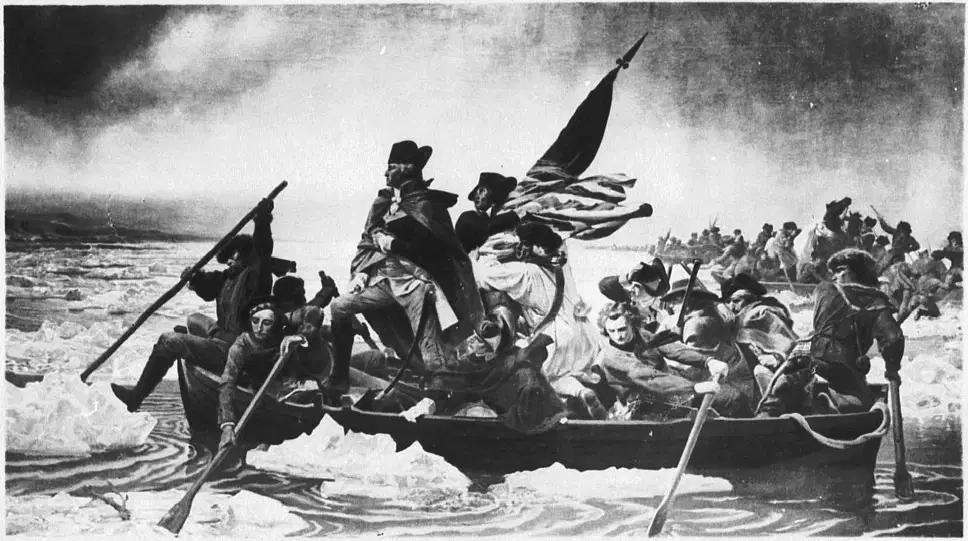
This artwork below depicts General George Washington and his troops crossing the partially frozen Delaware River on the night of December 25,1776. This daring act led to a key Patriot victory at the:
a)
Battle of Boston
b)
Battle of Bunker Hill
c)
Battle of Saratoga
d)
Battle of Trenton
2.

Washington read the words below to his troops during the harsh winter at Valley Forge. What effect was he trying to produce?
a)
To convince his troops that their cause was just
b)
To rally his troops at a particularly difficult time
c)
To discourage his troops from enlisting for another year
d)
To entertain his troops with popular literature
3.
Which of the following was a significant outcome of the Battle of Saratoga during the American Revolution?
a)
It resulted in the British capture of Philadelphia
b)
It convinced France to form a military alliance with the American colonies
c)
It marked the end of the Revolutionary War
d)
It was a decisive victory for the British forces
4.
Which person was instrumental in negotiating an French alliance for the American colonists?
a)
Benjamin Franklin
b)
Thomas Jefferson
c)
John Hancock
d)
John Adams
5.
What was the last major battle of the American Revolution?
a)
Saratoga
b)
Trenton
c)
Dorchester Heights
d)
Yorktown
6.
What advantage did the American colonists possess during the American Revolutionary War that contributed to their success?
a)
Superior number of troops
b)
Advanced military technology
c)
Familiarity with the terrain
d)
Extensive naval fleet support
7.
The Battle of Kings Mountain was significant because
a)
everyone, except for Colonel Ferguson, were colonists.
b)
it was the turning point of the war.
c)
it was the last major battle of the war.
d)
it was the first battle George Washington led.
8.
How did Friedrich von Steuben help the Continental Army at Valley Forge?
a)
He provided funds to buy supplies.
b)
He convinced Portugal to ally with the Americans.
c)
His training made them a finely tuned fighting force
d)
He spied on the British military and brought back valuable information to Washington.
9.
Why was the winter at Valley Forge such a difficult time for the Continental Army?
a)
The army lacked shelter and supplies.
b)
The army began to turn against the revolution.
c)
The army lost several important battles.
d)
The army refused to drill and train.
10.
Why did the United States seek an alliance with France during the American Revolution?
a)
France could provide supplies and naval support.
b)
France could get additional aid from Holland and Russia.
c)
France promised to give up any land conquered in the war.
d)
France had a system of government that was admired by Americans.
11.
What was the significance of the Battle of Trenton during the Revolutionary War?
a)
It marked the first major defeat of the American Army
b)
It secured crucial French support for the American cause
c)
It boosted morale among American troops and revived hope for independence
d)
It led to the capture of George Washington by British forces
12.
During the American Revolution, George Washington led the Continental Army with determination and strategic brilliance. Despite facing challenges like limited resources and inexperienced troops, Washington inspired his soldiers through his courage and commitment. He transformed his army into a disciplined force and employed both guerrilla warfare tactics and conventional maneuvers. Washington's famous crossing of the Delaware River and surprise attack on Hessian forces showcased his tactical ingenuity. Additionally, his diplomatic efforts secured crucial support from allies like France. Overall, Washington's leadership played a pivotal role in securing independence from British rule.
Based on the passage, which of the following statements best summarizes George Washington's military leadership during the American Revolution?
a)
Washington relied solely on conventional warfare tactics to defeat the British.
b)
Washington prioritized training his soldiers in guerrilla warfare tactics.
c)
Washington demonstrated inspirational leadership and strategic brilliance.
d)
Washington's diplomatic efforts had little impact on the outcome of the war.
13.
A style of fighting where fighters weaken the enemy with surprise hit and run attacks is called
a)
Swamp Fox
b)
Tiger Surprise
c)
Sniper Warfare
d)
Guerilla Warfare
14.
Which group did the British military use as mercenaries during the American Revolution?
a)
French soldiers
b)
Italian soldiers
c)
Spanish soldiers
d)
Hessian soldiers
15.
What led George Washington to abandon his ban on African Americans serving in the Continental Army?
a)
the bravery of black militiamen
b)
a meeting with John Laurens
c)
the need for additional troops
d)
an impassioned speech by Marquise de Lafayette
16.
Which event occurred as a result of General Cornwallis’s surrender at the Battle of Yorktown?
a)
France recognized American independence and declared war against Great Britain.
b)
The Second Continental Congress agreed to the Articles of Confederation.
c)
Great Britain and the United States signed the Treaty of Paris.
d)
The Second Continental Congress sent the Olive Branch Petition to King George III.
17.
Which of the following best captures the impact of the Treaty of Paris 1783 on the outcome of the Revolutionary War?
a)
The Treaty of Paris 1783 led to increased tensions between the United States and Britain due to unresolved issues, prolonging hostilities beyond the war's end.
b)
The Treaty of Paris 1783 resulted in territorial gains for the United States, expanding its borders and securing its position as a major power in North America.
c)
The Treaty of Paris 1783 solidified American independence from Britain, formally ending the conflict and establishing the United States as a sovereign nation.
d)
The Treaty of Paris 1783 diminished the United States' influence on the world stage, as it failed to secure favorable terms for trade and diplomacy with European powers.
18.
Which of the following statements accurately reflects the impact of Thomas Paine's "The Crisis" during the American Revolution?
a)
It directly led to the signing of the Treaty of Paris, ending the war.
b)
It served as a primary catalyst for Loyalist defection, weakening British forces.
c)
It bolstered morale among Patriots, but also stirred debate about independence.
d)
It had little influence on the outcome of the war, overshadowed by military strategies.
19.
What territory did the U.S. gain in the Treaty of Paris 1783?
a)
All lands west of the Mississippi River except Florida and Canda
b)
Florida and Canada
c)
All lands east of the Mississippi River except Florida and Canada
d)
Louisiana
20.
What advantage did the British Army possess during the American Revolution?
a)
Familiar with terrain
b)
A larger, trained, and experienced professional army
c)
Fighting for belief in their cause
d)
Widespread support
21.

Which group would have been most likely to agree with this statement?
a)
Patriots
b)
Loyalists
c)
Native Americans
d)
Monarchists
22.
During the American Revolution, what strategy did the British employ to recruit African Americans?
a)
Offering them immediate citizenship upon enlistment.
b)
Promising them significant land grants in Africa after the war.
c)
Providing financial incentives and the promise of freedom from slavery.
d)
Coercing them into service through threats of punishment.
23.
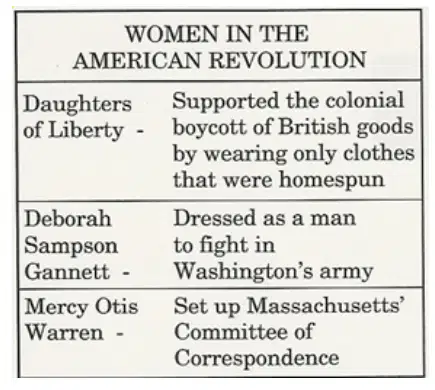
Which generalization is best supported by the information in the chart?
a)
Women made no significant contributions to the Revolution.
b)
Most American women supported the loyalist cause.
c)
Women served in many ways during the Revolutionary War.
d)
Economic actions were the only weapons of Patriot women.
24.
What African American woman wrote poems supporting independence and was the 1st enslaved person to publish a book?
a)
Mercy Otis Warren
b)
Abigail Adams
c)
Harriet Beecher Stowe
d)
Phillis Wheatley
25.
The Virginian serving in the Second Continental Congress who was chosen to lead the Continental Army was ________________.
a)
Thomas Jefferson
b)
George Washington
c)
Patrick Henry
d)
Benedict Arnold
26.
Which of the following best summarizes the impact of key military and diplomatic events of the Revolutionary War, including the Valley Forge encampment?
a)
The Valley Forge encampment marked a turning point for the Continental Army, where soldiers endured harsh conditions but emerged better trained and disciplined, contributing to subsequent victories.
b)
The Valley Forge encampment led to significant losses for the Continental Army, weakening their morale and causing diplomatic setbacks with European allies.
c)
The Valley Forge encampment solidified British control over the colonies, as the Continental Army suffered from inadequate supplies and internal divisions.
d)
The Valley Forge encampment resulted in a decisive victory for the Continental Army, boosting their confidence and leading to successful diplomatic negotiations with Britain.
27.
What American woman wrote plays supporting the patriots and the independence movement?
a)
Phillis Wheatley
b)
Mercy Otis Warren
c)
Abigail Adams
d)
Harriet Beecher Stowe
28.
How were Native Americans affected by the Treaty of Paris 1783?
a)
They were not mentioned & lost much of their land
b)
They were paid for land by the Americans
c)
They were made citizens of the United States
d)
They agreed to cede their land & move West
29.
What was the motivation factor of Native Americans choosing a side in the American Revolution?
a)
Which side would give them their freedom
b)
Which side would protect their homeland and culture
c)
Which side would make them citizens
d)
Which side was going to pay them more
100 %

