
 Worksheets
Grade 10 MA1 T1 Alg 2 Revision
Total questions: 128
Worksheet time: 5hrs 33mins
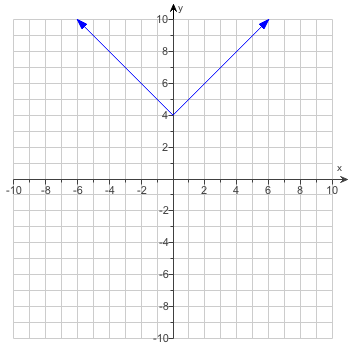
What is the vertex of the absolute value function?
(4, 0)
(0, 4)
(−∞, ∞)
[4, ∞)

What is the domain of the absolute value function?
(4, 0)
(0, 4)
(−∞, ∞)
[4, ∞)

What is the range of the absolute value function?
(−∞, ∞)
[3, ∞)
[0, ∞)
(−∞, 3]

What is the range of this graph?
(−∞, ∞)
(−∞, 3]
(2, 3)
[3, ∞)

What is the y-intercept?
(0, 2)
(2, 0)
none
(2, 2)

What is the vertex?
(1, 4)
(4, 1)
(0, 0)
(0, 1)

What is the y-intercept?
(0, 7)
none
(-4, 3)
(0, 0)

What is/are the x-intercept(s)? Select all that apply.
(-10, 0)
(2, 0)
(0, -1)
(-4, -3)
What is/are the x-intercept(s) of the absolute value function?
(0, 4)
none
(4, 0)
[4, infinity)


f(t) = -2|t - 15| + 50
is graphed and represents weekly sales of shoes, f(t) in $1000s, where t is weeks. What is the domain for this graph?


Vertical Stretch of 2
Horizontal shift left 1 unit
Vertical shift down 9 units
Reflection across the x-axis
Vertical shift right 2 units
Horizontal shift down 7 units

y= -4|x+2|+5
y= 4|x|+1
What is the transformation for the function: y = -3|x| ?
stretched and shifted down
compressed and shifted down
opens down and compressed
opens down and stretched
Write the equation for a graph that shifts down 9.
y=|x|-9
y=|x-9|
y=-9|x|
y=|x|+9
What is the transformation for the function: y=|x|+10 ?
Shifted left 10
Shifted right 10
Shifted up 10
Shifted down 10
What are the transformations of the equation: y = -1/2|x| + 3
Stretch
Reflect
Vertical shift
Shrink - Compress
What is the vertex of the following function?
y=2|x-3|+1
(2,3)
(-3,1)
(2,-3)
(3,1)
Write an absolute value function given the following transformations:
Reflection across the x-axis
Vertical shift right 2 units
Horizontal shift down 7 units
y = -|x + 2| - 7
y = |x - 2| - 7
y = -|x - 2| - 7
y = -|x - 2| + 7
Determine the transformation
Left 5, up 1
Left 5, down 1
Right 5, up 1
Right 5, down 1
Write an absolute value function given the following transformations from the parent function: Reflection across the x-axis Vertical shift right 2 units Horizontal shift down 7 units
y=−∣x+2∣−7
y=∣x−2∣−7
y=−∣x−2∣−7
y=−∣x−2∣+7
Describe the transformation of the equation below:
y = I x + 3 I
Left 3
Right 3
Up 3
Down 3
Describe the transformation of the equation below from the parent function of y = IxI
y = I x + 2 I - 5
Left 2 up 5
Right 2 up 5
Left 2 down 5
Describe the transformation that is applied to the parent function.
f(x) = IxI - 5
Shifts left 5
Shifts right 5
Shifts up 5
Shifts down 5
What is the transformation for the function: y = 3|x| ?
horizontally stretched
vertically compressed
up 3 units
vertically stretched
What is the transformation for the function: y= -|x| ?
Shifted right 1
Shifted down 1
reflected across the x-axis
reflected across the y-axis
What is the transformation for the function: y = |-x| ?
horizontal stretch
reflection across the x-axis
reflection across the y-axis
vertical compression
Describe the transformation from the parent function
y = |x|?
y = |3x|
Vertical Compression
Vertical Stretch
Horizontal compression
Horizontal Stretch

The blue graphs is the parent function f(x)=|x|, the red must be
g(x)=|x+2|
g(x)=|x|+2
g(x)=|x-2|
g(x)=|x|-2
Describe the transformation of the equation below from the parent function of y = I x I
y = -2 I x - 3 I + 3
reflected over x axis, stretched by 2, right 3, up 3
reflected over x axis, stretched by 2, left 3 up 3.
reflected over x axis, compress by 2, right 3, up 3
reflected over the x axis, compress by 2, left 3, up 3

Describe the transformations of the absolute value equation.
Reflects over x-axis, compresses wider, shifts right 1 unit
Reflects over x-axis, compresses wider, shifts up 1 unit
Reflects over x-axis, stretches more narrow, shifts right 1 unit
Reflects over x-axis, stretches more narrow, shifts up 1 unit

The graph represents a piecewise function. How many pieces make up the function?
1
2
3
4

What is the equation and domain of the blue piece, labelled as "A"?
f(x) = x + 1, x ≤ –1
f(x) = x + 2, x ≤ –1
f(x) = x, x ≤ –1
f(x) = x – 1, x ≤ –1
The equation of the red piece is y = 1. What is the domain of the red piece?
x > –1
x < –1
x < –1 or x > 1
–1 < x < 1
What is the equation and domain of the green piece, labelled as "C"?
f(x) = 3x + 1, x ≥ 1
f(x) = 3x, x ≥ 1
f(x) = 3x – 1, x ≥ 1
f(x) = 3x – 2, x ≥ 1

Which graph matches:
-x+4 if x<2
2x-6 if x>=2
A
B
C
D

Match the graph with the correct equation.


Match the graph with the correct equation.


What are the values of A, H and K in the equation below?
f(x) = 4|x +2| - 3
A= 4
H= 2
K= - 3
A= 4
H= - 2
K= - 3
A= - 3
H= 4
K= 2
Which of the following represents a vertical stretch of the parent function f(x) = |x| by a factor of 5?
f(x) = |x| + 5
f(x) = 5|x|
f(x) = |5x|
f(x) = |x| - 5
Evaluate: |-12|
12
-12
0
1.2
What graph is an absolute value graph?


What equation goes with this graph?
y = (x+2)2+3
y=∣x−2∣+3
y=∣x−3∣+2
y=(x−2)2+3
Identify which graph goes along with the function y=(x−4)2+2


Identify what function represents the graph?
y=∣x−4∣−1
y=∣x+4∣−1
y=(x−4)2−1
y=(x+4)2−1
A Quadratic function moves to the right 3 units and down 2 units. Which function goes with this graph?
y=∣x+3∣−2
y=(x+3)2−2
y=∣x−3∣−2
y=(x−3)2−2

Identify what function goes with the graph?
y=∣x+4∣−1
y=(x+4)2−1
y=−(x+4)2−1
y=−∣x+4∣−1

What is the Range of this graph?
[0,∞]
(0,∞)
[0,∞)
(−∞,∞)
What is the Domian of this graph?
[0,∞]
[−∞,∞]
[0,∞)
(−∞,∞)

Evaluate f(3) on the graph
f(3) = 1
f(3) = 2
f(3) = 0
f(3) = -1

Evaluate f(5)
f(5) = 0
f(5) = 1
f(5) = -3
f(5) = -2
Evaluate g(-2) with the function g(x)=−2x+4
g(-2) = 8
g(-2) = 0
g(-2) = 4
g(-2) = -4

On what intervals of x is f(x) negative?
4≤x≤∞
0≤x≤4
On what intervals of x is f(x) decreasing?


y = -2|x - 3| + 5


Evaluate f(-4)
-2
-3
11
-5
Evaluate f(4)
3
7
-4
-7

Determine the interval of increase.
(−∞,−2)
(−2,1)
(1,∞)
(−1,∞)

Evaluate f(0).
-2
0
1
2
Evaluate f(3).
-2
0
1
2

Identify the correct equation & inequality for the blue piece:
2; x<−3
−3; x≤2
2; x≥−3
−3; x<−3
Identify the correct equation & inequality for the orange piece:
−x+1; x≥−3
x+1; −3≤x<2
x+1; −3>x>2
−x+1; −3≤x<2
Identify the correct equation & inequality for the green piece:
−x; x>2
−x−2; x≥−4
−x−2; x≥2
x+2; x≤2

Determine the piecewise equation & inequality for the middle step of the function:
4; 4<x<6
4; 4<x≤6
3; 5<x≤6
3; 5<x<6


What is f when x equals 0?
-5
0
1/2
1

What is f when x equals 4?
-5
0
3
6

What is f when x equals 8?
0
5
11
16


Find f(0)
-3
18
4
0


What absolute value function would go through these points?
f(x)=−∣x−1∣−2
f(x)=∣x+1∣+2
f(x)=−∣x−1∣+2
f(x)=∣x−1∣+2

Which of the 3 piecewise equations is depicted by the graph? (Take your time!) (Hint: think about everything you know about graphs and how they should behave)
f(x)
g(x)
h(x)

(1/3)x if {x<-3}
x2 - 4 if {-3≤x<1}
√x if {x≥1}
(1/3)x +3 if {x<-4}
x2 - 4 if {-4≤x<4}
√x if {x≥0}
(1/3)x +2 if {x<-3}
x2 - 4 if {-3≤x<1}
(2/3)x +2 if {x<-5}
x2 - 4 if {-3≤x<1}
√x if {x≥1}

1. What is this type of function called?
Discrete Function
Segment Function
Step Function
Jump Function
Linear


What is the value of y when x = -2?
4
2
-3
-4

How many "pieces" are graphed in this function?
1
2
3
4

What is the DOMAIN of the function?
All Real Numbers
x ≤ 4
x > 4
0 ≤ x ≤ 4
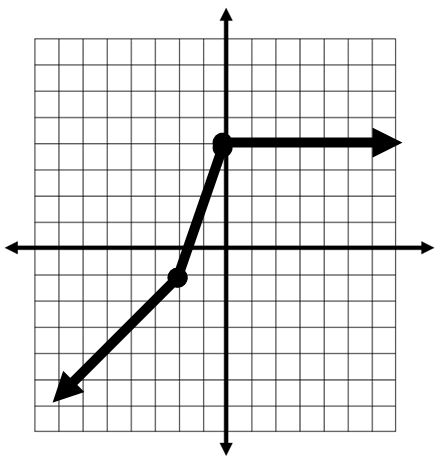
What is the RANGE of the function?
All Real Numbers
y ≤ 4
y < 4
0 < y < 4

Name the type of function:
piecewise function
linear function
quadratic function
step function

Which of functions represents the graph?


Which of the piecewise functions matches this graph?


Arithmetic, geometric, or neither?
4, 9, 14, 19, ...
Arithmetic
Geometric
Neither
Arithmetic, geometric, or neither?
100, 50, 25, 12.5, ...
Arithmetic
Geometric
Neither
Find the common difference:
25, 13, 1, -11, ...
12
-12
8
-8
Find the common ratio:
2, 8, 32, 128, ...
1/4
4
1/6
6
Find the next term:
100, 65, 30, -5...
20
-20
40
-40
an = 7 + (n - 1)5
What is the 16th term of the following sequence?
36
38
40
42
-21, -16, -11, -6, ...
Is this sequence arithmetic, geometric, or neither?
arithmetic (common difference d = 5)
geometric (common ratio r = 5)
neither (no common difference OR common ratio) neither (no common difference OR common ratio)
3, 9, 15, 22, ...
Is this sequence arithmetic, geometric, or neither?
arithmetic (common difference d = 6)
geometric (common ratio r = 4)
neither (no common difference OR common ratio) neither (no common difference OR common ratio)


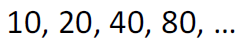
Using the formula an=a1+d(n−1) , where a1 represents the first term and d represents the common difference, write a formula for the sequence 18, 16, 14, 12, 10, 8, ...
an=18+2(n−1)
an=18−2(n−1)
an=2+18(n−1)
an=−2+18(n−1)
Which of the following best describes this sequence?
An arithmetic sequence with a common ratio of 3.
A geometric sequence with a common difference of 3.
An arithmetic sequence with a common difference of 3.
A geometric sequence with a common ratio of 3.
An arithmetic sequence has a1=2 and d=4. What is the Explicit Rule for an and use it to find the 20th term.
an = 2 - 4(n-1)
a20 = 82
an = 2 + 4(n-1)
a20 = 78
an = 2(4)n-1
a20 = 2199023255552
an = 4 + 2(n-1)
a20 = 42
The first three terms of an arithmetic sequence are 3, 11, and 19. Which function represents the sequence?
an = 8 + 3(n-1)
an = 8(3)n-1
an = 3 + 8(n-1)
an = 3 + 8n
A sequence is defined by the recursive rule
a1 = -4
an = an-1 + 5
What is the seventh term of the sequence?
8
31
7
26
Write the explicit formula for the sequence.
9, 5, 1, -3, ...
f(n)=9+5(n−1)
f(n)=9−4(n−1)
f(n)=4+9(n−1)
f(n)=9⋅4(n−1)
The first three terms of an a sequence are 3, 11, and 19. Which formula represents the sequence?
an = 8 + 3(n-1)
an = 8(3)n-1
an = 3 + 8(n-1)
an = 3 + 8n
Find the explicit formula:
8, 14, 20, 26, ...
aₙ = 6n + 2
aₙ = 8n + 6
aₙ = 2n + 6
aₙ = 6n + 8
Given the recursive formula below, find the first five terms.
u1 = 3
un = un-1 + 2
3, 5, 7, 9, 11
5, 7, 9, 11, 13
15, 12, 9, 6, 3 ....
un = un-1 + 3
un = un-1 + 3
un = un-1 - 3
un = un-1 - 3
a0 = 1
an = an-1 + 5
3, 8, 13, 18 ...
Write the recursive formula of 13, 9, 5, 1, -3, ...
an=an-1-4
an=an-1+3
an=an-1-5
an=an-1+4
Write a recursive formula for the sequence -4, -6, -8, -10, … .
an=an+1+2
an=an−1+2a
an=an−1−2
an=an−1+2

