

Wayground logo

Free Printable Worksheets

Font size

S
M
L
XL
Worksheets

Level : Warm-Up 10/21 -10/23

Total questions: 12

Worksheet time: 6mins

Name
Class
Date
1.

Scientists must analyze the soil samples to determine which nutrients are missing.

Using this sentence what does ANALYZE mean?

a)
examine in detail
b)
ignore the samples
c)
mix the samples
d)
discard the samples
2.

There is an argument among biologists about whether climate change affects plant growth more than human activity.

Using the above sentence, what is the meaning of the term ARGUMENT?

a)
A discussion or debate among biologists.
b)
A law governing climate change effects.
c)
A personal opinion of a biologist.
d)
A scientific fact about plant growth.
3.

The experiment began with the assumption that all plants were exposed to the same amount of sunlight.


Using the above sentence, what is the meaning of the term ASSUMPTION?

a)
A guess based on previous experiments.
b)
A conclusion drawn from scientific data.
c)
A proven fact about plant growth.
d)
A belief accepted without proof.
4.

When writing her lab report, Maya had to cite the sources that explained the chemical reaction.

Using the above sentence, what is the meaning of the term CITE?

a)
To reference or mention sources of information.
b)
To analyze the results of an experiment.
c)
To summarize the findings of a study.
d)
To ignore sources of information.
5.

After testing the water quality, the students wrote a conclusion about which pond had the most pollution.

Using the above sentence what is the meaning of the term CONCLUSION

a)

The final decision or judgment based on quality tests.
b)
A list of all the ponds tested.
c)
An initial hypothesis about the ponds.
d)
A summary of the water quality tests.
6.

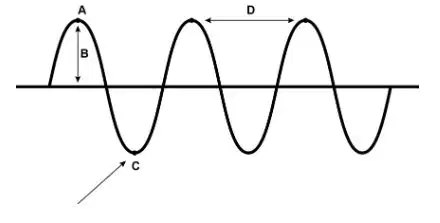
Identify the Amplitude

a)

A

b)

B

c)

C

d)

D

7.

Identify the Crest

a)

A

b)

B

c)

C

d)

D

8.

Identify the Trough

a)

A

b)

B

c)

C

d)

D

9.

Identify the Wave Length

a)

A

b)

B

c)

C

d)

D

10.

Define Wavelength

a)
The total energy carried by a wave.
b)
The speed of a wave in a medium.
c)

The distance between two crests or troughs of a wave.

d)
The frequency of a wave divided by its amplitude.
11.

Define Wave Frequency

a)
Wave frequency is the distance between two waves, measured in meters.
b)
Wave frequency refers to the amplitude of a wave, measured in decibels.
c)
Wave frequency is the total energy of a wave, measured in joules.
d)
Wave frequency is the number of cycles per second of a wave, measured in hertz (Hz).
12.

Differentiate between Wavelength and Frequency

a)
Wavelength is the distance between waves, while frequency is the number of waves per second.
b)
Wavelength is measured in hertz, while frequency is measured in meters.
c)
Wavelength and frequency are the same concept, just different terms.
d)
Wavelength is the speed of light, while frequency is the energy of the wave.