
 Worksheets
The American Revolution Unit 3 Lesson 9 Assessment
Total questions: 25
Worksheet time: 14mins
Name
Class
Date
1.
Which of these was a weakness of the Continental Army at the start of the war?
a)
weak commander
b)
unfamiliar territory
c)
supply shortages
d)
long travel distances
2.
At the start of the war, what was a weakness of the British troops?
a)
poor leadership
b)
understaffed army
c)
insufficient supplies
d)
poorly trained soldiers
3.
Why did many people in Britain not support the war?
a)
The cost to taxpayers was too high
b)
The king was unpopular
c)
They planned to move to America
d)
The wanted the Americans to have their independence
4.
What was the result of the American victories at Trenton and Princeton?
a)
The Hessians joined the American side.
b)
It showed that the Americans could defeat the British.
c)
It proved that General Washington was wrong about his soldiers.
d)
The British were forced to abandon New York and New Jersey.
5.
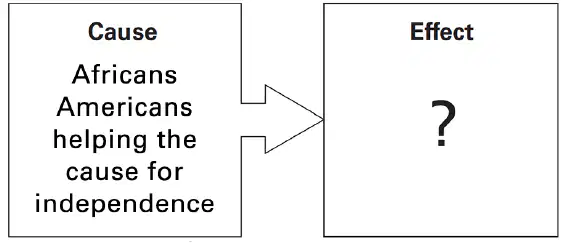
Which of these belongs in place of the question mark in the diagram below?
a)
Slavery was abolished throughout the colonies.
b)
African Americans who fought were given their freedom.
c)
Several colonies began to take steps to end slavery.
d)
African Americans were respected and their brave acts rewarded.
6.
Why did African Americans join the Continental army?
a)
They had excellent military skills.
b)
They hoped independence would lead to an end of slavery.
c)
They were generously paid to join the army.
d)
They blamed Great Britain for their enslavement.
7.
Which of these was an effect of the American victory at Saratoga?
a)
British troops gained confidence.
b)
General Burgoyne resigned his post.
c)
Great Britain withdrew from Canada.
d)
European countries came to the aid of America.
8.
Which of these nations became an American ally after the victory at Saratoga?
a)
France
b)
Canada
c)
Mexico
d)
Germany
9.
Which of these describes the progress of the war?
a)
The British won every battle until the final one.
b)
The British soldiers lost most of the battles against the disciplined American soldiers.
c)
At the beginning, the Americans were outmatched, but their skills and tactics improved.
d)
The Americans outnumbered the British, finally defeating them at the Battle of Yorktown.
10.
Where did the British general surrender?
a)
Saratoga
b)
Yorktown
c)
Bunker Hill
d)
Quebec
11.
What was the name of the British General that initiated the surrender?
a)
George Washington
b)
General Cornwallis
c)
King George
d)
The French
12.
What was the name of the treaty that recognized the independence of the United States?
a)
The Treaty of Paris
b)
The Treaty of the Colonies
c)
The Treaty of Independence
d)
The Treaty of the United States
13.
Why was Britain having financial problems?
a)
Their crops failed
b)
They had fought in several wars
c)
Spain was making them pay too much in taxes
d)
The king had died
14.
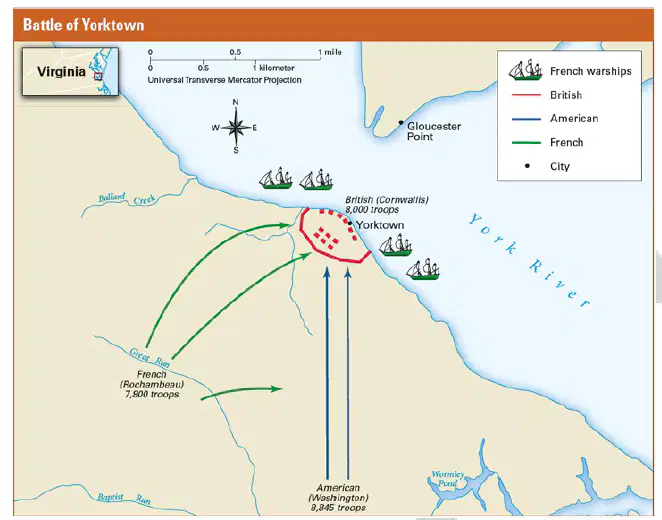
In which colonial region did the Battle of Yorktown take place?
a)
New England
b)
Middle
c)
Southern
15.
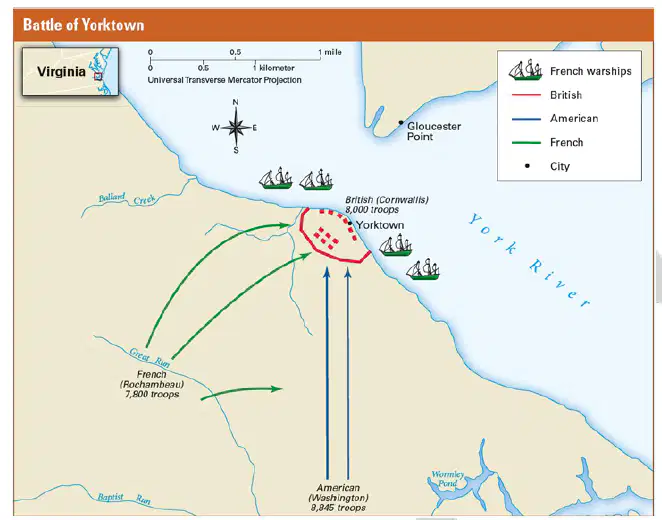
How were the British defeated at the Battle of Yorktown?
a)
British Troops were outnumbered
b)
The combined forces of the French and American troops prevented a British retreat
c)
French and American troops surrounded the British
d)
All of the above
16.

What effect did the battles of Trenton and Princeton have on the colonists?
a)
They Americans won and it boosted morale
b)
The Americans lost and many soldiers deserted
c)
The Americans won, but they lost many soldiers
17.

Surrounded by French and Continental armies, a large British army surrendered here.
a)
Saratoga
b)
Yorktown
c)
Bunker Hill
d)
Lexington and Concord
18.
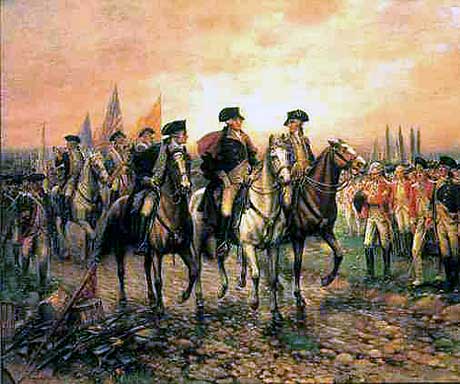
Which battle ended the American revolution?
a)
Battle of Lexington and Concord
b)
Battle of Saratoga
c)
Battle of Yorktown
d)
Battle of Trenton
19.

The Battle of Saratoga was a turning point in the war because it
a)
brought France into the war as an American ally.
b)
ended General Burgoyne's career.
c)
liberated Georgia from British control.
d)
forced the British to leave Canada.
20.

The American Revolution was between
a)
French & the Native Americans
b)
British & the Colonists
c)
Spain & Australia
21.

What was the outcome of the Battle of Yorktown?
a)
Cornwallis surrendered, ending the war.
b)
The warships were lost in a fierce storm.
c)
Washington withdrew rather than risk his army.
d)
Rochambeau's troops barely escaped alive.
22.

In the American Revolution, he warned that the "regulars were coming", not the "British were coming"
a)
George Washington
b)
Paul Revere
c)
Sam Adams
d)
Ben Franklin
23.

He imposed (forced) taxes unfairly on the colonists.
a)
King George III
b)
Benedict Arnold
c)
George Washington
24.

Which battle persuades France to help aid the American revolution?
a)
Battle of Saratoga
b)
Battle of Yorktown
c)
Battle of Lexington and Concord
d)
Battle of Trenton
25.
The army of the Thirteen Colonies in the Revolutionary-era United States
a)
Red Coats
b)
Continental Army
c)
minutemen
d)
British Army
100 %

