
 Worksheets
Why do we need to study about pumps?
Total questions: 88
Worksheet time: 44mins
Pumps are an integral _______ equipment common to all ships.
auxiliary
primary
decorative
navigation
Overview: Pumps are used in engine room, main engine, generator engine systems, liquid cargo operations, ballasting operations, etc. Which of the following is NOT a use of pumps on ships?
Engine room
Main engine
Cooking food
Ballasting operations
In case of emergencies like flooding and fires, pumps are also essential.
True
False
The purpose of Marine pumps and the types of other pumps used on board ships can be described as:
Marine pumps are used for transferring fluids and include types such as centrifugal, reciprocating, and gear pumps.
Marine pumps are only used for air circulation and include only vacuum pumps.
Marine pumps are used exclusively for fuel transfer and include only screw pumps.
Marine pumps are not essential equipment and are rarely found on ships.
Which of the following best describes the construction, operation, and application of rotary displacement pumps, including gear pumps, screw pumps, and rotary vane pumps?
They use rotating elements to displace fluid and are commonly used for pumping viscous liquids.
They rely on centrifugal force to move fluids and are best for high-flow, low-pressure applications.
They use reciprocating motion to move fluids and are ideal for high-pressure, low-flow situations.
They operate using diaphragm movement and are mainly used for metering small quantities of fluid.
The purpose and function of components of a centrifugal pump are to:
Convert mechanical energy into hydraulic energy and move fluids efficiently.
Store electrical energy for later use.
Measure the temperature of fluids passing through the pump.
Filter impurities from the fluid before it enters the pump.
The characteristic of a centrifugal pump with respect to suction lift, priming, discharge pressure, and vapour in liquid is:
It requires priming, has limited suction lift, moderate discharge pressure, and cannot handle vapour in liquid.
It does not require priming, has unlimited suction lift, high discharge pressure, and can handle vapour in liquid.
It requires priming, has unlimited suction lift, low discharge pressure, and can handle vapour in liquid.
It does not require priming, has limited suction lift, high discharge pressure, and cannot handle vapour in liquid.
Maintenance checks on submersible pumps, mono pumps, variable delivery pumps, and swash plate pumps involve:
Inspecting for leaks, checking electrical connections, monitoring vibration, and ensuring proper lubrication.
Only checking the pump casing for cracks.
Running the pumps continuously without inspection.
Ignoring electrical connections and focusing only on fluid levels.
Troubleshooting displacement and centrifugal pumps involves which of the following steps?
Checking for leaks, inspecting seals, and monitoring pressure levels
Ignoring unusual noises and vibrations
Running the pump at maximum speed regardless of issues
Replacing the pump without any inspection
The purpose and requirement of the bilge pumping system, emergency bilge suction, emergency fire pump, and ballast pumping system is to:
Ensure removal of unwanted water, provide emergency dewatering and firefighting, and manage vessel stability.
Increase the speed of the vessel and improve fuel efficiency.
Monitor engine performance and control navigation systems.
Supply fresh water to crew quarters and galley areas.
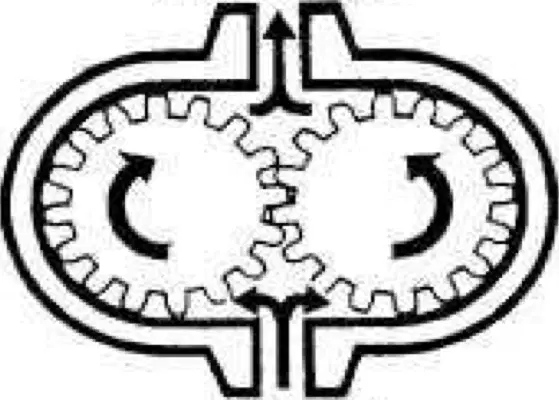
What is one function of a pump?
Transfer fluid between two points
Generate electricity
Store fluid
Cool fluid
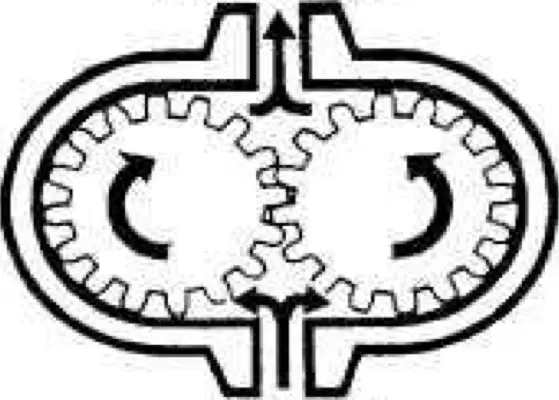
One function of a pump is to produce required ________.
flow rate
temperature
voltage
pressure
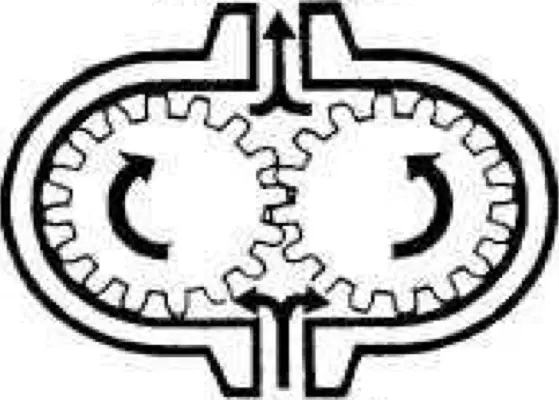
A pump is used to produce required ________.
pressure
temperature
velocity
volume
Which of the following does a pump change in a fluid?
Only velocity
Only pressure
Both velocity and pressure
Neither velocity nor pressure
What does a pump add to the system?
Pressure
Energy
Flow
Resistance
Power supplied to the pump is used to transfer fluid at specified flow rate and pressure by overcoming resistance in the pump and the system.
True
False
A pump does not create ________, it only provides flow. Pressure is just an indication of the amount of resistance to the flow.
pressure
heat
vacuum
energy
Viscosity of the fluid pumped must be within the range specified in the pump design.
True
False
Which type of pump can handle any required viscosity?
Centrifugal Pump
Reciprocating Displacement Pump
Rotary Positive Displacement Pump
Screw Pump
Rotary Positive Displacement Pumps (Common- Gear and Screw) are used for ______ range of viscosities.
intermediate
low
very high
narrow
Centrifugal Pumps are used for Medium to Low range of viscosities.
True
False
Onboard ships, permission should be obtained before any fluids are moved, which might affect the stability of the ship.
True
False
One use of pumps onboard ship is the ___
transfer of oil and other fluids from tanks, machinery or other equipment
navigation of the vessel
operation of radar systems
preparation of food in the galley
Pumps are used for ________ operation (discharging cargo in tankers) onboard ship.
cargo
navigation
anchoring
steering
Pumps are used for ________ operation onboard ship.
ballasting
navigation
cooking
painting
Pumps are used for ________ onboard ship.
fire fighting
navigation
cooking
painting
Pumps are used to pump out ________ in case of vessel ingress onboard ship.
seawater
oil
air
fuel
Pumps are used for ________ prevention onboard ship.
oil spill
fire
collision
theft
What is the full form of NPSH?
Net Positive Suction Head
Negative Pressure Suction Head
Nominal Pressure Safety Head
Normal Pump Suction Height
Why is the Net Positive Suction Head (NPSH) margin important when selecting a pump?
It determines the color of the pump
It is a crucial factor that is commonly overlooked while selecting a pump
It affects the pump's weight
It is not important
What is the difference between NPSHa and NPSHr at the pump’s inlet?
NPSHa is the available Net Positive Suction Head, and NPSHr is the required Net Positive Suction Head by the pump to operate without cavitation
NPSHa is the required Net Positive Suction Head, and NPSHr is the available Net Positive Suction Head
Both are the same
NPSHa and NPSHr are unrelated
What is cavitation? Cavitation is the formation of _______ at the pump inlet, followed by their sudden collapse, which can cause permanent damage.
bubbles
crystals
solids
gases
Why must the NPSH margin value be positive? The NPSH margin value must be _______ to avoid cavitation.
positive
negative
zero
undefined
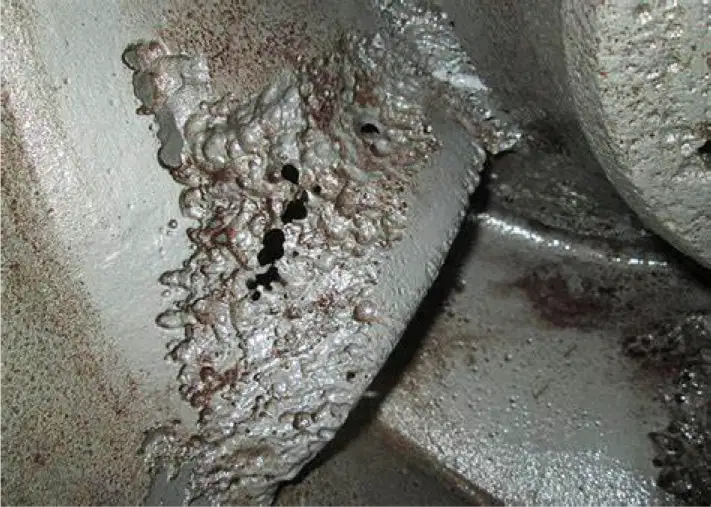
Look at the image on the left. What phenomenon is shown on the metal surface?
Corrosion
Cavitation
Fatigue
Erosion
Cavitation can cause damage to metal surfaces in pumps and turbines.
True
False
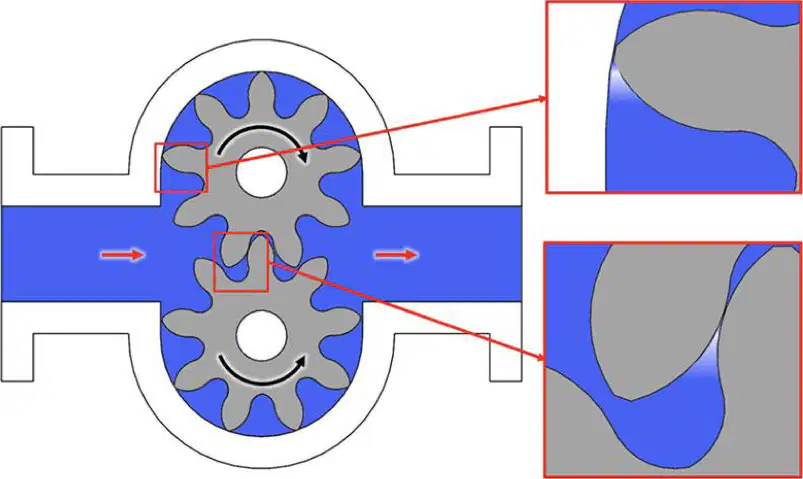
In the diagram on the right, cavitation occurs in the areas where the fluid flow creates low pressure zones. Cavitation is the formation of ________ in a liquid due to rapid changes in pressure.
bubbles or vapor cavities
ice crystals
solid particles
foam
Considering the total energy of a fluid moving, every time a fluid increases its velocity, its pressure _________?
decreases
increases
remains the same
doubles
This relationship between velocity and pressure produces some unwelcome effects with respect to:
Electrical machinery
Hydraulic machinery, pipes, and hydraulic structures
Thermal machinery
Pneumatic machinery
These problems arise when the absolute pressure falls sufficiently for the small quantity of air that is dissolved in the water to be released followed by local vaporization of the liquid. What is this phenomenon called?
Condensation
Cavitation
Sublimation
Precipitation
It results in small bubbles of vapour being formed that gradually get bigger. What happens to these bubbles when pressure increases?
They expand
They implode
They float
They solidify
Cavitation occurs when the absolute pressure falls sufficiently for the small quantity of air dissolved in the water to be released, followed by local ________ of the liquid.
vaporization
condensation
solidification
oxidation
One of the factors affecting suction lift is ________ and volatility of the fluid.
Temperature
Pressure
Density
Viscosity
________ exerted on the free side of the liquid is a factor affecting suction lift.
Pressure
Temperature
Viscosity
Density
Friction losses at entrances, bends and pipes in the ________ system affect suction lift.
suction
delivery
ventilation
cooling
A prime mover is a term for a machine or device that converts other forms of energy into ________ mechanical energy.
rotational
thermal
chemical
electrical
Which of the following is a type of pump prime mover?
Electric motor
Solar panel
Wind turbine
Battery
Which of the following is NOT listed as a type of pump prime mover?
Hydraulic motor
Pneumatic
Electric motor
Steam engine
One type of pump prime mover mentioned in the list is:
Electric motor
Solar panel
Wind turbine
Steam engine
There are circumstances where it may be desirable to use two or more pumps operating together instead of one large machine. What are the three choices for pump operation?
Single machine
Pumps in series
Pumps in parallel
All of the above
There are circumstances where it may be desirable to use two or more pumps operating together instead of one large machine. One of the choices for pump operation is _________.
Single machine
Parallel operation
Series operation
Multiple stage operation
There are circumstances where it may be desirable to use two or more pumps operating together instead of one large machine. One of the choices for pump operation is _________?
Pumps in series
Pumps in parallel
Pumps in reverse
Pumps in isolation
There are circumstances where it may be desirable to use two or more pumps operating together instead of one large machine. One of the choices for pump operation is _________
Pumps in parallel
Pumps in series
Pumps with variable speed drives
Pumps with different impeller sizes
Why is it preferable to use several small machines operating at peak efficiency when the required discharge varies over a wide range?
Because the required discharge varies over a wide range, hence it is preferable to use several small machines operating at the peak efficiency.
Because small machines are always cheaper than large machines.
Because large machines cannot operate at all under varying discharge.
Because small machines require less maintenance than large machines.
What does it mean if Q and H are out of the range of the individual machine?
It means that the required flow rate (Q) and head (H) cannot be achieved by a single pump, so a combination of pumps is needed.
It means the machine will automatically adjust to any required flow rate and head.
It means the machine will operate more efficiently at higher values of Q and H.
It means the machine will shut down to prevent damage.
What is the advantage of splitting the duty between several pumps if the pump is in continuous use?
Splitting the duty between several pumps allows one to be on standby to provide emergency backup in the event of a breakdown, and for planned maintenance.
It increases the overall energy consumption of the system.
It reduces the lifespan of each pump due to frequent switching.
It complicates the control system, making it harder to operate.
In pumps in series (P+P), each pump has its own _____?
motor
valve
pipe
switch
In pumps in series (P+P), both pumps are fitted to the same suction and delivery pipes, i.e., the same water passes through each of the pumps in _____
turn
parallel
reverse
opposite
In pumps in series (P+P), Q is the same as a single pump but the head is _____, hence we obtain by doubling it for a given Q.
doubled
halved
unchanged
reduced
What is one advantage of pumps in series (P+P)?
We can cover a high range of H.
The system never fails.
It reduces friction completely.
It decreases capacity.
What happens if one pump in a series system breaks?
The whole system fails
The other pumps work harder
The system continues to work
The capacity increases
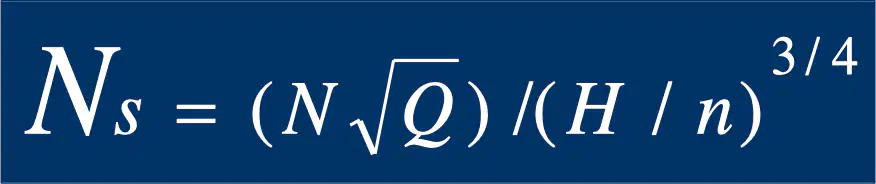
Fill in the blank: The specific speed for each unit in series is given by the formula _______.
(H/n)3/4NQ
H0.75NQ0.5
H0.5NQ
H1.5NQ
If friction consists the major part of the system curve, series operations provide more capacity.
True
False
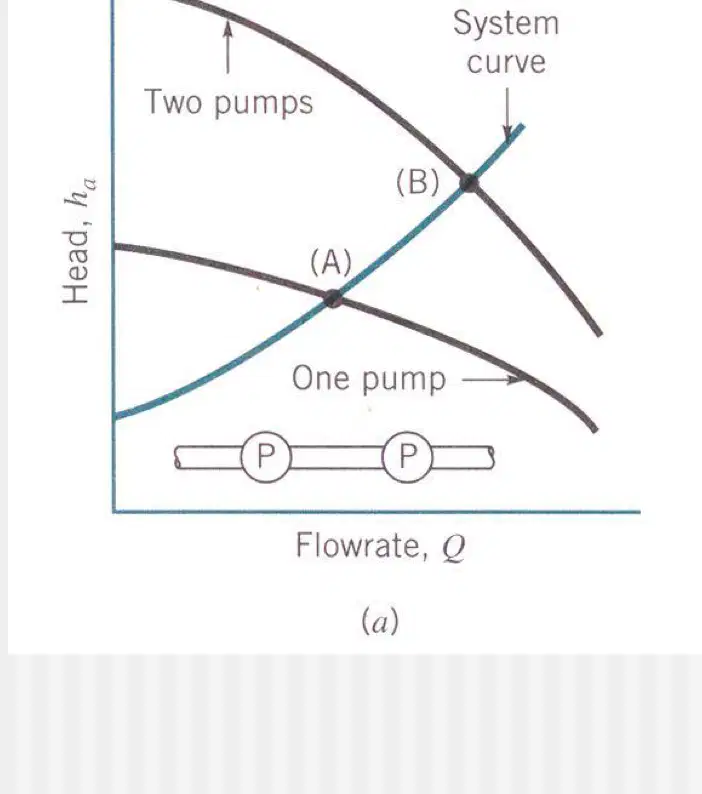
What is the effect of connecting two pumps in series on the head (ha) compared to a single pump?
The head is doubled
The head remains the same
The head is halved
The head decreases
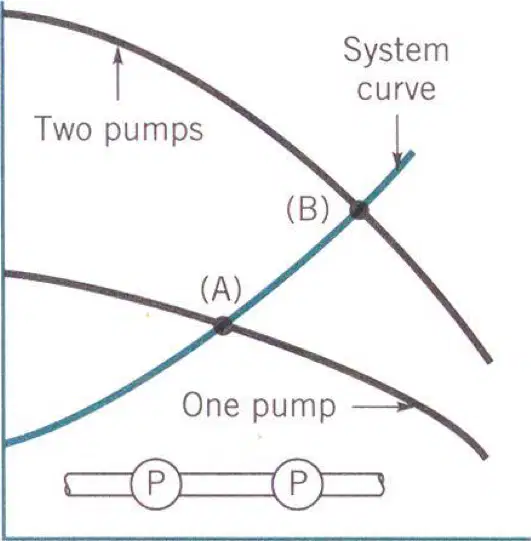
At point (B) on the system curve, how many pumps are operating in series?
One pump
Two pumps

When two pumps are connected in series, the total head (ha) is ______ compared to a single pump.
higher
lower
the same
zero
Pumps in parallel (P//P): Each pump has its own suction pipe but delivers into a _________
common delivery pipe
separate delivery pipe
common suction pipe
individual reservoir
Pumps in parallel (P//P): The head obtained from the two pumps is the same as for a single pump, but the ________ is doubled.
discharge
head
efficiency
power
Pumps in parallel (P//P): The H-Q curve may be obtained by doubling Q for a particular H.
True
False
Pumps in parallel (P//P) This may be the best arrangement when H is relatively constant but Q varies over a wide range. Is this statement True or False?
True
False
If the static head component is a large portion of the system total head and friction losses are low, pumps in parallel provide more capacity. Is this statement True or False?
True
False
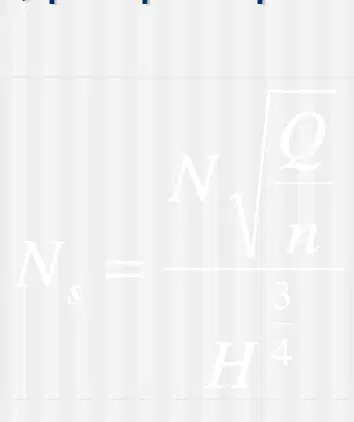
Fill in the blank: The specific speed of each unit is given by the formula:
Ns = N∗Q/n/H3/4
Ns = N∗Q/H(1/2)
Ns = N / (Q * H)
Ns = N∗H3/4/Q
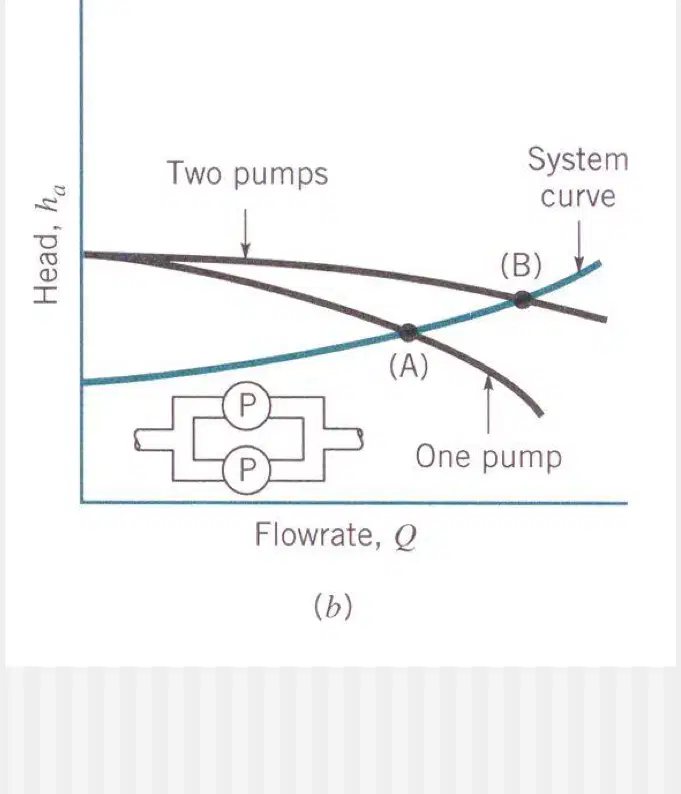
What happens to the flowrate when two pumps are operated in parallel compared to a single pump?
The flowrate decreases
The flowrate remains the same
The flowrate increases
The flowrate becomes zero
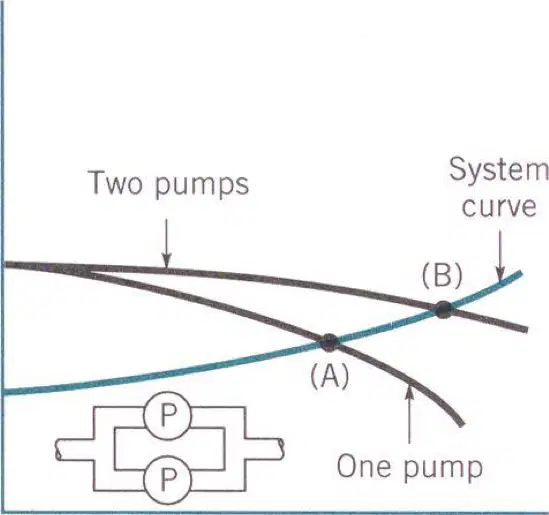
In the diagram titled 'Pumps in parallel (P//P)', at point (A), which configuration is being represented?
Two pumps in parallel
One pump
System curve
No pump
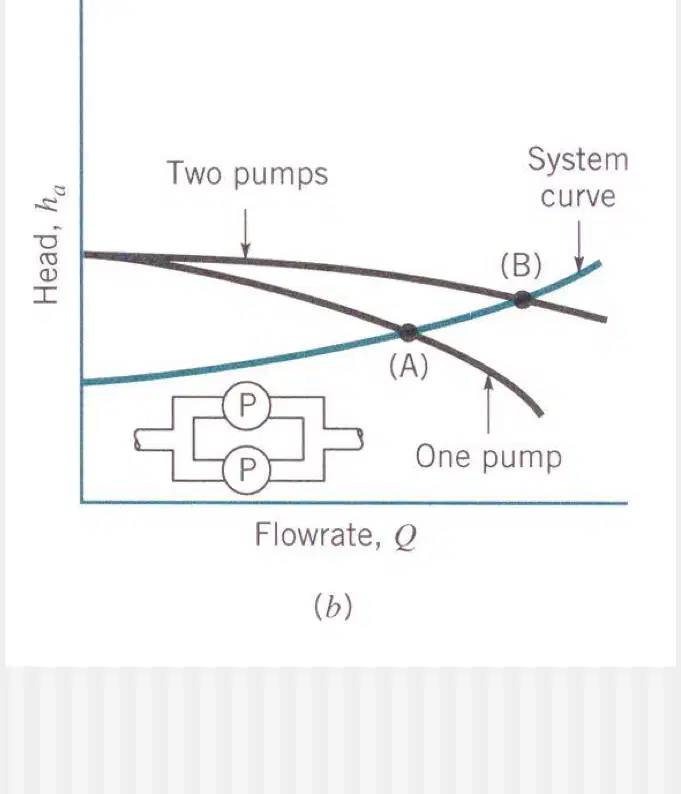
In a parallel pump system, the total flowrate is the _______ of the individual pump flowrates.
sum
average
difference
product
Which of the following is increased by pumps in SERIES?
Flowrate
Total dynamic head (Pressure)
Temperature
Total volume transferred
Pumps in PARALLEL increase the ________ (i.e. Total volume transferred by the pump).
flowrate
pressure
temperature
efficiency
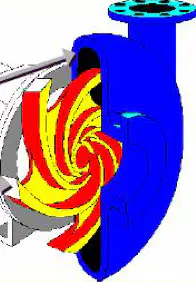
What is the most commonly used pump in water supply systems?
Centrifugal pump
Reciprocating pump
Gear pump
Screw pump
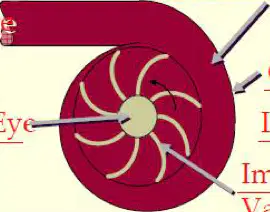
The common feature of all centrifugal pumps is the _______.
Volute
Impeller Shaft
Nozzle
Reciprocating Piston
The impeller vanes in a centrifugal pump rotate to draw water into the center and discharge it by centrifugal force.
True
False
Identify the type of mechanical component shown in the image.
Gear
Pulley
Spring
Cam
What is the location of the dowel pin as indicated in the diagram?
At the parting line
At the center of the core
Near the ejector pin
At the base of the cavity
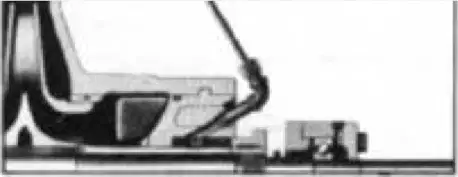
According to TABLE "A", what is the packing size for a pump size of 4 x 6-10?
12
10
14
16
In the diagram, what is the optional feature shown on the right side of the pump?
Internal piping with seal cage
External cooling fan
Pressure relief valve
Integrated flow meter
Which of the following pump sizes has a dimension 'A' of 10.825 according to TABLE "A"?
8 x 8-14
8 x 8-18
8 x 10-17
10 x 12-12
A pump changes both _______ and pressure of the fluid.
velocity
temperature
density
color
A pump only adds to the system energy.
True
False
Power supplied to the pump is to transfer fluid at specified flow rate and pressure by overcoming _______ in the pump and the system.
resistance
temperature
velocity
density
A pump creates pressure and provides flow.
True
False

