
Font size
 Worksheets
year 10 IGCSE Physics
Total questions: 162
Worksheet time: 3hrs 41mins
When does an object falling vertically through the air reach terminal velocity?
when the acceleration of the object becomes negative
when the acceleration of the object is equal to g
when the air resistance equals the weight of the object
when the air resistance is greater than the weight of the object

An athlete runs a 100m race in a straight line. The table shows how his speed changes with time for the first 0.5s of the race. What is the average acceleration of the athlete between time 2.0s and time 3.0s?
1.6m/s^2
1.9m/s^2
4.9m/s^2
5.7m/s^2
The gravitational field strength on the Moon is 1.6N/kg. An astronaut has a mass of 75kg. What is the weight of the astronaut on the Moon?
47N
75N
120N
740N

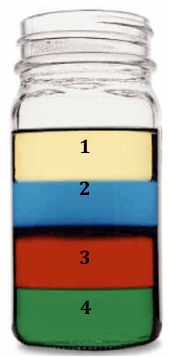
Two objects P and Q are placed in a beaker containing a liquid. Object P floats in the liquid and object Q sinks. Which row for the densities of object P, object Q and the liquid is possible?
A
B
C
D
A ball of mass 0.12kg is hit by a tennis player. The velocity of the ball changes from 0m/s to 5m/s in 0.60s. What is the average resultant force acting on the ball while it is being hit?
1.0N
2.5N
3.6N
8.3N

A balloon and a mass are attached to a rod that is pivoted at a fixed point P. The balloon is filled with helium, which is a gas that is less dense than air. The balloon filled with helium applies an upward force on the rod. The rod is horizontal and in equilibrium. Which action causes the rod to rotate clockwise?
moving the balloon to the 40cm mark and the mass to the 30cm mark
moving the balloon to the 20cm mark and the mass to the 10cm mark
moving the balloon to the 25cm mark and the mass to the 25cm mark
moving the balloon to the 20cm mark and the mass to the 30cm mark

A hole is made in a square tile of uniform thickness. The diagram shows the tile hanging loosely on a nail. Where is the centre of gravity of the tile?
A
B
C
D
An object of mass 0.16kg is moving forwards at a speed of 0.50m/s. A second object of mass 0.10kg is at rest. The first object strikes the second object. After the collision, the second object moves forwards at a speed of 0.50m/ s. What is the speed of the first object after the collision?
0m/s
0.19m/s
0.31m/s
0.5m/s
A ball is at rest at the top of a hill. The ball rolls down the hill. At the bottom of the hill the ball hits a wall and stops. Which energy changes occur?
gravitational potential energy → internal energy → kinetic energy
gravitational potential energy → kinetic energy → internal energy
kinetic energy → gravitational potential energy → internal energy
kinetic energy → internal energy → gravitational potential energy
A man climbs a ladder. Which quantities can be used to calculate the useful power of the man?
the weight of the man and the time taken only
the weight of the man and the vertical distance moved only
the work done by the man and the time taken only
the work done by the man and the vertical distance moved only
A student uses her thumb to push a drawing pin (thumb tack) into a notice board. The pin goes into the board but does not penetrate her thumb. Which statement explains this?
The force exerted by the pin on her thumb is greater than the force exerted by the pin on the notice board.
The force exerted by the pin on the notice board is greater than the force exerted by the pin on her thumb.
The pressure of the pin on her thumb is greater than the pressure of the pin on the notice board.
The pressure of the pin on the notice board is greater than the pressure of the pin on her thumb.
A submarine is a boat that can travel below the surface of the sea. A submarine is 20m below the surface of the sea. The pressure due to the sea water at this depth is P. On another day, the submarine is 26m below the surface of fresh water. The density of sea water is 1.3 times the density of fresh water. What is the pressure due to the fresh water at a depth of 26m?
P/1,3
P
1.3P
1.7P
When particles of a gas collide with a wall of a container, the wall experiences a pressure. What is the cause of this pressure?
the change in energy of the particles
the change in momentum of the particles
the change in power of the particles
the change in speed of the particles
Copper is a type of metal. A block of copper has a mass of 2.0kg. The block of copper absorbs 12000J of thermal energy. The specific heat capacity of copper is 385J /(kg°C). What is the temperature rise of the copper?
15.6°C
31.2°C
46.8°C
62.4°C

The diagram shows the gap between a hot surface and a cold surface. The gap can contain air (gas), iron (solid), a vacuum or water (liquid). Which material in the gap allows the quickest transfer of thermal energy between the surfaces by conduction?
air (gas)
iron (solid)
Vacuum
Water (liquid)

Which row about boiling and about evaporation is correct?
A
B
C
D

The diagram shows four objects on a flat surface. The centre of mass of each object is marked M. Which object is about to fall over?
A
B
C
D

A pool of water evaporates. As molecules escape, the temperature of the water left in the pool changes. From where do the molecules escape and what is the effect on the temperature of the water in the pool?
A
B
C
D

Two farmers use an electrically powered elevator to lift bales of hay. All the bales of hay have the same mass. As sunset approaches, they increase the speed of the elevator so that more bales are lifted up in a given time. How does this affect the work done in lifting each bale and the useful output power of the elevator?
A
B
C
D

The diagrams show two swimming pools. One contains fresh water and the other contains salt water. Salt water is more dense than fresh water. At which labelled point is the pressure the greatest?
A
B
C
D
What is kinetic energy?
moving energy
potential energy
stored energy
renewable energy
The energy in which store decreases as a candle burns?
Chemical energy store
Kinetic energy store
Nuclear energy store
_______________ is when energy is transferred due to charge flowing around a circuit.
Electrically
Kinetic
Mechanically
By radiation
________ is when energy is transferred between areas that have different temperatures.
By radiation
By heating
Mechanically
Nuclear
When you eat fruits and vegetables, the energy is stored as ...
a. thermal energy
b. food energy
c. electrical energy
d. chemical energy


A stretched rubber band has energy in this energy store
Magnetic
Electrostatic
Elastic
Nuclear
What is a renewable energy source.
Coal
Solar Power
Nuclear Power
Natural Gas
What is a non renewable energy source.
Solar Power
Wind
Natural Gas
Tidal
It takes over millions of years for fossil fuels to form underground.
True
False
What are the 3 MAIN types of fossil fuels?
Coal - Oil - Nuclear
Coal - Oil - Solar
Oil - Coal - Gas
How are fuels normally used?
Cooked
Burnt
Boiled
As they come
Fossil Fuels are reliable
True
False
Running costs for fossil fuels are high
True
False
The releasing of stored chemical energy in fuels by burning; burning gas in car, burning wood is called ____________________________.
combustion
fossil fuels
resources
greenhouse gases
What is the energy produced by moving water?
hydroelectric power
streams
hydrowater power
rivers
What is it called when two hydrogen nuclei combine to form one helium nucleus which has less mass than the hydrogen nuclei?
nucleus
nuclear power
nuclear fusion
nuclear fission
Coal is formed from .....
decaying plant remains
hydrogen atoms
nuclei
living plants and animals
If we had the technology, why could nuclear fusion be better than nuclear fission?
produces more energy
produces less energy
___________________ stops the transfer of heat.
Insulation
Air conditioners
Heating systems
Windows
The intense heat from Earth’s interior is called ____________________________________________ energy.
thermal
geothermal
solar
wind
What are the units of power?
Joules
Newtons
Amps
Watts
Kilowatt-hours
What quantity is measured in kilograms?
(a)
What is the correct formula for force?
Mass x weight
Mass x velocity
Mass x acceleration
Mass x time
Mass x distance
If two cars are travelling towards each other, which of these statements is true.
One has a negative time
One has a negative mass
One has a negative distance
One has a negative momentum
One has a negative kinetic energy
What is the average speed equation?
average speed = total time / distance travelled
average speed = time taken / total distance
average speed = total distance travelled / time taken
average speed = total distance travelled x time taken
What is the symbol equation for acceleration?
a = (v + u) / s
a = (v - u) / t
a = (u - v) / t
a = (u - v) / s
Which of the following equation is the average speed equation re-arranged so that 'time taken' is the subject.
time taken = average speed / distance travelled
time taken = average speed x distance travelled
time taken = distance travelled / average speed
time taken = distance travelled x average speed
Which of the following equation is the acceleration equation re-arranged so that 'change in velocity' is the subject.
change in velocity = acceleration / time taken
change in velocity = acceleration x time taken
change in velocity = time taken x acceleration
change in velocity = time taken / acceleration
What is the Equation for Weight?
Weight = Mass x Gravitational Field Strength
Weight = Mass / Gravitational Field Strength
Weight = Gravitational Field Strength / Mass
What is the Equation for Force applied to a Spring?
Force applied to a Spring = Spring Constant x Extension
Force applied to a Spring = Spring Constant / Extension
Force applied to a Spring = Extension / Spring Constant
What is the Equation for Wave Speed?
Wave Speed = Wave Length x Frequency
Wave Speed = Wave Length / Frequency
Wave Speed = Frequency / Wave Length
What is the Equation for Charge Flow?
Charge Flow = Current x Time
Charge Flow = Current / Time
Charge Flow = Time / Current
What is another Equation for Power?
Power = Potential Difference x Current
Power = Potential Difference / Current
Power = Current / Potential Difference
What is the equation that links current (I), potential difference (P) and resistance (R)?
Potential difference = Current x Resistance, or V=IR
Potential difference = Current / Resistance, or V=I/R
Potential difference = Resistance / Current, or V=R/I
What is the equation that links Power (P), Time (t) and Work Done (W)?
Power = Time x Work Done, or P=tW
Power = Time / Work Done, or P=t/W
Power = Work Done / Time, or P=W/t
What is the average speed equation?
average speed = total time / distance travelled
average speed = time taken / total distance
average speed = total distance travelled / time taken
average speed = total distance travelled x time taken
What are the standard units of acceleration?
m
s
m s-1
m s-2
Force is measured in
meter
Newton
kg
Nm
the unit of power is
Volts
Watt
Joule
W/s
Momentum is a vector quantity
yes
No
Extension in spring is measured in
sec
kg
Ampere
cm
Moment of Force has a unit of
N
Ns
Nm
m
The units of frequency are...
metres
seconds
Hertz
degrees
Light is an example of a transverse wave
True
False
Sound is an example of a transverse wave
True
False
Which of the following statements describes the period of a wave?
Number of waves per second
Distance from crest to crest
Distance from resting position to top of the wave
Time taken to produce one wave
The lowest frequency form of visible light is...
Red
Yellow
Green
Violet
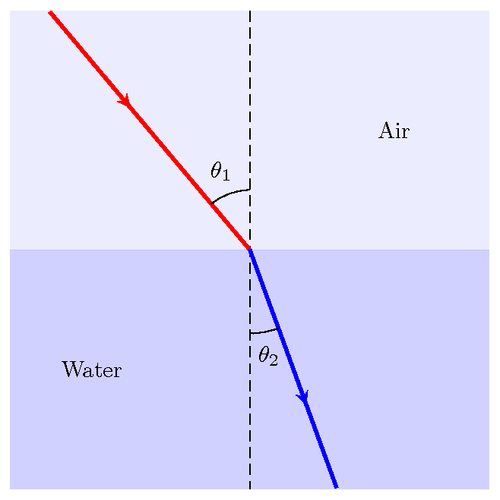
The following image demonstrates...
Reflection
Refraction
Interference
Diffraction
What is the correct equation linking speed of a wave frequency and wavelength
v = f x λ
v = f / λ
v = λ / f
106.00
0.678
How many milliliters are in 13 liters? (1 liter = 1,000 milliliters)
0.013 mL
130 mL
1,300 mL
13,000 mL

10 m = _____ mm
10,000 mm
100 mm
1 mm
1,000 mm
987 mm = _____ cm
98.7 cm
9,870 cm
9.87 cm
0.987 cm
18 kg = _____ g
180 g
1,800 g
1.8 g
18,000 g

What is the number of protons that the element in this image contain?
14
7
21

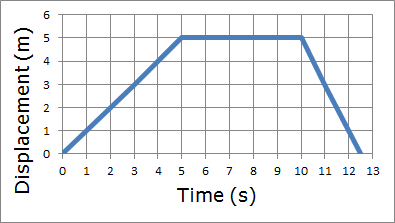
According to the graph how fast does the person travel in the first 5 seconds?
2 m/s
10 m/s
12.5 m/s
1 m/s

How far does the car travel at constant speed?
75 m
150 m
200 m
250 m
How far does the car travel whilst decelerating
75 m
150 m
200 m
250 m

The graph shows the vertical speed of a parachutist. At which point did they open the parachute?
A
B
C
D
A parachutist of mass 75 kg jumps from a plane at a height of 4 000 m above sea level.
The parachutist falls through a distance of 2 400 m during the first 60 seconds. Calculate the average speed of the parachutist during this time.
20 m/s
40 m/s
67 m/s
80 m/s
Just after the parachutist jumps out of the plane (before the parachute opens). The relative forces on them are:
downward weight balances the upward friction force
upward friction is constant
downward weight is greater that the upward friction
upward friction is greater than the downward weight
John, mass = 68 kg dives out of an aeroplane
a) What is John's weight
b) What happens to John's weight as he falls?
a) 0.68 N
b) stays the same
a) 680 N
b) stays the same
a) 680 N
b) increases
a) 0.68 N
b) decreases
A submarine is found 20 meters below the surface of the sea. The density of sea water is 1020 kg m-3 and g = 10 m/s2 Calculate the pressure due to the sea water acting on the submarine?
20.4 Pa
2.04 x 10³ Pa
2.04 x 10² Pa
2.04 x 10⁵ Pa
2.04 x 10⁻² Pa
The pressure due to water at the base of a pond is measured as 50 kPa. What is the depth of the pond?
[density of water is 1,000 kg m-3]
10 m
0.5 m
2 m
5 m

The greatest ocean depths on the Earth are found in the Marianas Trench near the Philippines. Given its depth is 11.0 km and the density of seawater is 1200 kg/m3, How do you calculate the pressure due to the ocean at the bottom of this trench.
1200x10x11
1200x11
1200x11000x10
1200x10

What types of waves transfer energy perpendicular to the direction of oscillations?
Longitudinal waves
Transverse waves
Sound waves
P-waves
What is the speed of a wave that has a wavelength of 2 and a frequency of 2.5 Hz?
2.5 m/s
5 m/s
4.5 m/s
6 m/s
What is a transfer of thermal energy by electromagnetic waves?
Radiation
Convection
Conduction
Heat

What would be the effect on the particles if the gas is heated?
They would slow down
They would stop moving
They would speed up
There would be no effect
Object A has a specific heat capacity of 250 J/kg/⁰C and object B has a specific heat capacity of 1820 J/kg/⁰C. Which object will heat up faster if they have the same mass?
Object A, it has a lower specific heat capacity
Object B, it has a lower specific heat capacity
Object A, it has a higher specific heat capacity
Object B, it has a higher specific heat capacity
How much energy (Q) is released when a 25.00 g piece of aluminum foil (shc = 897 J/kg/°C) is taken out of the oven and cools from 100.00 °C to 25.00 °C?
1682 J
394J
1259 J
985 J

Which line shows how the extension depends on the force applied for a wire
A
B
C
D
Which line shows how the extension depends on the force applied for a rubber band
A
B
C
D
Calculate the mass of a object with density 2 g/cm3 and dimensions 10 cm x 5 mm x 1 m
0.04 g
1000 g
100 g
25 g


A
B
C
D
A tunnel has a length of 50 km. A car takes 20 min to travel between the two ends of the tunnel. What is the average speed of the car?
2.5 km / h
16.6 km / h
150 km / h
1000 km / h

pole 1 and pole 2.
pole 2 and pole 3.
pole 3 and pole 4.
pole 4 and pole 5.

A
B
C
D

A
B
C
D
A small steel ball is dropped from a low balcony. Ignoring air resistance, which statement describes its motion?
It falls with decreasing acceleration.
It falls with constant acceleration.
It falls with decreasing speed.
It falls with constant speed.

Which speed/ time graph applies to an object at rest?
A
B
C
D

A
B
C
D

10 m
20 m
100 m
200 m

150 m
300 m
600 m
1200 m

4.0 s
6.0 s
10 s
16 s

A
B
C
D

A
B
C
D

A
B
C
D

A
B
C
D

A
B
C
D

A
B
C
D

A
B
C
D

A
B
C
D

A
B
C
D


A resultant force of 4.0N acts on an object of mass 0.50 kg for 3.0 seconds.
What is the change in velocity caused by this force?
4.0 m / s
6.0 m / s
12 m / s
24 m / s
Which property of an object cannot be changed by a force?
mass
motion
shape
size
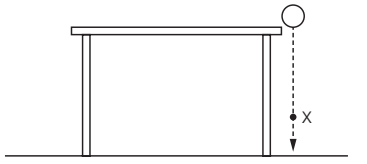
A ball is dropped from a table-top. Air resistance may be ignored.
Which row describes the velocity and the acceleration of the ball at point X
acceleration = constant; velocity = constant
acceleration = constant; velocity = increasing
acceleration = increasing; velocity = constant
acceleration = increasing; velocity = increasing

When the velocity of the car is constant, the force of friction on it is
zero
greater than the driving force
smaller than the driving force
the same size as the driving force
Which are the units for acceleration
m/s
m/s2
s/m
m/s3
The cyclist accelerates at 1.4 m/s2.
The mass of the cyclist and bicycle is 60 kg.
Calculate the resultant force.
(a)


The unit of force is...
m/s
m
N
kg
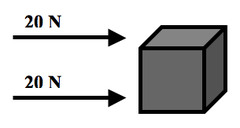
What is the resultant force?
40 N, Left
0 N, Balanced
400 N, Right
40 N, Right

What is the resultant force?
400 N, Up
400 N, Down
800 N, Up
800 N, Down

What is the resultant force?
17 N, Left
6N, Right
11N , Left
12N, Left

What is the resultant force?
40N, Left
40N, Right
0N, Balanced
75N, Right

