Wayground logo

Free Printable Worksheets

Font size

S
M
L
XL
Worksheets

EXTRA PRACTICE: Graph Characteristics/Transformations Quadratic

Total questions: 133

Worksheet time: 5hrs 36mins

Name
Class
Date
1.
Is this a max or min?
a)
max
b)
min
c)
cannot be determined
2.
A line about which a figure is symmetric is the:
a)
Solution Set
b)
Intercept Formula
c)
Quadratic Function
d)
Axis of Symmetry
3.
What is the Axis of symmetry?
a)
Y=3
b)
y=-3
c)
x= 3
d)
x=-3
4.

What is the significance of the ordered pair (2, -4) to the graph?

a)

It is the vertex

b)

It is an x-intercept

c)

It is the y-intercept

d)

It is the axis of symmetry

5.

Determine the domain and range of the function

a)

Domain: All real numbers, Range: All real numbers

b)

Domain: x ≥ -4, Range: All real numbers

c)

Domain: All real numbers, Range: y ≥ -4

d)

Domain: -1 ≤ x ≤ 5, Range: y ≥ -4

6.

Quadratic equations take the shape of a _______ when graphed.

a)

parabola

b)

straight line

c)

snaked line

d)

elliptical

7.
Use the picture to find  the vertex and axis of symmetry
a)
 Vertex (3,8) Axis x=3
b)
Vertex (3,8) Axis y=3
c)
Vertex (8,3) Axis x=3
d)
Vertex (8,3) Axis y=3
8.

State the vertex of the graph whose function is  f(x)=(x−4)2+8f\left(x\right)=\left(x-4\right)^2+8  

a)

(4,8)

b)

(4, -8)

c)

(-4, 8)

d)

(-4, -8)

9.

Does the following graph of the quadratic have a maximum or minimum: y=−3(x+4)2+7y=-3\left(x+4\right)^2+7  

a)

maximum

b)

minimum

c)

neither

d)

both

10.

State the axis of symmetry  y=−3(x+4)2+7y=-3\left(x+4\right)^2+7  

a)

x=4x=4  

b)

y=4y=4  

c)

x=−4x=-4  

d)

y=−4y=-4  

11.

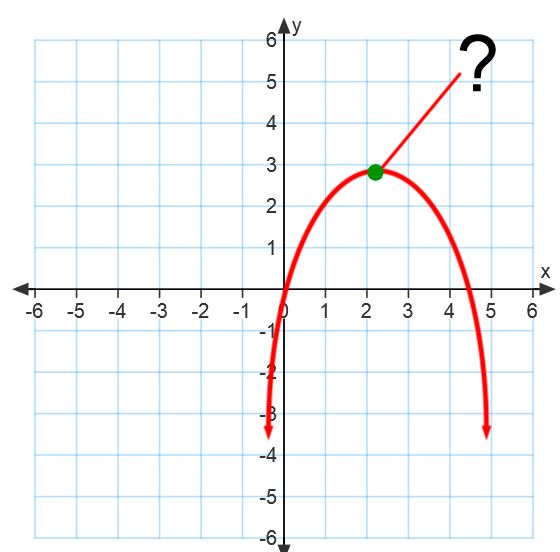
What is the green dot on the parabola called?

a)

maximum

b)

minumum

c)

roots

d)

zeros

12.

What is the range of this parabola?

a)

All real #'s

b)

y > -1

c)

y < -1

d)

x > -4

13.
Does the parabola
f(x)=4(x-2)2 + 3
open up or down?
a)
up
b)
down
14.
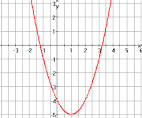
What is the equation of this graph?
a)
f(x) = (x -5)2 + 1
b)
f(x) = (x - 1)2 - 5
c)
f(x) = (x + 1)2 - 5
d)
f(x) = (x + 5)2 +1
15.
Factor x2 + 7x + 12
What two numbers ADD UP TO 7 
and MULTIPLY to 12. 
a)
(x + 2)(x + 5)
b)
(x + 3)(x + 4)
c)
(x + 1)(x + 6)
16.
Factor x2 + 12x + 20
WHAT TWO NUMBERS MULTIPLY TO 20
AND ADD UP TO 12? 
a)
(x + 2)(x + 10)
b)
(x + 7)(x + 5)
c)
(x + 6)(x + 6)
17.
What piece of information does h identify in the following equation?
y=a(x-h)2+k
a)
y value of the vertex
b)
Axis of Symmetry and the x coordinate of the vertex
c)
Direction (facing up or down)
d)
x-intercept
18.
What causes the graph of y = x2 to open downward?
a)
multiply the x2 by a fraction
b)
multiply the x2 by a decimal
c)
multiply the x2 by a negative number
d)
multiply the x2 by a number greater than 1
19.
Which of the following is the correct equation for the given graph?
a)
f(x) = -(x + 2)2 - 4
b)
f(x) = -(x - 2)2 - 4
c)
f(x) = -3(x - 2)2 - 4
d)
f(x) = -3(x + 2)2 - 4
20.
Which of the following is a transformation of the graph y = 3x2.
a)
Shifts up 3.
b)
Shifts left 3.
c)
Vertical stretch by a factor of 3.
d)
Shifts right 3.
21.

Using the graph of the quadratic function, identify the y-intercept.

a)

(4, -6)

b)

(0, 2)

c)

(.5, 0)

d)

(7.5, 0)

22.

Using the graph of the quadratic function, identify the vertex.

a)

(4, -6)

b)

(0, 2)

c)

(.5, 0)

d)

(7.5, 0)

23.

What is Standard form?

a)

y=ax2+bx+cy=ax^2+bx+c  

b)

y=a(x−p)(x−q)y=a\left(x-p\right)\left(x-q\right)  

c)

y=a(x−h)2+ky=a\left(x-h\right)^2+k  

d)

y=mx+by=mx+b  

24.

x-intercepts are also known as...

a)

Zeros

b)

Roots

c)

Solutions

d)

I have no idea what you are talking about

25.
Find the zeros.
a)
0 and 4
b)
0 and -4
c)
0
d)
-4
26.

A parabola has a vertex at (-3,2). Where is the axis of symmetry?

a)

y = -2

b)

x = 3

c)

x = -3

d)

y = 2

27.

What is the axis of symmetry for the following equation?

y=4x2-8x+9

a)

x=-8

b)

x=1

c)

x=-1

d)

x=2

28.
Does this graph in the back have maximum or minimum value?
a)
maximum
b)
minimum
c)
neither
d)
both
29.
The two solutions to 
y = 2x2 -x -3 are...
a)
1 and 3/2
b)
-1 and 3/2
c)
-1 and -3/2
d)
1 and -3/2
30.

Identify where the function is decreasing.

a)

(−∞,0)\left(-\infty,0\right)  

b)

(0,∞)\left(0,\infty\right)  

c)

(−∞,∞)\left(-\infty,\infty\right)  

d)

(−3,3)\left(-3,3\right)  

31.

Identify where the function is increasing.

a)

(−∞,0)\left(-\infty,0\right)  

b)

(0,∞)\left(0,\infty\right)  

c)

(−∞,∞)\left(-\infty,\infty\right)  

d)

(−3,3)\left(-3,3\right)  

32.

Determine if the function graphed has a maximum or a minimum value and identify that value.

a)

maximum at -1

b)

minimum at -1

c)

maximum at 4

d)

minimum at 4

33.

What is the direction of the following graph?

a)

Increasing

b)

Decreasing

c)

Constant

d)

Not a function

34.
Describe the end behavior of the graph.
a)
x → ∞, y→ ∞ and
x→ ∞, y→⁻∞
b)
x → ∞, y→ ∞ and
x→⁻∞, y→∞
c)
None of these
d)
x →∞,y→⁻∞ and
x→∞, y→⁻∞
35.
Which one means the function goes down on the left
a)
x →-∞, y→∞
b)
x →-∞, y→-∞
36.
Which one means up
a)
y →-∞
b)
y →∞
37.
Where is the function decreasing?
a)
y≤-1
b)

y≤-1

c)
y≤3
d)

y≥3

38.

Where is the function increasing?

a)

y≤0

b)

y≥0

c)

y≥4

d)

y≤4

39.
The graph of a quadratic function is called a
a)
Parabola
b)
Vertex
c)
Axis of Symmetry 
d)
Vertex Form
40.
What divides the parabola into 2 perfect halves?
a)
Axis of Symmetry
b)
Vertex
c)
Axis of Doom
d)
x - intercept
41.
What do we call the highest or lowest point of a quadratic?
a)
parabola
b)
vertex
c)
graph
d)
point
42.
What is the vertex?
a)
(2, 4)
b)
(3, -1)
c)
(0, 8)
d)
(4, 2)
43.
What are the x- intercepts?
a)
x= 0 and x= -4
b)
x= 0 and x= 4
c)
y= 0
d)
x= 2
44.
The axis of symmetry of this parabola is...
a)
y = 4
b)
y = -4
c)
x = 4
d)
x = -4
45.
What is the domain of this quadratic function?
a)
All real numbers.
b)
x ≥ 4
c)
x < 2
d)
x ≤ 4
46.
What is the range of this quadratic function?
a)
All real numbers.
b)
y ≥ 4
c)
y < 4
d)
y ≤ 4
47.
What is the vertex of this quadratic equation?  
y = 2(x - 2)2  +  5
a)
(-2,5)
b)
(2,5)
c)
(5,-2)
d)
(-5,-2)
48.
Given the equation for this parabola:
 y=-(x-4)2-3,
does this parabola have a maximum or minimum value?
a)
Maximum
b)
Minimum
49.
In vertex form, what effect does the a have on the graph?
a)
Translates Up/Down
b)
Translates Left/Right
c)
Narrows/Widens Parabola
d)
Flips it
50.
In vertex form, what effect does the h have on the graph?
a)
Translates Up/Down
b)
Translates Left/Right
c)
Narrows/Widens Parabola
d)
Flips it
51.
Which quadratic function is represented by the graph?
a)
y = 2(x - 4)2 + 5
b)
y = 2(x + 4)2 + 5
c)
y = -2(x - 4)2 + 5
d)
y = -2(x + 4)2 + 5
52.
How would you describe the translation from f(x)=x2  to  f(x)=(x-3)2 ?
a)
Horizontal translation: three units to the left
b)
Horizontal translation: three units to the right
c)
Vertical translation: three units up
d)
Vertical translation: three units down
53.
Shift f(x)=x2 three units to the left and 4 units down
a)
f(x)=(x+3)2-4
b)
f(x)=(x-3)2-4
c)
f(x)=(x+4)2-3
d)
f(x)=(x-4)2-3
54.
How would you describe the translation from f(x)=x2  to  f(x)=x2+5 ?
a)
Horizontal translation: five units to the right
b)
Horizontal translation: five units to the left
c)
Vertical translation: five units up
d)
Vertical translation: five units down
55.

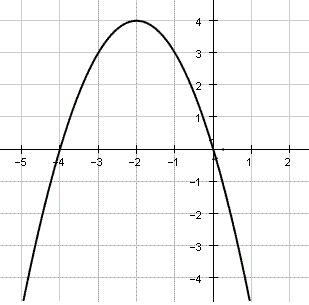
What is the axis of symmetry of the graph?

a)

x=−2x=-2

b)

x=4x=4

c)

y=−2y=-2

d)

y=4y=4

56.

What is the vertex of the graph?

a)

(−2, 4)\left(-2,\ 4\right)

b)

(4, −2)\left(4,\ -2\right)

c)

(2,4)\left(2,4\right)

d)

(4,2)\left(4,2\right)

57.

Does this graph have a maximum or minimum?

a)

Maximum at (−2,4)\left(-2,4\right)

b)

Minimum at (−2, 4)\left(-2,\ 4\right)

58.

What is the range of the graph?

a)


y≤4y\le4

b)

x≤4x\le4

c)

y≥4y\ge4

d)

x≥4x\ge4

59.

What is the axis of symmetry of the graph?

a)


x=−2x=-2

b)

x=0x=0

c)

y=−2y=-2

d)

y=0y=0

60.

What is the vertex of the graph?

a)


(−2,0)\left(-2,0\right)

b)

(0,−2)\left(0,-2\right)

c)

(2,0)\left(2,0\right)

d)

(0,2)\left(0,2\right)

61.

Does this graph have a maximum or minimum?

a)

Maximum at (−2,0)\left(-2,0\right)

b)

Minimum at (−2,0)\left(-2,0\right)

62.

What is the range of the graph?

a)


y≥0y\ge0

b)

x≥0x\ge0

c)

y≤0y\le0

d)

x≤0x\le0

63.

What is the axis of symmetry of the graph?

a)


x=−4x=-4

b)

y=−4y=-4

c)

x=1x=1

d)

y=1y=1

64.

What is the vertex of the graph?

a)


(−4, 1)\left(-4,\ 1\right)

b)

(1,−4)\left(1,-4\right)

c)

(−4, −1)\left(-4,\ -1\right)

d)

(−1, −4)\left(-1,\ -4\right)

65.

Does this graph have a maximum or minimum?

a)

Maximum at (−4,1)\left(-4,1\right)

b)

Minimum at (−4,1)\left(-4,1\right)

66.

What is the range of the graph?

a)

y≤1y\le1

b)

x≤1x\le1

c)

y≥1y\ge1

d)

x≥1x\ge1

67.

The graph of a quadratic is called a?

a)

curve

b)

circle

c)

line

d)

parabola

68.

What is the significance of the ordered pair (2, -4) to the graph?

a)

It is the vertex

b)

It is an x-intercept

c)

It is the y-intercept

d)

It is the axis of symmetry

69.
Is this a max or min?
a)
max
b)
min
c)
cannot be determined
70.

Using the graph of the quadratic function, identify the y-intercept.

a)

(4, -6)

b)

(0, 2)

c)

(.5, 0)

d)

(7.5, 0)

71.
What is the Axis of symmetry?
a)
Y=3
b)
y=-3
c)
x= 3
d)
x=-3
72.
The axis of symmetry of this parabola is...
a)
y = 4
b)
y = -4
c)
x = 4
d)
x = -4
73.
What form is the following equation written in?
y = 2(x - 2)2 + 4
a)
Standard
b)
Vertex
c)
Factored
d)
Hege
74.
What form is the quadratic equation written in?
y = 2x2 + 5x + 5
a)
Hege
b)
Vertex
c)
Standard
d)
Factored
75.
What form is the quadratic equation written in?
y = (x - 2)(x + 4)
a)
Factored
b)
Standard
c)
Vertex
d)
Hege
76.
What are the x-intercept(s) for the graph of the function:  y = (x - 2)(x + 4)
a)
-2, -4
b)
-2, 4
c)
2, -4
d)
2, 4
77.
What is the y-intercept for the graph of the function:  y = (x - 2)(x + 4)
a)
2
b)
-4
c)
-6
d)
-8
78.
What is the y-intercept for the graph of the function:  y = x2 - 3x - 10 
a)
3
b)
-3
c)
-10
d)
10
79.
What is the vertex for the graph of the function?  y = -2 (x - 3)2 + 4 
a)
(3, 4)
b)
(-3, 4)
c)
(-3, -4)
d)
(3, -4)
80.
What is the equation for the axis of symmetry for the graph of the function?
y = (x - 1)2 + 9
a)
x = -1 
b)
x = 1
c)
x = 9
d)
x = -9
81.
What can we find easily in standard form?
a)
vertex
b)
zeros/x-intercepts
c)
y-intercept
82.
What can we find easily in factored form?
a)
y-intercept
b)
vertex
c)
zeros/x-intercepts
83.
What can we find easily in vertex form?
a)
vertex
b)
y-intercept
c)
zeros/x-intercepts
84.
What is the vertex of y=x2+4x+3?
a)
(2,1)
b)
(-2,1)
c)
(0,0)
d)
(-2,-1)
85.

Find the axis of symmetry of f(x) = -(x + 2)(x - 4)

a)

y = 1

b)

x = 1

c)

y = -1

d)

x = -1

86.

WITHOUT USING DESMOS

If the x intercepts are -3 and 5, which equation in intercept form would represent this?

a)

y=(x+3)(x−5)y=\left(x+3\right)\left(x-5\right)

b)

y=(x−3)(x−5)y=\left(x-3\right)\left(x-5\right)

c)

y=(x−3)(x+5)y=\left(x-3\right)\left(x+5\right)

d)

y=(x+3)(x+5)y=\left(x+3\right)\left(x+5\right)

87.

Describe the transformation: y=-3(x-2)2-4.

*Mark all that apply.

a)

reflection across x-axis

b)

VS by factor of 3

c)

VC by factor of 3

d)

down 4

e)

right 2

88.

y=(x+2)2+4

*Mark all that apply.

a)

reflection across x-axis

b)

left 2

c)

up 4

d)

right 2

89.

y=-2(x+5)2

*Mark all that apply.

a)

right 5

b)

left 5

c)

VC by a factor of 2

d)

reflection across x-axis

e)

VS by a factor of 2

90.

y= -(x-11)2+6

*Mark all that apply.

a)

right 11

b)

reflection across x-axis

c)

VC

d)

up 6

91.

y= 1/4x2+8

*Mark all that apply.

a)

VC by a factor of 1/4

b)

up 8

c)

left 8

d)

right 8

92.

y= 5/3(x-7)2 - 8

*Mark all that apply.

a)

right 7

b)

up 8

c)

down 8

d)

VS by a factor of 5/3

93.

Write the equation of this transformation: up 8

a)

y=(x+8)2

b)

y= x2+8

c)

y= x2-8

d)

y=8x2

94.

Write the equation of this transformation: reflection across x-axis, left 2, down 5

a)

y= -(x+2)2+5

b)

y= -(x+2)2

c)

y= (x-2)2-5

d)

y= -(x+2)2-5

95.

Write the equation of this transformation: VC by a factor of 1/7 and up 2

a)

y= 7x2 + 2

b)

y= (x+1/7)2 + 2

c)

y= 1/7x2 + 2

d)

y= 1/7x2 - 2

96.

Write the equation of this transformation: reflection across x-axis, left 3, up 15

a)

y= -(x+3)2+15

b)

y= -(x+3)2 - 15

c)

y= (x+3)2+15

d)

y= -(x+15)2+3

97.
What are the transformations?
y = (x - 2)2 + 4
a)
shift 2 units right
shift 4 units up
b)
shift 2 units left
shift 4 units up
c)
shift 2 units right
shift 4 units down
d)
shift 2 units left
shift 4 units up
98.
Does the following quadratic equation have a maximum or minimum value? How can you tell?
y=x
²+2x-3
a)
Minimum value, because the a value is positive
b)
Maximum value, because the b value is positive
c)
Maximum value, because the a value is positive
d)
Minimum value, because the c value is negative
99.
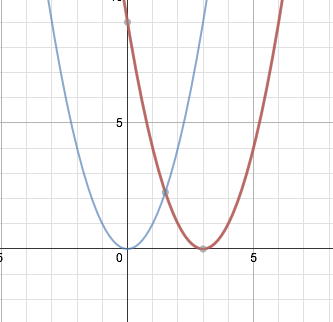
If the blue is f(x) = x2 , the red must be:
a)
g(x) = (x + 3)2
b)
g(x) = (x - 3)2
c)
g(x)= x2 + 3
d)
g(x) = x2 - 2
100.
How did we transform from the parent function?
y = x2 + 2
a)
horizontal shift up
b)
vertical shift up
c)
horizontal shift down
d)
vertical shift down
101.
What is the horizontal shift of this equation?
y = -(x + 3)2 - 5
a)
left 3
b)
right 3
c)
left 5
d)
right 5
102.
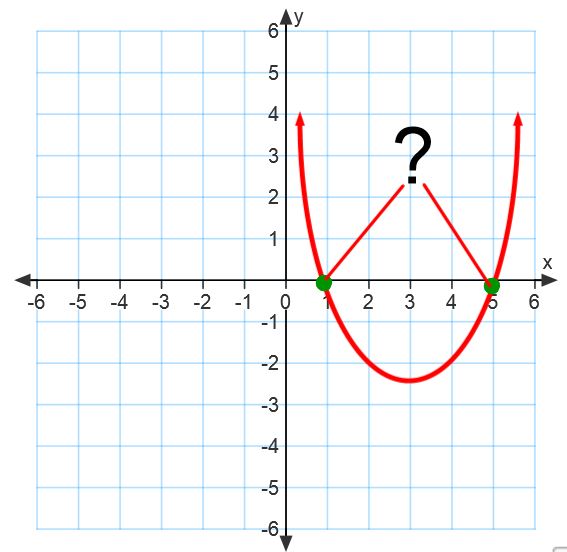
What are the green dots called?
a)
axis of symmetry
b)
vertex
c)
parabola
d)
roots or x-intercepts
103.
Which of the following does NOT contain a REFLECTION of y = x2?
a)
y = -2(x + 5)2 + 3
b)
y = (-3x + 5)2 + 3
c)
y = (1/2) (x + 5)2 + 3
d)
y = -x2 + 3
104.
Which transformation maps the graph of
f(x) = x2 to the graph of g(x) = (x + 4)2?
a)
a reflection across the line x = -4
b)
a reflection across the line y = -4
c)
a translation shifting f(x) 4 units to the left
d)
a translation shifting f(x) 4 units to the right
105.
How does the graph of f(x) = (x + 3)2 + 5 compare to the graph of
g(x) = (x - 1)2 - 4. {Hint: Compare their vertexes.}
a)
f(x) is shifted 4 left and 9 up from g(x)
b)
f(x) is shifted 4 to the right and 9 down from g(x)
c)
f(x) is shifted 3 left and 5 up from g(x)
d)
f(x) is shifted 4 left and 9 down from g(x)
106.
What is vertex form of a quadratic function
a)
ax2 + bx + c
b)
a(x - h)2 + k
c)
y - y1 = m(x - x1)
d)
Ax + By = C
107.
Does the following function have a maximum or a minimum
f(x) = -2(x+3)2 - 5
a)
Maximum
b)
Minimum
108.
What is the y-intercept of the following function?
f(x) = -2x2 + 3x - 7
a)
(0, -2)
b)
(0, 3)
c)
(0, -7)
d)
(0, 7)
109.
The standard form of a quadratic function is:
a)
ax2 + bx + c
b)
a(x - h)2 + k
c)
y - y1 = m(x - x1)
d)
Ax + By = C
110.
If a is negative in the function, which way does the parabola 
a)
up
b)
down
c)
left
d)
right
111.
Does the following function open up or down 
1/2(x + 2)2 - 3
a)
up
b)
down
c)
left
d)
right
112.
The quadratic parent function is
a)
y = x
b)
f(x) = x
c)
f(x) = x2
d)
y = √x
113.
y = (x + 2)2 + 9
This graph shifts... 
a)
Left 2, down 9
b)
Left 2, up 9 
c)
Right 2, up 9
d)
Right 2, down 9 
114.

What is the equation for the axis of symmetry?

a)

y=3

b)

x=3

c)

x=5

d)

x=1

115.

Which of the following is the correct equation for the given graph?

a)

f(x) = (x - 2)2 - 1

b)

f(x) = (x + 2)2 - 1

c)

f(x) = -(x + 2)2 - 1

d)

f(x) = -(x - 2)2 - 1

116.

Determine the vertex of the parabola:
y = 5x2 - 20x + 13

a)

(5, -7)

b)

(-2, -7)

c)

(2, -7)

d)

(-7, -2)

117.

Identify ALL of the transformations performed on f(x)=x2f\left(x\right)=x^2 to create the graph of  g(x)=−(x−4)2+2g\left(x\right)=-\left(x-4\right)^2+2  

a)

reflection

b)

stretch

c)

compress

d)

left 4, up 2

e)

right 4, up 2

118.
119.

Label the graphs with the correct transformation compared to the parent function f(x)=x^2

120.

The parent function, f(x), is transformed so that it maps into g(x). Which equation would correctly represent g(x)?


(a)  

Choose from the below words

g(x)=f(x - 3)

g(x)=f(x + 3)

g(x)=f(x) + 3

g(x)=f(x) - 2

121.

"a" causes the parabola to vertically ​ (a)   when a > 1.

Choose from the below words

stretch

compress

122.

The parent function f(x) = x2The\ parent\ function\ f\left(x\right)\ =\ x^2 has translated by opening ​ (a)   ​ and moving (b)   and to the ​ (c)  

the final equation would look like ​ (d)  

Choose from the below words

up 3

down 3

right 1

left 1

downward

upward

f = −(x−1)2 +3f\ =\ -\left(x-1\right)^2\ +3  

123.
Question Image

Match each graph with how it would move according to the (h,k) shifts. The original graph is y=x2.y=x^2. It's graph is on the left.

a)

1.

(h,k) = (2,-3)

b)

2.

(h,k) = (-2,3)

c)

3.

(h,k) = (-3,-2)

124.

"a" causes the parabola to vertically ​ (a)   when a < 1.

Choose from the below words

compress

stretch

125.

"b" causes the parabola to horizontally ​ (a)   when b>1b>1 .

Choose from the below words

compress

stretch

126.

The parent function f(x) = x2The\ parent\ function\ f\left(x\right)\ =\ x^2 has translated by reflecting (a)   ​ and moving (b)   and to the ​ (c)  

the final equation would look like ​ (d)  

Choose from the below words

up 3

down 3

right 1

left 1

across x axis

upward

f = −(x−1)2 +3f\ =\ -\left(x-1\right)^2\ +3  

127.

Identify the possible function that matches each specific transformation listed from the parent function f(x)=x2f\left(x\right)=x^2

128.

If the blue graph is
f(x) = x2 
then the red must be...

129.

Identify the possible functions that matches each specific transformation listed from the parent function f(x) = x^2

130.

Match the description to its equation.Moves right 7 (a)  

Choose from the below words

A

B

C

D

131.

"b" causes the parabola to horizontally*​ (a)   when b<1b<1 .

*TYPO ON PACKET

Choose from the below words

compress

stretch

132.

The graph of quadratic parent function f was transformed to create the graph of e(x). Which two equations represent the translation on the graph? (Place the f(x) version in the second spot).

Choose from the below words

e(x)=x2 + 3e\left(x\right)=x^2\ +\ 3  

e(x)=f(x) + 3e\left(x\right)=f\left(x\right)\ +\ 3  

e(x)=x2 − 3e\left(x\right)=x^2\ -\ 3  

e(x)=f(x) − 3e\left(x\right)=f\left(x\right)\ -\ 3  

e(x)=(x − 3)2e\left(x\right)=\left(x\ -\ 3\right)^2  

e(x)=f(x − 3)e\left(x\right)=f\left(x\ -\ 3\right)  

e(x)=(x + 3)2e\left(x\right)=\left(x\ +\ 3\right)^2  

e(x)=f(x + 3)e\left(x\right)=f\left(x\ +\ 3\right)  

e(x)=3f(x)e\left(x\right)=3f\left(x\right)  

e(x)=3x2e\left(x\right)=3x^2  

133.

Label how each number transforms the function