
 Worksheets
Understanding the System Development Life Cycle (SDLC)
Total questions: 40
Worksheet time: 30mins
What does SDLC stand for?
System Development Life Cycle
Software Design Logic Circuit
System Data Linkage Control
Software Development Logic Chart
Which of the following is NOT a phase of the System Development Life Cycle (SDLC)?
Planning
Analysis
Marketing
Testing
The purpose of the System Development Life Cycle (SDLC) is to:
provide a structured approach to software development
eliminate the need for project management
ensure software is developed without any planning
focus only on hardware installation
Fill in the blank: The critical phases of SDLC are Planning, Analysis, Design, Implementation, Testing, and ________.
Maintenance
Deployment
Documentation
Evaluation
Each phase of the SDLC plays a vital role in ensuring that the final system meets user requirements.
True
False
What does the Budget refer to in the Planning Phase of the System Development Life Cycle?
The schedule to complete the project
The money/resources needed to finish the project
The list of team members
The software requirements
Fill in the blank: In the Planning Phase, the _______ is the schedule or deadline to complete the project.
Timeline
Budget
Resource
Location
Which of the following is an example of a Budget in the Planning Phase?
CvSU allocates ₱150,000 for computers, software, and internet upgrades
Online enrollment system must be ready before next semester’s enrollment
The project scope is only for IT Department
The objective is to reduce manual conflicts
Fill in the blank: In the Analysis Phase, one of the key activities is to ______ user needs through interviews, surveys, and observation.
Identify
Ignore
Complicate
Distract

What is the main purpose of the Design Phase in the System Development Life Cycle?
Writing code for the system
Converting requirements into a blueprint
Testing the system
Deploying the system
Fill in the blank: In the Design Phase, requirements are converted into a ________, similar to an architect's plan for a house before construction.
blueprint
sketch
contract
schedule
Creating data flow diagrams and ERD (Entity Relationship Diagram) is part of the Design Phase in the System Development Life Cycle.
True
False
What is the main activity during the Implementation (Development) Phase of the System Development Life Cycle?
Planning the system
Building the system and integrating modules
Testing the system
Documenting the system
Which of the following is NOT a task performed by developers during the Implementation (Development) Phase?
A) Assign tasks (frontend, backend, database)
B) Install software/hardware
C) Configure the system
D) Write user manuals
Fill in the blank: During the Implementation (Development) Phase, programmers code and integrate modules based on the _____
design
budget
deadline
feedback
What is Unit Testing?
Testing combined modules
Testing small modules
Letting actual users test the system
Checking system reliability
Integration Testing refers to _______.
testing combined modules
testing individual units
testing user interfaces
testing documentation
Core Phases of the System Development Life Cycle - Testing Phase
Based on the example provided, why do testers try scanning QR codes with different phones and networks before launching GCash’s QR payment in sari-sari stores?
To ensure compatibility and reliability across various devices and network conditions
To promote the QR payment feature to more users
To collect data for marketing purposes
To reduce the cost of launching the QR payment feature
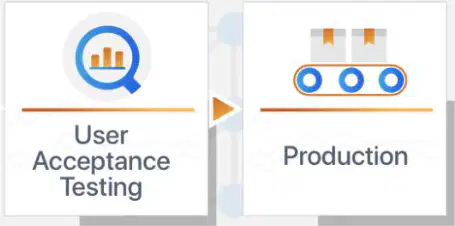
What is the main goal of the User Acceptance Testing (UAT) phase in the System Development Life Cycle?
To write code for the system
To confirm that the system meets the agreed requirements and is user-friendly
To design the user interface
To deploy the system
Who conducts the User Acceptance Testing (UAT) phase?
Only developers
Only managers
Employees, students, or customers (the actual users)
System administrators
Fill in the blank: User Acceptance Testing (UAT) focuses on usability, ________, accuracy, and reliability.
functionality
speed
cost
security
If users approve the system during User Acceptance Testing (UAT), what is the next step?
The system is deployed to production.
The system is sent back for development.
The system is scheduled for another round of UAT.
The system is archived.
Give an example of User Acceptance Testing (UAT) as described in the passage.
Testing the software with real users to ensure it meets their requirements.
Checking the code for syntax errors before deployment.
Running automated unit tests to verify individual functions.
Reviewing design documents for consistency.
What is the Deployment Phase in the System Development Life Cycle?
The phase where the system is designed
The phase where the system is officially released to its intended users
The phase where the system is tested
The phase where the system is retired
Fill in the blank: In Big Bang Deployment, the system is released to ________ at once.
everyone
a few users
developers only
testers only
Fill in the blank: In Phased Deployment, the system is released ________, starting with one department and then expanding.
gradually
immediately
randomly
simultaneously
Which deployment strategy involves testing the system in a small group before full launch?
Big Bang Deployment
Phased Deployment
Pilot Deployment
Waterfall Deployment

Adding new features when needed is part of the Maintenance Phase of the System Development Life Cycle.
True
False
The Predictive Approach is characterized by its ______ and sequential nature, where each phase is completed before moving to the next.
linear
dynamic
random
iterative
In the Predictive Approach, requirements are fixed and changes can be challenging to implement.
True
False

Which of the following is NOT a phase in the Predictive Development (Plan-driven) approach?
Implementation
Design
Analysis
Prototyping
Testing

Arrange the following phases of Predictive Development in the correct order:
Analysis, Design, Implementation, Testing, Maintenance
Design, Analysis, Implementation, Testing, Maintenance
Implementation, Analysis, Design, Testing, Maintenance
Testing, Design, Analysis, Implementation, Maintenance
Which of the following is a benefit of the Predictive Approach (Plan-driven)?
Flexible requirements
Very structured, making it easier to track progress
No need for documentation
Phases can be skipped

What is the adaptive approach in system development characterized by?
Rigidity and strict planning
Iterative and flexible nature
Fixed requirements
Waterfall methodology
Which of the following best describes the Adaptive Approach (Change-driven)?
A) A rigid, sequential model where all requirements are defined upfront
B) A flexible, iterative model (like Agile or Scrum) where development is done in small increments or sprints
C) A model that discourages feedback from users
D) A model that never adapts to new requirements

Unified Process is:
an iterative and incremental software development process framework
a hardware design methodology
a type of database management system
a network protocol for data transmission
Which of the following best describes the Unified Process (UP)?
A) A purely predictive software development framework
B) A purely adaptive software development framework
C) A framework that combines both predictive and adaptive approaches
D) A hardware development framework
Which of the following is an example of a Project Management Tool?
Lucidchart
MS Project
Google Workspace
Slack
Which of the following is an example of a Collaboration Tool?
A) Trello
B) Canva
C) Google Workspace
D) ClassPoint
Which of the following is an example of a Diagramming & Modeling Tool?
Jira
Lucidchart
MS Project
Slack

