
 Worksheets
Physical Science - Atomic Structure
Total questions: 30
Worksheet time: 15mins
What do we call the tiny core at the center of an atom, containing most of the atom’s mass and all of its positive charge?
Electron
Neutron
Proton
Nucleus
The "building blocks" of matter are:
electrons.
atoms and molecules.
found only in the plasma state.
as of yet undiscovered.
Atoms with the same atomic number but different atomic mass are called:
prototypes.
subtypes.
isotopes.
ions.
What is the fundamental property of matter that can either be positive or negative?
Charge
Mass
Magnetism
Gravity
Protons and neutrons in the nucleus are held together by:
gravity.
electromagnetic force.
the strong nuclear force.
the weak force
Compared to protons, electrons have:
much smaller mass and opposite charge.
about the same mass and opposite charge.
much larger mass and the same charge.
much larger mass and opposite charge.
The ____ is one kind of particle that makes up the atom and carries a positive charge.
electron
proton
neutron
plasma
Atomic number is:
the number of electrons and protons in an atom.
the number of neutrons and protons in an atom.
the number of electrons in an atom.
the number of protons in an atom.
Electrons are bound to the nucleus by:
gravity.
electromagnetic force.
the strong nuclear force.
the weak force.
A particle with zero charge found in the nucleus of an atom is called a(n):
electron.
proton.
neutron.
positron.
The charge on a proton is:
+1e
+2e
-1e
zero
The mass of an electron is about:
1800 times heavier than a proton.
1800 times lighter than a proton.
10,000 times heavier than a proton.
10,000 times lighter than a proton.
The mass of an atom is determined mainly by the:
mass of the neutrons.
mass of the neutrons and protons.
mass of the electrons.
mass of the electrons and neutrons.
The letter e represents the elementary charge. In normal matter, the charge that would not be found is:
+1e
+2e
+2.5e
-2e
A common isotope of Carbon has an atomic number of 6 and a mass number of 13. How many neutrons are in an atom of this isotope?
6
7
12
13
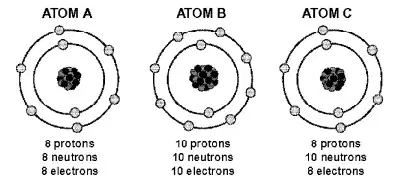
Do any of the atom diagrams below represent atoms of the same element?
No, they are all different elements.
Yes, atom A and atom B are the same element.
Yes, all of the atoms are the same element.
Yes, atom A and atom C are the same element.
The charge on a complete atom is equal to:
the number of protons.
the number of electrons.
zero.
e.
Which of the following is a TRUE statement about atoms? Answer is "All atoms........different numbers of neutrons"
All atoms of the same element have the same number of electrons, protons, and neutrons.
Atoms of different elements may have different numbers of protons in the nucleus.
All atoms of the same element have the same number of electrons and protons, but may have different numbers of neutrons.
The number of neutrons in an atom is equal to the number of protons.
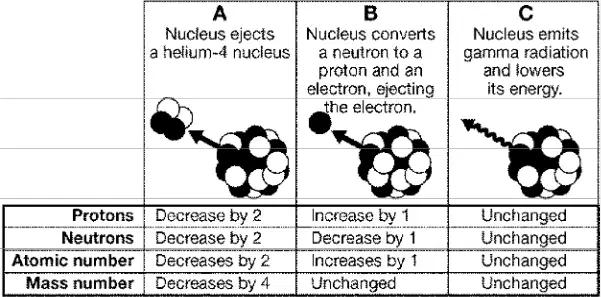
Which of the reactions shown in Figure 14-1A illustrates beta decay? Answer is "A"
A
B
C
None of the above
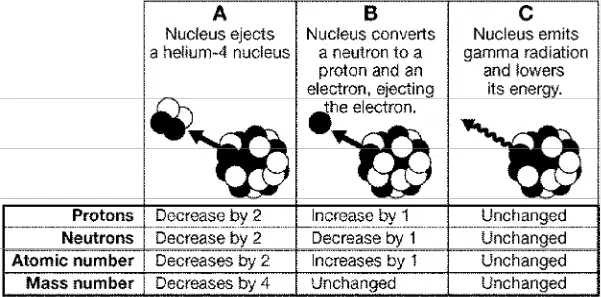
According to Figure 14-1A, which of the following statements is true of gamma radiation?
It is a form of pure energy.
It is a high energy electron.
It is a nucleus of a helium atom.
All of the above
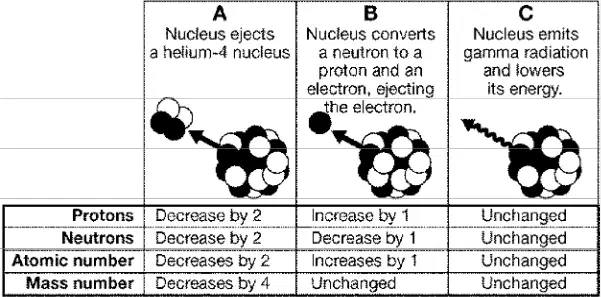
In Rutherford’s gold foil experiment, he bombarded gold foil with helium ions. Which type of radioactivity shown in Figure 14-1A was responsible for creating the helium ions? Answer is "Alpha decay"
Alpha decay
Beta decay
Gamma decay
None of the above
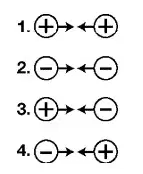
The diagrams below, in which arrows indicate the direction of movement, represent charged particles placed near one another. The diagram that correctly represents the motion of the charged particles is: Answer is "3"
1
2
3
4
A charged particle that accounts for nearly half the mass of an atom is the:
electron.
neutron.
proton.
positron.
Atoms of the same element may contain:
the same number of neutrons but a different number of protons.
the same number of protons but a different number of neutrons.
a different number of protons and a different number of neutrons.
the same number of electrons but a different number of protons.
Electrons with higher energy are located:
farther from the nucleus of the atom.
closer to the nucleus of the atom.
in the nucleus of the atom.
at lower levels of the atom.
Many models have been developed to explain the nature of atoms. The model that helped scientists to understand energy levels of atoms was developed by:
Niels Bohr.
Albert Einstein.
Sir Isaac Newton.
Richard Feynman.
An atom absorbs energy as its electrons:
move from a low energy level to a high energy level.
stay in a high energy level.
move from a high energy level to a low energy level.
stay in a low energy level.
Why don’t all the electrons in an atom fall to the lowest energy level? Answer is "The lowest energy level...."
Electrons move so fast they quickly bounce out of the lowest energy level.
Gravity won’t allow it.
The lowest energy level can only hold 2 electrons.
The nucleus repels the electrons.
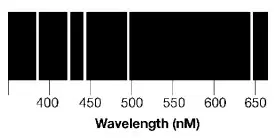
The diagram below represents a spectrum. Each line is a different color of light. The bright colored lines represent: Answer is "light of different energies...."
the diameter of several isotopes.
light of different energies from an element.
atoms that are radioactive.
values for the strong force for several isotopes.
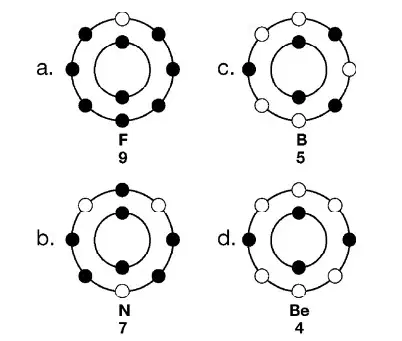
The diagram below represents the electron energy levels for the first two levels of an atom. The dark circles show a filled electron energy level. The diagram that would best represent an atom whose nucleus contains 5 protons and 4 neutrons is: Answer is "C"
a. a
b. b
c. c
d. d

