
 Worksheets
Isometric Sketch Quiz- No notes
Total questions: 15
Worksheet time: 8mins
The purpose of isometric graph paper in technical drawing is:
to help create three-dimensional drawings accurately
to measure electrical circuits
to record experimental data
to write mathematical equations
Spatial visualization is important in STEM careers because:
it helps professionals solve complex problems and understand abstract concepts.
it is only useful for artistic purposes.
it is not relevant to scientific or technical fields.
it makes memorization easier without understanding.
An isometric sketch appears three-dimensional and should include all important information about the object.
True
False
Fill in the blank: Sketch appears ________ because three sides are shown.
three-dimensional
flat
circular
transparent
Width and depth lines are drawn at ____ degrees from horizontal.
30
45
60
90
Fill in the blank: The shapes of the object faces are ______ (not represented as true shapes).
distorted
circular
parallel
transparent
To accurately record all important dimensions of a form, what tool should you use to measure and annotate your isometric sketch?
A ruler
A compass
A protractor
A calculator
The Isometric View Orientation resource is primarily used for which purpose?
To represent three-dimensional objects in two dimensions
To calculate the area of a surface
To determine the weight of an object
To measure the temperature of a material
To create an accurate isometric sketch of your block at full scale, what must you do?
Properly orient the best front view and use a ruler to lay out accurate dimensions so every width, depth, and height matches the physical object.
Sketch freehand without measuring dimensions.
Use only the top view for orientation and ignore true size dimensions.
Draw the block at half scale to save space.
Exchange your isometric sketch with a teammate. Peer review your partner’s sketch. Check each of the following and provide effective feedback to help your partner improve their sketch: Are object lines heavy, clear, and complete?
True
False
Isometric views on technical drawings typically do not include which of the following?
Dimensions
Labels
Material notes
Section lines
Why is it important to identify a light source when shading a sketch?
It is important to identify a light source so that you shade object faces consistently and avoid haphazardly choosing values without considering how the light creates shadows.
It helps you choose the right paper for your sketch.
It ensures that your sketch will be in color.
It allows you to draw faster without making mistakes.
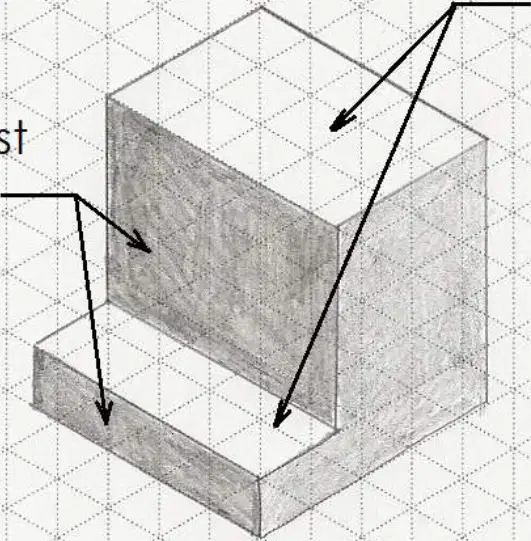
Refer to the diagram labeled 'Figure 4. Isometric Sketch with Shading'. The light source on the sketch of your simplest block is located at which position?
Top left
Bottom right
Directly above
Bottom left
The biggest challenge when creating isometric sketches is often:
Maintaining accurate proportions and angles
Choosing the right colors
Drawing freehand without any guidelines
Using only digital tools
A technical sketch and an artistic sketch are similar in that they both involve drawing, but how do they differ?
A technical sketch focuses on precise details and measurements, while an artistic sketch emphasizes creativity and expression.
A technical sketch uses only colors, while an artistic sketch uses only black and white.
A technical sketch is always abstract, while an artistic sketch is always realistic.
A technical sketch is used for painting, while an artistic sketch is used for engineering.

