
 Worksheets
Ancient China
Total questions: 25
Worksheet time: 13mins
Fill in the blank: The (a) Mountains ran along China's southern border.
Which two major river systems are found in China?
A) Nile and Amazon
B) Yangtze and Huang He
C) Mississippi and Danube
D) Volga and Mekong
Fill in the blank: The Huang He is also known as the (a) River.
Self Check: Which of the following statements is TRUE about the Yangtze River?
It is known as 'China's Sorrow'.
It has high banks that kept homes safe from floods.
It is found north of the Yellow River.
It empties into the Yellow Sea.
Ancient China was surrounded by desert, mountains, and ocean. What impact (effect) did these natural borders have on the culture?
They caused China to constantly be at war with other world civilizations.
They helped China to establish trade with other Civilizations.
They isolated Chinese civilization, enabling it to develop independently.
The geographical features had no impact on Ancient China.
What resources did the rivers provide to the early settlers of China?
Fish
Fertile Soil
Transportation
Fresh Water
All of the above
Who usually owned the land that farmers worked on?
(a)
Which crops were introduced in the 16th century?
Wheat and millet
Sweet potatoes, maize, and peanuts
Tea and sugar
Rice
Why did farmers celebrate the Spring Festival every year?
(a)
According to the passage, what type of houses did rich people in ancient China live in?
Large wooden houses with tiled roofs
Huts with thatched roofs
Stone houses
Brick apartments
Who was usually in charge of the family in ancient China?
The eldest female
The eldest male (usually the father)
The youngest child
The mother
Fill in the blank: In ancient China, the daily life of a woman was filled with taking care of the (a) and the children.
The Chinese prayed to their ancestors and offered sacrifices to them because:
they believed ancestors could influence their lives and bring good fortune.
they wanted to celebrate seasonal festivals only.
they were required to by law.
they hoped to gain military power.
What job did most of the people in Ancient China do?
Merchants
Craftsmen
Farmers
Poets
Which class of workers were considered the lowest class?
Farmers
Soldiers
Government officials
merchants
What is a dynasty?
A) A type of government
B) A line of rulers from the same family
C) A group of warriors
D) A city in China
What did Chinese rulers call their special right to rule?
Mandate of Heaven
Rule of Law
Divine Command
Emperor's Decree
During the Shang dynasty, the kingship was passed from (a) to brother or from brother to nephew, instead of from father to son.
The construction of the Great Wall of China was started by which dynasty and completed by which dynasty?
Started by Qin dynasty, completed by Ming dynasty
Started by Han dynasty, completed by Tang dynasty
Started by Ming dynasty, completed by Qing dynasty
Started by Yuan dynasty, completed by Song dynasty
Which of the following lists three important inventions or achievements from different Chinese dynasties and explains how each changed life in China?
The compass (navigation), paper (record keeping), and gunpowder (military technology) revolutionized travel, communication, and warfare in China.
The abacus (mathematics), silk (clothing), and jade (jewelry) only affected the wealthy in China.
The printing press (entertainment), porcelain (decoration), and tea (beverage) had no significant impact on Chinese society.
The Great Wall (tourism), kites (toys), and chopsticks (utensils) were mainly for leisure activities.
The Tang Dynasty is called the “Golden Age” of Ancient China because:
It was a period of great cultural and economic prosperity.
It was the shortest dynasty in Chinese history.
It was known for its military failures.
It was a time of constant civil war.
What was the earliest trace of writing in East Asia?
(a)
Describe the process by which the king received answers from the oracle bones.
The king asked questions, and priests interpreted cracks on heated bones to provide answers.
The king wrote answers on bones and buried them for good luck.
The king received answers from the stars after burning bones.
The king used oracle bones to communicate directly with ancestors without interpretation.
How many characters does modern Chinese writing have?
5,000
50,000
500
500,000
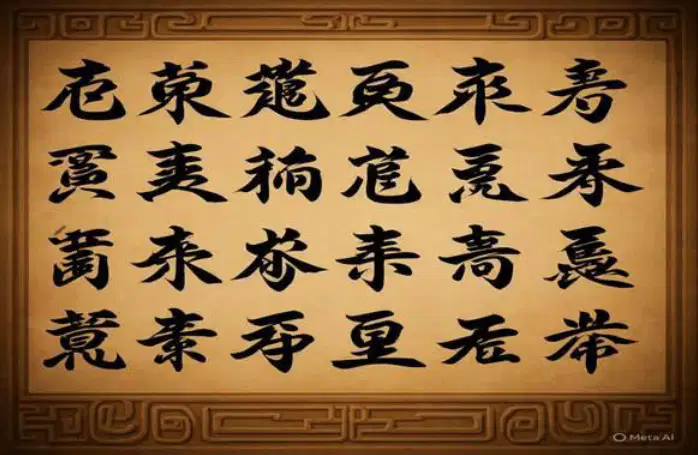
What does the image show?
Ancient Chinese writing
Modern English writing
Egyptian hieroglyphics
Roman numerals

