
 Worksheets
Unit 3: Nuclear Chemistry Review 1
Total questions: 60
Worksheet time: 1hrs 27mins
In Alpha decay what particle is emitted?
Helium (He)
Electron (e-)
Energy (Photon)
In Beta decay what particle is emitted?
Helium (He)
Electron (e-)
Energy (Photon)
In Gamma decay what particle is emitted?
Helium (He)
Electron (e-)
Energy (Photon)
Which form of radiation can be stopped by something as thin as a sheet of paper?
Alpha
Beta
Gamma

Identify the missing variable in the following reaction.


Identify the missing variable in the following reaction.

Identify the missing variable in the following reaction.
Gamma rays _________.
have no mass and no charge
have mass but no charge
have no mass but have charge
have mass and charge
List the three types of nuclear radiation in increasing order of penetrating power.
gamma, beta, alpha
This radiation can only be stopped by a thick sheet of lead or several meters of water.
alpha
beta
gamma
alpha and beta
none of the above
This type of decay creates a new element
alpha
beta
gamma
alpha and beta
none of the above
This type of radiation can alter DNA and result in cancerous cells.
alpha
beta
gamma
all of the above
none of the above
This type of decay does not cuase a change in the atomic mass of the product
alpha
beta
gamma
beta and gamma
none of the above
What is an isotope?
forms of the same element that contain equal numbers of electrons but different numbers of protons
forms of the same element
forms of the same element that contain equal numbers of protons but different numbers of neutrons
An atom with no nucleus
radioactivity is
the energy that came from radius
The energy that is released from the nucleus of the atom
the energy that is released from the outer shell of the atom
An isotope is a version of an element with the same number of protons but different number of __________.
neutron
electron
In alpha decay, the atomic number...
increases by 2
decreases by 2
increases by 4
decreases by 4
In alpha decay, the mass number...
increases by 2
decreases by 2
increases by 4
decreases by 4

The mass number of Neptunium (Np) is _____.
93
237
95
941

The atomic number of Neptunium (Np) is _____.
93
237
95
241
The particle emitted in beta-minus decay is a ____________________.
a proton
an electron
a neutron
alpha particles have a __________ penetrating power.
weak
medium
stong
gamma rays have a __________ penetrating power.
weak
medium
stong
beta particles have a __________ penetrating power.
weak
medium
stong
alpha particles can be stopped with?
aluminum
piece of paper
lead
beta particles can be stopped with?
aluminum
piece of paper
lead
gamma rays can be stopped with?
aluminum
piece of paper
lead
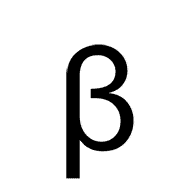
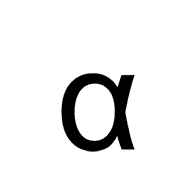
146C --> 0-1e + ________
Solve this equation for alpha decay.
88226Ra --> ___ + 24He
86222Rn
89226Ac
84224Po
88225Ra
Solve this equation for beta decay.
614C --> ___ + -10e
410Be
714N
210He
613C
In the symbol 167N what the 7 stand for?
Mass number
Atomic number
Atomic mass
Number of neutrons
24395Am → 23993Np + 42He
_______ is when a large nucleus is split into smaller nuclei releasing large amounts of energy.
fusion
fission
radioactive decay
gamma radiation

This is an example of...
Fission reaction
Fusion reaction
Combustion reaction
Radioactive Decay
_______ is when two small nuclei collide and join together to form a larger nucleus releasing large amounts of energy.
fission
beta decay
alpha decay
fusion

Which nuclear process if shown in the picture?
fission chain reaction
fusion reaction
combustion
radioactive decay

Atom is divided
Two atoms join
Nuclear waste is an issue
Uses uranium and other radioactive elements
1000 x stronger
Typically uses hydrogen and produces helium
Naturally occuring on the sun
Produces energy in stars
Used in nuclear power plants
Chain reaction can occur
What are the main differences between fission and fusion?
Fission involves combining small nuclei to form a larger nucleus, while fusion involves splitting a large nucleus into smaller ones.
Fission involves splitting a large nucleus into smaller ones, while fusion involves combining small nuclei to form a larger nucleus.
Fission and fusion are the same processes that release energy in nuclear reactions.
Fission occurs only in stars, while fusion occurs only in nuclear reactors.

What do you find here?
Nuclear fusion
Nuclear fission
What type of nuclear reaction is currently used in nuclear power-plants?
Fusion
Half-life
Fission
Fusion or fission
Which subatomic particle seems to have a stabilizing effect on an isotope?
protons
neutrons
electrons
quarks
Which process, fusion or fission, is considered a natural process?
Fission
Fusion
The term given to unstable radioactive atoms.
Parent
Daughter
Half Life
Igneous
The % of the parent isotope remaining after 1 Half Life.
50%
25%
12.5%
6.25%
A sample will lose half of the parent isotope after 1 half life.
TRUE
FALSE
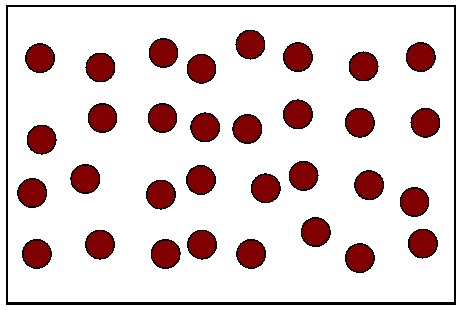
The diagram shows 32 atoms
32 of the Red are the parent isotope
0 of the atoms are daughter isotopes
How many half-lives have occurred?
0
1
2
3
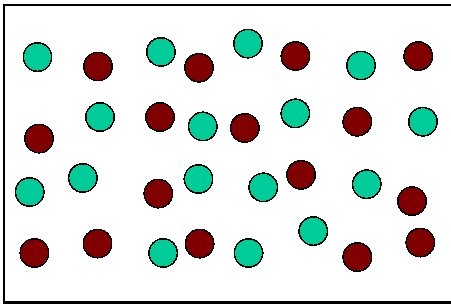
The diagram shows 32 atoms.
16 of the Red are parent isotopes
16 of the Green are daughter isotopes
How many half-lives have occurred?
0
1
2
3
0.5g
What is an isotope?
Different forms of an element
When an atom loses a proton
A type of radioactivity
The tool used to identify radioactivity
An isotope of cesium (cesium-137) has a half-life of 30 years. If 1.0 mg of cesium-137 disintegrates over a period of 90 years, how many mg of cesium-137 would remain?
0.5 mg
0.25 mg
0.125 mg
0.0625 mg
Which phrase describes a risk associated with producing energy in a nuclear power plant?
depletion of atmospheric hydrogen (H₂)
depletion of atmospheric carbon dioxide (CO₂)
production of wastes needing long-term storage
production of wastes that cool surrounding water supplies

