
 Worksheets
Cell Cycle, Mitosis, and Meiosis 101
Total questions: 70
Worksheet time: 2hrs 8mins
How many divisions are in meiosis?
46
23
2
4
Timmy fell off his skateboard and scraped his knee. Which cell process is going to be used to heal the wound?
Mitosis
Meiosis
The wound would not heal
Cell diffusion
If an organism reproduces asexually, its offspring will most likely be...
genetically identical to the parent
genetically different from each other
produced from specialized cells known as gametes
A mutant
During prophase I crossing over occurs and genetic material is exchanged between homologous chromosomes. How is this important
Increases genetic variation
Reduces the diploid number to the haploid number
Increases the haploid number to the diploid number
Reduces the probability of mutations

What does the image demonstrate
Punnet squares
Crossing over
Metaphase
Dna replication
Which of the following are in order from smallest to largest
Cells -> tissue -> organ -> organ system
Cells -> Organ system -> tissue -> organ
Organ system -> Organ -> Tissue -> Cell
Tissue -> organ system -> Cell -> Organ
If a person has leukemia, they are given a medicine that inhibits (stops) DNA synthesis. Which phase of the cell cycle will be most affected by this medicine?
G1
S
G2
M phase
Which phase is not a phase of MITOSIS (when the nucleus divides)?
Interphase
Prophase
Metaphase
Anaphase
Telophase
How many daughter cells are produced by meiosis?
one
two
four
six
How many daughter cells are produced by mitosis?
one
two
four
six
A mosquito cell which undergoes mitosis has 6 chromosomes. How many chromosomes will the daughter cells have?
3
6
12
24
Creation of reproductive cells (gametes) requires...
Mitosis
Meiosis
Neither
Replacement of dead cells requires...
Mitosis
Meiosis
Neither
Growth requires
Mitosis
Meiosis
Neither
When does crossing over occur?
Metaphase I
Metaphase II
Prophase I
Prophase II
How many cells are produced as a result of meiosis?
2
4
6
8
How many chromosomes are found in a human egg cell?
23
46
unknown
How many chromosomes are found in a human somatic cell?
23
46
48
52
When does DNA replication occur?
G1 phase
S phase
G2 phase
Cytokinesis
When are chromosomes visible during the cell cycle?
Interphase
Mitotic Phase
Cytokinesis
Never
As a cell becomes larger...
Its volume increases faster than its surface area
Its volume and surface area increase at equal rates
The volume increases but the surface area remains the same
What is the period between cell divisions?
Interphase
Prophase
Metaphase
Anaphase
Which of the following results in two cells identical to the parent cell?
mitosis
meiosis

A nuclear membrane reforms around the chromosomes.
The chromatin condenses and chromosomes become visible.
Stage of intense cell growth and activity.
A cell spends 90% of the cycle in this phase.
Forms at the beginning of Cytokinesis in plant cells
Forms at the beginning of Cytokinesis in animal cells
After meiosis is complete, how many daughter cells will be produced?
1
2
3
4
At the end of MEIOSIS, the haploid number of chromosomes in a human sex cell (gamete) is:
46
92
22
23

What is the name of the process in which homologous chromosomes exchange information during meiosis?
switching
crossing-over
melding
blending
In which types of cells does mitosis occur?
egg cells
sperm cells
jail cells
Body cells except the sperm and egg cells

Which stage of mitosis is this?
Prophase
Metaphase
Anaphase
Telophase

Which stage of mitosis is this?
Prophase
Metaphase
Anaphase
Telophase
Which of the following shows the correct order for mitosis?
Prophase, telophase, anaphase, metaphase
telophase, metaphase, anaphase, prophase
prophase, metaphase, anaphase, telophase
prophase, metaphase, telophase, anaphase

What is cancer?
A group of diseases characterized by no cell growth
A group of diseases caused by the failure of chromosomes to separate
A group of diseases characterized by uncontrolled cell division
A group of diseases caused by normal replication of chromosomes

The division of the cytoplasm is called ______.
mitosis
interphase
cytokinesis
somatic
In the G1 stage of the cell cycle, the cell
Grows and carries out routine functions
Divides
Copy DNA
None of the above
What ensures that cells only divide when conditions are right?
ribosomes
spindle fibers
centromeres
cyclins and check points
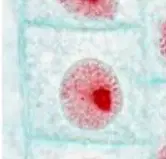
This is...
Metaphase
Interphase
Telophase
Anaphase
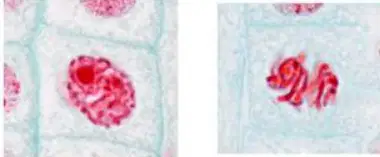
This is...
Metaphase
Cytokinesis
Telophase
Anaphase
Prophase
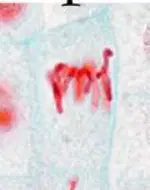
This is...
Metaphase
Cytokinesis
Telophase
Anaphase
Prophase
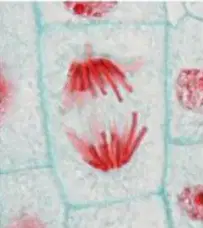
This is...
Metaphase
Interphase
Telophase
Anaphase
Prophase
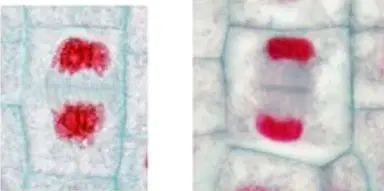
This is...
Metaphase
Interphase
Telophase
Anaphase
Prophase
Specialized fibers that pull sister chromatids and chromosomes during Anaphase in mitosis, and Anaphase I and II in meiosis...
Spindle Fibers
Microtubules
Traction Fibers
Centrioles
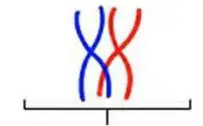
This is a...
Sister Chromatid
Chromosome
XX
Tetrad
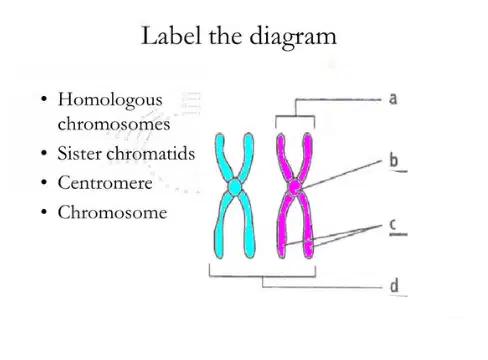
On the diagram, A is...
Homologous Chromosomes
Sister Chromatids
Centromere
Chromosome
On the diagram, B is...
Homologous Chromosomes
Sister Chromatids
Centromere
Chromosome
On the diagram, C is...
Homologous Chromosomes
Sister Chromatids
Centromere
Chromosome
On the diagram, D is...
Homologous Chromosomes
Sister Chromatids
Centromere
Chromosome
What forms in plant cells during cytokinesis?
Cell plate
Cleavage furrow
Chromatid Bridge
Centriole Wall
The nucleolus is responsible for:
Ribosome Production
DNA Replication
Protein Folding
Telling Stomata When to Open and Close
If a cell’s nucleolus clearly is visible, the cell is most likely in:
Interphase
Prophase
Metaphase
Anaphase
What are spindle fibers made of?
RNA
Lipids
Microtubules in the cytoskeleton
DNA
Which of the following is only found in animal cells? Select all that apply
Asters
Microtubules
Spindle Fibers
Centrioles
Which of the following correctly defines diploid?
A cell that only contains autosomes
A cell that contains one set of chromosomes (1n)
A set that contains two sets of chromosomes (2n)
A cell that has lost its nucleus
Independent assortment increases genetic diversity because:
Sister chromatids separate at random times
Crossing over happens more frequently
Maternal and paternal chromosomes randomly align and separate
Chromosomes replicate twice
What is most similar to mitosis on the way that it divides sister chromatids?
Meiosis I
Meiosis II
Meiosis III
Meiosis IV
Why is meiosis I often called “reduction division”?
Because the chromosome number is cut in half
Because the cell loses organelles
Because the cell size decreases
Because DNA is degraded
Which event most directly leads to genetic differences between siblings (except identical twins)?
Mutation
Chromosome replication
Cytokinesis
Crossing over and independent assortment
Which statement best describes an allele?
A structure in the nucleus that contains many genes
A segment of DNA that codes for a specific protein
A different version of the same gene found at the same location on homologous chromosomes
A complete set of chromosomes in an organism
Mitosis in human cells takes approximately
12 hours
1 hour
45 minutes
18 hours
Mitosis in cancer cells takes approximately
12 hours
1 hour
45 minutes
18 hours
If a gene controls flower color, what would the alleles represent?
The overall size of the flower
Color options such as purple or white
The location of the flower on the stem
The total number of petals on the flower
Why does DNA helicase "unzip" DNA during the synthesis stage?
To allow chromosomes to condense for cell division
To expose the nitrogen bases so the DNA can be copied correctly
To help the cell destroy damaged genetic material
To prepare the nucleus for cytokinesis
A student observes a cell under a microscope and notices that the DNA is tightly coiled into visible chromosomes. In a nearby cell, the DNA appears uncoiled and threadlike.
Question:
What can the student conclude about the stages of these two cells?
Both cells are in cytokinesis because the cytoplasm is dividing.
The cell with coiled DNA is preparing for division, while the uncoiled one is copying DNA during interphase.
Both cells are in interphase because DNA is always uncoiled.

