
 Worksheets
Matter & Atomic Structure Practice Test
Total questions: 99
Worksheet time: 3hrs 30mins
What causes an atom to be radioactive?
It has too many protons only
It has too many or too few neutrons
It has the wrong number of electrons
It has lost all its energy
Which statement about radioactive isotopes is true?
All isotopes are radioactive
Radioactive isotopes have unstable nuclei
Radioactive isotopes have equal numbers of protons and neutrons
Radioactive isotopes never occur naturally
If boron has two isotopes, boron-10 and boron-11, which do you think is more abundant?
boron-10
boron-11
A student creates a hypothesis about their upcoming experiment. What must the student do in their experiment with relationship to their hypothesis?
change the experiment to make the hypothesis correct
create a law based on the hypothesis
make observations to prove or disprove the hypothesis
ignore the hypothesis
Which of the following would NOT be used in the event a students clothing caught fire?
Eyewash fountain
Safety shower
Fire blanket
Fire extingisher

A team of students uses a balance to find the mass of a large beaker. What is the mass of the beaker?
53.6 g
253.6 g
536 g
2536 g

Which of the following is the best estimate of the volume poured from the graduated cylinder?
3.00 mL
3.60 mL
4.40 mL
4.60 mL
Which of these is the correct isotopic notation for sodium-23?


A group of students are comparing elements C and D found on the periodic table displayed. Which of the following statements accurately compare these two elements? Select TWO correct answers.
Element D has more protons than element C.
Element D has more valence electrons than element C.
Element D has more energy levels than element C.
Element C has more valence electrons than element D.
Element C has more protons than element D.

Use your periodic table and determine which of the following atoms is represented by the Bohr model.
aluminum
calcium
iron
sodium

In the Bohr model of an atom (shown), protons are represented in blue, the neutrons are red and the electrons are green. Use your periodic table and determine which of the following atoms is represented by the Bohr model.
magnesium
calcium
aluminum
sodium
Which of these has the most mass?


A group of students was asked to generate statements about the structure of an atom. The students came up with the statements below. Which statements accurately describe the structure of atoms?
Select TWO correct answers.
Valence electrons are the electrons located on the outermost energy level.
Electrons are neutrally charged and located outside the nucleus.
The nucleus of an atom contains positively charged protons and negatively charged electrons.
Protons are positively charged and located outside the nucleus.
The number of neutrons is equal to the mass number minus the number of protons.
Atoms are made up of three subatomic particles: protons, neutrons, and electrons. A student is creating a list of statements about each of the subatomic particles found in an atom. Which of the following statements accurately describes protons?
Select TWO correct answers.
Protons are located in the nucleus and have a negative charge.
Protons are located in the nucleus and have a positive charge.
Protons are located in the electron cloud and are neutrally charged.
Protons are located in the nucleus and contribute to the mass of an atom.
Protons are located in the nucleus and do not contribute to the mass of an atom.

A student has a block of metal with a mass of 54 g and a volume of 18 cm³. What is the density of the block?
0.33 g/cm³
3.0 g/cm³
36 g/cm³
972 g/cm³

A rectangular block of wood has a mass of 240 g. Its length is 10 cm, width is 4 cm, and height is 3 cm. What is the density of the block?
2.0 g/cm³
8.0 g/cm³
20.0 g/cm³
80.0 g/cm³

The graph here shows the volume of a liquid as its mass increases. Based on the graph, what is the density of the liquid?
0.25 g/mL
0.50 g/mL
1.0 g/mL
2.0 g/mL
Which of these represents a mixture of elements?


Which of these represents a pure substance?
Iron rusting is an example of a
physical change
chemical change
physical property
chemical property
Which of the following correctly describes the arrangement of particles in the three main phases of matter?
Solid – particles move freely with lots of space; Liquid – particles are fixed in place; Gas – particles slide past one another.
Solid – particles are closely packed and vibrate in place; Liquid – particles are close but can move past each other; Gas – particles are far apart and move freely.
Solid – particles are spread far apart and move rapidly; Liquid – particles are evenly spaced; Gas – particles are fixed in a rigid structure.
Solid – particles are randomly scattered; Liquid – particles vibrate in fixed positions; Gas – particles are tightly packed.
Which of the following is a pure substance?
air
salt water
carbon dioxide (CO2)
pizza
Which of the following is an element, not a compound?
Water (H₂O)
Copper (Cu)
Carbon dioxide (CO₂)
Sodium chloride (NaCl)
Which subatomic particle has a negative charge and is found outside the nucleus?
Proton
Neutron
Electron
Nucleon
How many neutrons are in an atom of chlorine?
How many neutrons in an atom of oxygen?
How many neutrons in the isotope neon-22?
How many neutrons in the isotope neon-20?
Which of the following is a compound?
Gold (Au)
Oxygen (O2)
Iron (Fe)
Ammonia (NH3)
What is the charge of a neutron?
Positive
Negative
No charge
Both positive and negative
Which of the following is an example of a physical property?
Density
Reactivity with acid
Ability to rust
Flammability
Which of the following is a chemical property?
Density
Ability to react with oxygen
Color
Melting point
What is the main difference between a mixture and a compound?
Mixtures retain the properties of their components; compounds have new properties.
Compounds can be separated by physical means; mixtures cannot.
Compounds are always gases; mixtures are always solids.
Mixtures have a fixed ratio of components; compounds do not.
Which subatomic particle is found in the nucleus and has a positive charge?
Neutron
Quark
Electron
Proton
Which of the following is an example of a mixture?
Hydrogen gas (H2)
Table salt (NaCl)
Steel
Carbon monoxide (CO)
Which subatomic particle determines the atomic number of an element?
Proton
Quark
Neutron
Electron
Which of the following best describes a solution?
A mixture where substances are evenly distributed
A mixture with visible separate parts
A pure substance made of only one type of atom
A compound formed by chemical reactions
Which of the following changes is a physical change?
Baking a cake
Melting ice
Burning wood
Rusting iron
Which of the following is a chemical change?
Boiling water
Freezing juice
Melting wax
Burning paper
Which subatomic particle is responsible for the mass number of an atom?
Proton
Electron
Neutron
Both protons and neutrons
Which of the following best describes an element?
A substance made of only one kind of atom
A mixture of two or more substances
A compound formed by chemical reactions
A solution with evenly distributed particles
Isotopes of an element have a different number of...
Protons
Neutrons
Electrons
Mass
Potassium-39 has how many neutrons?
19
18
20
21
Nickel-59 has how many neutrons?
30
31
32
33
Bromine-80 has how many neutrons?
41
42
44
45
76 protons and 114 neutrons
Osmium-114
Osmium-76
Osmium-190
Osmium-190.23
12 protons and 13 neutrons
Mg-12
Mg-13
Mg-25
Mg-24.305
9 protons and 9 neutrons
Fluorine-18
Fluorine-9
Fluorine-16
Fluorine-18.998
How do you calculate mass number?
Mass x percent
Protons + Electrons
Protons + Neutrons
Neutrons + Protons + Electrons
If an isotope has an atomic number of 15 and a mass number of 31, how many neutrons does it have?
15
16
31
46
Which of the following isotopes has the most neutrons?
Oxygen-16
Oxygen-17
Oxygen-18
They all have the same number of neutrons.
If two isotopes have the same mass number but different atomic numbers, what can you infer about them?
They are isotopes of the same element.
They have the same number of neutrons.
They are not isotopes but different elements.
They have the same number of protons.
An isotope of nitrogen has 7 protons and 8 neutrons. What is its mass number?
7
8
15
22
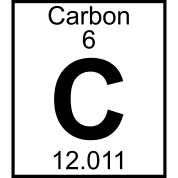

What does the 6 represent?
Atomic mass
atomic number
chemical symbol
element name
Which is NOT part of an atom?
protons
neutrons
neurons
electrons
Electrons are located______.
outside the nucleus
inside the nucleus
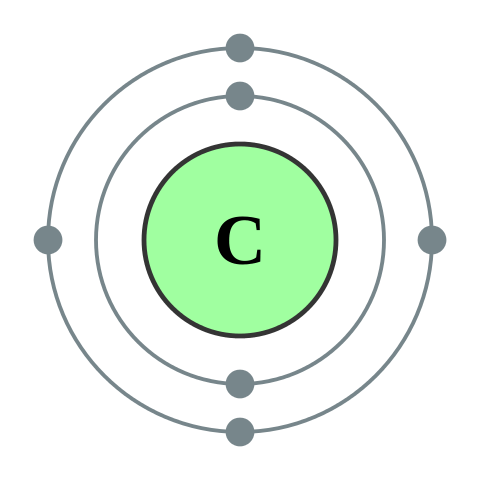
How many valence electrons does carbon have?
4
5
6
7
USE THE PERIODIC TABLE
How many valence electrons does sodium have?
1
2
3
4
USE THE PERIODIC TABLE
How many valence electrons does Phosphorus have?
31
5
15
4
Which elements have the most similar chemical properties?
boron and carbon
oxygen and sulfur
aluminum and bromine
argon and silicon
The period that an element is in, tells you what?
Number of protons
Number of electrons
Number of valence electrons
Number of shells
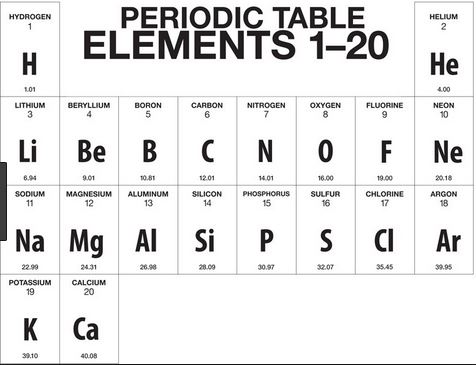
How many valence electrons does Hydrogen Have?
1 Valence electron
2 Valence electron
3 Valence electron
4 Valence electron
5 Valence electron
How many valence electrons does Helium Have?
1 Valence electron
2 Valence electron
3 Valence electron
4 Valence electron
5 Valence electron

Name this element.
Argon
Chlorine
Aluminum
Boron

How many valence electrons are in this element?
7
6
5
2

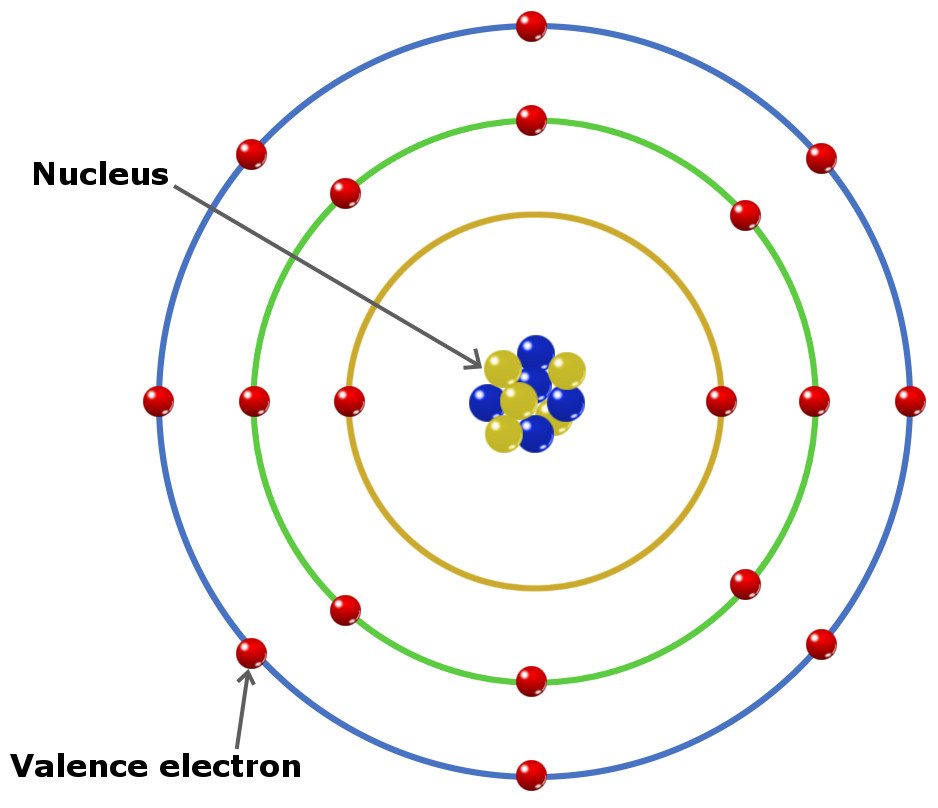
The outer most electrons are called...
valence electrons
heavy electrons
emission electrons
Excited electrons
How many valence electrons are in this element?
7
6
5
2


This is a correct dot diagram for oxygen (O)
true
false
Which of these is incorrect?


Which ones are acceptable?


This is a correct dot diagram for nitrogen (N)
true
false

This is a correct dot diagram for carbon (C)
true
false

This is a correct dot diagram for neon (Ne)
true
false

This could be the dot diagram of
Mg
Cl
C
O

Is this correct way to draw the Lewis Dot Structure for Carbon?
Yes
No, too many electrons
No, not enough electrons
No, dots are in wrong places

Is this the correct Lewis Dot Structure for Boron?
Yes
No, missing electrons
No, too many electrons
No, dots are in wrong place.

