
 Worksheets
MIDTERM Practice Test - Foundations of Literacy development
Total questions: 99
Worksheet time: 2hrs 39mins
About how many students nationally cannot read proficiently by 4th grade? What are some of the emotional or economic byproducts of this statistic?
65% nationally. Leads to higher dropout rates, lower income earnings, and emotional effects such as shame or frustration.
25% nationally. Leads to increased college attendance and higher self-esteem.
80% nationally. Results in improved job prospects and emotional well-being.
40% nationally. Leads to lower dropout rates and increased financial stability.
What does the following statement mean to you and do you think it is accurate? Explain. Literacy is a social justice issue.
Literacy affects access to education, jobs, and participation in democracy. Inequitable literacy instruction perpetuates systemic inequality.
Literacy is only about reading books and has no impact on society.
Literacy is a personal achievement unrelated to social issues.
Literacy is important only for academic success, not for social justice.
What are the two main components of reading according to the “Simple View” of reading?
Decoding and Language Comprehension.
Phonics and Spelling.
Vocabulary and Writing.
Fluency and Handwriting.
What are the two main components of reading according to the “Simple View” of writing?
Transcription and Ideation (text generation).
Phonological Awareness and Vocabulary.
Comprehension and Decoding.
Fluency and Syntax.
What are the 5 key components of reading as identified by the National Reading Panel in 2001?
Phonemic Awareness, Phonics, Fluency, Vocabulary, Comprehension.
Phonemic Awareness, Grammar, Writing, Vocabulary, Comprehension.
Phonemic Awareness, Phonics, Spelling, Vocabulary, Listening.
Phonemic Awareness, Phonics, Fluency, Writing, Comprehension.
Does reading develop in the same way that speaking develops? Explain.
No — speech is natural; reading is learned and requires explicit instruction.
Yes — both reading and speaking develop naturally without instruction.
Yes — reading and speaking are both innate abilities.
No — reading develops earlier than speaking.
What is meant by “code breaking” and “meaning making” when it comes to learning to read?
Code-breaking: recognizing print-sound relationships (decoding). Meaning-making: understanding text (comprehension).
Code-breaking: writing stories. Meaning-making: drawing pictures to represent stories.
Code-breaking: memorizing words. Meaning-making: reciting the alphabet.
Code-breaking: learning grammar rules. Meaning-making: identifying punctuation marks.
What 3 central processing areas of the brain are involved in learning to read? (NOTE-technical names or Brain City terms are both acceptable)
Sound City, meaning mountain, Vision Villages.
Memory Lane, Logic Loop, Emotion Expressway.
Hearing Hills, Touch Town, Smell Street.
Balance Bridge, Taste Tunnel, Sleep Square.
Our written system is:
Alphabetic
Pictographic
Hieroglyphic
Logographic
Select at least two brain benefits of being bilingual from the options below.
Improved cognitive flexibility and better memory
Decreased attention span and slower thinking
Reduced problem-solving skills and less creativity
Increased risk of language confusion and forgetfulness
Mirror writing is when a person writes letters or words in reverse, and it is associated with which region of the brain? What is one way to help children with mirror writing, and does mirror writing always indicate dyslexia?
Mirror writing is associated with the parietal lobe, can be helped by practicing correct letter formation, and does not always indicate dyslexia.
Mirror writing is associated with the occipital lobe, can be helped by using colored pencils, and always indicates dyslexia.
Mirror writing is associated with the frontal lobe, can be helped by reading more books, and always indicates dyslexia.
Mirror writing is associated with the temporal lobe, can be helped by using a mirror, and never indicates dyslexia.
According to cognitive neuroscience, as children are developing written language skills, they process words:
Letter-by-letter (sound by sound)
By the global shape of a word
By color of the letters
By the meaning of the word only
The letterbox (visual word form area) serves what role in the reading brain, and why is it important?
It recognizes written words and is crucial for fluent reading.
It processes spoken language and is essential for speech production.
It controls eye movement during reading and is vital for visual tracking.
It stores vocabulary and is important for memory recall.
Of the 3 processing areas in the brain related to reading, two are closely connected to spoken language and one is connected to written language. Which areas are connected to spoken language, and when does spoken language begin to develop?
connected to spoken language: sound city, vision village
Written language: meaning mountain.
spoken language begins to develop in infancy.
connected to spoken language: vision village
Written language: meaning mountain.
spoken language begins to develop in adulthood
connected to spoken language: vision village
Written language: meaning mountain.
connected to spoken language: meaning mountains
Written language: sound city
spoken language begins to develop in childhood
Which of the following lists the 4 components of oral language (4S’s) or the standard 5 domains of spoken language, and explains how oral language is related to reading development?
Phonology, vocabulary, syntax, pragmatics; oral language provides the foundation for reading development.
Phonology, spelling, handwriting, comprehension; oral language is unrelated to reading.
Vocabulary, spelling, punctuation, fluency; oral language only affects speaking, not reading.
Syntax, punctuation, handwriting, comprehension; oral language is not connected to reading development.
What are 3 ways to nurture language and literacy with children under 5 years old?
Read aloud daily; Engage in conversations; Encourage storytelling, songs, or pretend play.
Limit talking to only instructions; Avoid reading books; Discourage questions.
Focus only on teaching the alphabet; Ignore playtime; Use only worksheets.
Let children watch TV alone; Correct every mistake immediately; Avoid singing or rhymes.
What is meant by “serve and return” and brain building?
Interactive exchanges (adult responds to child’s vocalizations) — builds neural connections.
A type of physical exercise for children.
A method of teaching math to toddlers.
A way to encourage children to eat more vegetables.
What is one benefit of singing and practicing nursery rhymes with young children?
Boosts phonemic awareness and memory through rhythm and repetition.
Teaches advanced mathematics concepts.
Improves adult vocabulary instantly.
Guarantees perfect pitch in all children.
What is one kind of read aloud that is designed to build vocabulary and social interaction with young children? What is one kind of prompt to use during these kinds of lessons?
Dialogic read-alouds; use open-ended prompts like “Why do you think…?”.
Silent reading; use yes/no questions only.
Phonics drills; use spelling prompts.
Shared writing; use fill-in-the-blank prompts.
What kind of expressive language might you expect to hear from a child who is 18 months to 2 years old?
Short phrases (“more milk,” “my toy”) — vocabulary explosion phase.
Complex sentences with conjunctions and clauses.
Reading simple storybooks independently.
Writing their own name and simple words.
Why might a 3 year old pronounce the word “think” as “sink” or “chair” as “tair” or “really” as “weally”?
Developmental speech patterns; fronting and simplifying difficult sounds.
Hearing impairment causing mispronunciation.
Lack of exposure to language at home.
Deliberate imitation of adult speech errors.
What are 1-2 sounds that children typically have difficulty pronouncing until age 4 or 5?
/r/, /l/, /th/, /s/ clusters
/b/, /m/, /p/
/t/, /d/, /n/
/k/, /g/, /h/
What are 3-4 best practices to nurture spoken language in the early years (in phase 1 and early phase 2)?
Model correct speech, expand on child’s words, read and sing, and engage in conversation.
Focus only on written language, avoid correcting mistakes, and limit conversation.
Encourage silent reading, use flashcards exclusively, and avoid singing.
Teach grammar rules strictly, discourage questions, and use complex vocabulary only.
What is phonemic awareness (or sound sensitivity) and what are at least 2 classroom games to build it?
Ability to hear/manipulate individual sounds. Games: “I Spy” (sound version), “Sound Bingo”, “Rhyming pairs.”
Ability to write letters quickly. Games: “Alphabet Race”, “Letter Drawing”, “Word Search.”
Ability to memorize stories. Games: “Story Recall”, “Memory Match”, “Story Chain.”
Ability to count syllables. Games: “Syllable Clapping”, “Counting Words”, “Syllable Hopscotch.”
What is meant by phonemic blending and segmenting and why is it important to reading and spelling?
Blending: combining sounds (/c/ + /a/ + /t/ = cat). Segmenting: breaking apart words. Essential for decoding and spelling.
Blending: recognizing rhyming words. Segmenting: identifying syllables. Important for vocabulary building.
Blending: matching letters to sounds. Segmenting: memorizing word shapes. Important for handwriting.
Blending: reading words backwards. Segmenting: counting letters. Important for fluency.
What is meant by the “alphabetic principle” and how does this connect to reading?
The understanding that letters and letter patterns represent the sounds of spoken language, which is essential for learning to read.
The belief that reading is only about memorizing whole words without understanding sounds.
The idea that reading is unrelated to spoken language and only involves visual memory.
The concept that reading is best learned through pictures rather than letters.

The first child’s writing sample below (on left) is reported as “mama.” What is happening here? Does this child understand the “alphabetic principle” or “print concepts”? Explain briefly.
hows print awareness but not yet alphabetic principle (scribble or symbol use).
Demonstrates full understanding of the alphabetic principle and can spell phonetically.
Shows advanced grammar and punctuation skills for their age.
Has mastered cursive writing and uses it consistently.
What are at least two kindergarten skills that predict reading achievement in 1st grade?
Letter-sound knowledge and phonemic awareness.
Counting and sorting objects.
Drawing and coloring skills.
Physical coordination and balance.
What is a “decodable text” and what is its purpose? How is it different from other “controlled” texts?
Text using taught phonics patterns; helps apply decoding skills. Different from leveled/controlled readers focused on meaning or sight words.
Text that uses only high-frequency sight words; its purpose is to build vocabulary. Different from decodable texts that focus on phonics.
Text with complex sentence structures; its purpose is to challenge comprehension. Different from decodable texts that use simple sentences.
Text that is chosen based on student interest; its purpose is to increase engagement. Different from decodable texts that are assigned randomly.
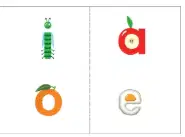
What method of teaching letter-sound knowledge is demonstrated with the cards below? Associated pictures or embedded pictures? Explain.
Embedded pictures: letter is drawn into the picture (supports recall).
Associated pictures: picture is placed next to the letter but not integrated.
Phoneme isolation: focusing on individual sounds without pictures.
Letter tracing: students trace the letter shapes without pictures.
What are the names of the first four phases of reading and spelling development?
pre-alphabetic, partial alphabetic, full alphabetic, and consolidated alphabetic phases
emergent, transitional, conventional, and advanced phases
phonetic, morphemic, syntactic, and pragmatic phases
pre-phonemic, semi-phonetic, phonetic, and post-phonetic phases
Describe one spelling or reading behavior in each of the first three phases of reading development.
In the first phase (emergent), readers recognize familiar logos and pictures without understanding their letters. In the second phase (early decoding), a common behavior is 'invented spelling,' where they spell words phonetically (e.g., 'gruaj' for 'garage'). In the third phase (fluency), a key reading behavior is substituting known words for unknown ones to maintain story flow.
In the first phase (emergent), readers can fluently read chapter books. In the second phase (early decoding), they memorize entire texts without looking at the words. In the third phase (fluency), they only read single letters at a time.
In the first phase (emergent), readers write full sentences with correct grammar. In the second phase (early decoding), they skip all unfamiliar words. In the third phase (fluency), they refuse to read aloud.
In the first phase (emergent), readers use context clues to analyze complex texts. In the second phase (early decoding), they only read silently. In the third phase (fluency), they focus solely on spelling each word correctly.
If a child is only using initial and final sounds to recognize a word, what phase are they in?
partial alphabetic
pre-alphabetic
full alphabetic
consolidated alphabetic
What is orthography?
System of written symbols and spelling patterns.
A type of musical notation.
A branch of mathematics.
A style of painting.
What is a digraph? Why is it spelled “di”graph and not “dia”graph?
Two letters = one sound (e.g., ch, th, sh). “Di” = two.
It refers to a word with two syllables. “Di” means double meaning.
It is a letter that is silent in a word. “Di” means silent.
It is a sound made by three letters. “Di” means three.
What is phonics?
Instruction linking sounds (phonemes) to letters (graphemes).
A method of teaching mathematics using numbers and symbols.
A technique for memorizing historical dates.
A process of learning new languages through immersion.
What is spelling (or encoding)? What is the nature of the relationship between spelling and reading?
Writing sounds into letters. Reading = decoding; spelling = encoding — two sides of the same coin.
Spelling is memorizing words only. Reading and spelling are unrelated skills.
Spelling is about drawing pictures. Reading is about understanding stories.
Spelling is the same as reading aloud. There is no connection between spelling and reading.
What is a phoneme? What is a grapheme?
Phoneme = sound unit; Grapheme = written representation of that sound.
Phoneme = written letter; Grapheme = spoken word.
Phoneme = sentence; Grapheme = paragraph.
Phoneme = punctuation mark; Grapheme = number.
How many letters are in the alphabet? How many sounds in total are there in English?
26 letters ~44 sounds in English
24 letters ~30 sounds in English
30 letters ~50 sounds in English
26 letters ~26 sounds in English
What is the central difference between consonant sounds and vowel sounds?
Consonants block airflow; vowels are open sounds.
Vowels block airflow; consonants are open sounds.
Both block airflow equally.
There is no difference between them.
About how many consonant sounds in English? Examples of an unvoiced consonant? A voiced consonant?
~25 consonant sounds. Unvoiced: /p/, /t/, /f/; Voiced: /b/, /d/, /v/.
~10 consonant sounds. Unvoiced: /m/, /n/, /l/; Voiced: /s/, /t/, /k/.
~40 consonant sounds. Unvoiced: /b/, /g/, /z/; Voiced: /p/, /k/, /f/.
~15 consonant sounds. Unvoiced: /a/, /e/, /i/; Voiced: /o/, /u/, /y/.
What are at least four categories of vowel sounds in English? (linguistic terms or kid-friendly terms)
short vowels, long vowels, diphthongs, and r-controlled vowels
consonants, blends, digraphs, and silent letters
nasal vowels, voiced stops, fricatives, and glides
monosyllabic, polysyllabic, triphthongs, and plosives
What are at least 2 tricky consonant combinations or rules?
silent letters and consonant clusters that shift their pronunciation
vowel blends and diphthongs
prefixes and suffixes
syllable stress and intonation
What are the 6 steps of a phonics lesson?
1) Phonemic Warm-Up, 2) Teach the Sound-Spelling, 3) Practice Blending, 4) Apply to Decodable Text, 5) Dictation and Spelling, and 6) Word Work
1) Vocabulary Review, 2) Teach the Alphabet, 3) Practice Writing, 4) Read a Story, 5) Group Discussion, and 6) Homework Assignment
1) Sound Recognition, 2) Letter Formation, 3) Silent Reading, 4) Oral Presentation, 5) Group Work, and 6) Test Preparation
1) Listening Exercise, 2) Teach the Sound-Spelling, 3) Practice Blending, 4) Apply to Decodable Text, 5) Dictation and Spelling, and 6) Free Reading
What is orthographic mapping and why is it important for early reading instruction?
Storing word spelling-sound relationships in memory; leads to automatic word recognition.
A method for teaching handwriting skills; improves penmanship.
A technique for memorizing vocabulary lists; enhances rote learning.
A process of decoding unfamiliar words using pictures; supports comprehension.
How would you map the following words? Sample: thumb: /th/ /u/ /mb/ spoon really catch
spoon: /s/ /p/ /oo/ /n/; really: /r/ /ea/ /ll/ /y/; catch: /c/ /a/ /tch/
spoon: /sp/ /oo/ /n/; really: /re/ /al/ /ly/; catch: /ca/ /tch/
spoon: /s/ /oo/ /n/; really: /r/ /eal/ /ly/; catch: /c/ /a/ /ch/
spoon: /s/ /p/ /o/ /n/; really: /r/ /e/ /a/ /l/ /l/ /y/; catch: /c/ /a/ /t/ /ch/
What kind of grip is best for letter formation?
Tripod grip (thumb + index + middle finger).
Fist grip (all fingers wrapped around the pencil).
Quad grip (using four fingers).
Overhand grip (holding pencil from above).
When teaching printing, do letters start at the bottom, the middle, or the top lines? (There are 2 right answers).
Top or middle lines (never bottom).
Bottom or middle lines (never top).
Only at the bottom line.
Only at the middle line.
What is a “digger” letter and why is it called that? How does referring to letters like this help students?
Letters that go below the line (g, j, p, q, y); helps visual-motor memory.
Letters that are written in uppercase only; helps with spelling.
Letters that are always silent; helps with pronunciation.
Letters that are used at the start of sentences; helps with capitalization.
Write the number of phonemes next to the words below. For ONE of the bolded words, list the number of consonant sounds and number of vowel sounds.
pitch: 3- /p/…/i/…/ch/ [2 consonant sounds: p, ch; 1 vowel sound: i]
pitch: 4- /p/…/i/…/t/…/ch/ [3 consonant sounds: p, t, ch; 1 vowel sound: i]
pitch: 2- /p/…/ch/ [2 consonant sounds: p, ch; 0 vowel sounds]
pitch: 3- /p/…/i/…/t/ [2 consonant sounds: p, t; 1 vowel sound: i]
Write the number of phonemes next to the words below. 2. shack _
shack: 3
shack: 2
shack: 4
shack: 5
Write the number of phonemes next to the words below. 3. float _
4
3
5
6
Write the number of phonemes next to the words below. 4. knight _
3
4
5
2
Write the number of phonemes next to the words below. 5. boost____
4
3
5
6
Write the number of phonemes next to the words below. 6. large____
large: 3
large: 4
large: 2
large: 5
Write the number of phonemes next to the words below. 7. string____
5
4
6
7
Write the number of phonemes next to the words below. 8. foxes____f...o...k...s...i...s
5
4
6
7
Write the number of phonemes next to the words below. 9. scooper______
5
4
6
7
Write the number of phonemes next to the words below. 10. joint______
4
3
5
6
Write the number of phonemes next to the words below. 11. pencil______
6
4
5
7
Write the number of phonemes next to the words below. 12. sinking______
6
5
7
8
Write the number of phonemes next to the words below. 13. graph____
graph: 4
graph: 3
graph: 5
graph: 6
In the following words, underline the consonant digraphs and circle the vowel digraphs. NOTE - One word may contain both a consonant digraph, as well as a vowel digraph: choose, shout, wrist, booth, dress, spray
choose (ch - consonant digraph, oo - vowel digraph), shout (sh - consonant digraph, ou - vowel digraph), wrist (wr - consonant digraph), booth (th - consonant digraph, oo - vowel digraph), dress (dr - consonant blend, ss - double consonant), spray (spr - consonant blend, ay - vowel digraph)
choose (ch - consonant blend, oo - vowel digraph), shout (sh - consonant digraph, ou - vowel blend), wrist (wr - consonant digraph), booth (th - consonant digraph, oo - vowel blend), dress (dr - consonant digraph, ss - double consonant), spray (spr - consonant blend, ay - vowel digraph)
choose (ch - consonant digraph, oo - vowel blend), shout (sh - consonant blend, ou - vowel digraph), wrist (wr - consonant blend), booth (th - consonant digraph, oo - vowel digraph), dress (dr - consonant blend, ss - double consonant), spray (spr - consonant blend, ay - vowel blend)
choose (ch - consonant digraph, oo - vowel digraph), shout (sh - consonant blend, ou - vowel digraph), wrist (wr - consonant digraph), booth (th - consonant blend, oo - vowel digraph), dress (dr - consonant blend, ss - double consonant), spray (spr - consonant blend, ay - vowel digraph)
What is one other way to spell each of the sounds in the underlined words below?
meat: meet, sheet: sheat, bird: burd, fix: ficks, rain: rane, play: plae, night: nite
meat: mate, sheet: shate, bird: berd, fix: fex, rain: ran, play: ply, night: nite
meat: met, sheet: seat, bird: bard, fix: fiks, rain: rein, play: plea, night: knight
meat: meit, sheet: sheat, bird: burd, fix: ficks, rain: rane, play: plae, night: nite
Besides short “a,” what are the other four short/relaxed vowels? Give 2 sample words for each.
e (bed, step), i (pig, slip), o (mop, top), u (bug, sun)
e (bee, see), i (find, kind), o (go, so), u (cute, mule)
e (red, lead), i (ride, side), o (note, vote), u (rule, blue)
e (bet, pet), i (bit, lit), o (cot, dot), u (put, cut)
What is one of the most common types of spellings for a long vowel sound?
Silent-e or vowel teams (e.g., cake, rain, boat)
Double consonants (e.g., rabbit, kitten)
Adding -ing to a verb (e.g., running, jumping)
Consonant blends (e.g., bl, st, gr)
What is the difference between consonant digraphs and consonant clusters/blends? Give an example of each.
Digraph: two letters = one sound (sh, ch). Blend: two letters = two blended sounds (bl, st).
Digraph: two letters = two sounds (bl, st). Blend: two letters = one sound (sh, ch).
Digraph: two letters = two separate words. Blend: two letters = one word.
Digraph: two letters = one vowel sound. Blend: two letters = one consonant sound.
The words “sit” “pot” and “fan” fit which spelling pattern?
CVC
CVVC
CVCe
CCV
The words “frog” “grab” and “crib” follow which spelling pattern?
CCVC
CVCV
CVCC
VCC
The words “fake” “cute” “time” follow which spelling pattern?
CVCe
CVVC
CCVC
CVC

What do we know specifically about each of these student’s early literacy knowledge?
We know specific details about each student’s early literacy knowledge.
We do not have any information about the students’ early literacy knowledge.
We only know about the students’ math skills, not literacy.
We know only general information about the students’ early literacy knowledge.
Identify the phase they are in: Pre-alphabetic, Partial, or Full.
Pre-alphabetic
Partial
Full
Post-alphabetic
Ciela is a 2nd grader who participates during read alouds and has a very large oral vocabulary. Her parents read non-fiction to her each night so that she can learn about different kinds of animals. However, Ciela’s teacher says that in class, she struggles with spelling and with reading CVC words and cannot sound out words on her own. Ciela is having difficulty with one of the two central elements of reading. Which area is she struggling with, and what kind of instruction would help her most?
Ciela is struggling with comprehension, and explicit comprehension strategy instruction would help her most.
Ciela is struggling with fluency, and repeated reading practice would help her most.
Ciela is struggling with vocabulary, and word study instruction would help her most.
Ciela is struggling with phonics, and phonics-based instruction would help her most.

Look at the spelling sample below. Which spelling phase do you think this child is in? Choose the correct phase and give at least 2 examples to support your answer.
Emergent spelling phase, with examples such as random letters and lack of letter-sound correspondence.
Conventional spelling phase, with examples such as correct spelling of all words and use of advanced punctuation.
Pre-phonetic spelling phase, with examples such as scribbles and no recognizable letters.
Transitional spelling phase, with examples such as mostly correct spelling but occasional phonetic errors.
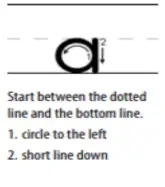
This concept would be taught during a phonics lesson in Kindergarten or 1st grade. Which step would you find it in?
Yes, it would be taught in the early steps of phonics instruction.
No, it would not be taught in Kindergarten or 1st grade phonics lessons.
Yes, but only in advanced phonics lessons beyond 1st grade.
No, it is not part of phonics instruction at any grade level.
If words were written like the two words below on a classroom wall, what would it mean? What do you think the blue squares and the hearts represent?
The blue squares and hearts represent missing letters in the words.
The blue squares and hearts are just decorations.
The blue squares and hearts are punctuation marks.
The blue squares and hearts represent numbers.
Write the number of phonemes next to the words below. For ONE of the bolded words, list the number of consonant sounds and number of vowel sounds. Words: quick, taxes, leave, leaves, started, going, pink, straight, three, quest, listen.
Answers will vary for each word. Example: quick = 4 phonemes (k-w-i-k). For a bolded word: quick = 3 consonant sounds, 1 vowel sound.
All words have 3 phonemes. For a bolded word: quick = 2 consonant sounds, 1 vowel sound.
Each word has 2 phonemes. For a bolded word: quick = 1 consonant sound, 1 vowel sound.
All words have 5 phonemes. For a bolded word: quick = 4 consonant sounds, 1 vowel sound.
What is one other way to spell each of the sounds in the underlined words below?
shout: cow (ow sound), baby: see (ee sound), soil: boy (oy sound)
shout: show (ow sound), baby: bay (ee sound), soil: sail (oy sound)
shout: now (ow sound), baby: bee (ee sound), soil: soy (oy sound)
shout: how (ow sound), baby: lay (ee sound), soil: toy (oy sound)
How would you map the following words: thought, catch, know, charge?
thought: th-ough-t, catch: c-a-tch, know: n-ow, charge: ch-ar-ge (answers may vary based on phoneme mapping)
thought: t-h-o-u-g-h-t, catch: c-a-t-c-h, know: k-n-o-w, charge: c-h-a-r-g-e
thought: tho-ught, catch: cat-ch, know: kn-ow, charge: char-ge
thought: th-o-t, catch: c-a-ch, know: n-o, charge: ch-a-ge
What are phonological neighbors?
Words differing by one sound (e.g., map → mat, cap).
Words with the same meaning but different spellings.
Words that rhyme with each other.
Words that are antonyms of each other.
Circle the words that are phonological (sound) neighbors: pit, pod, wet, pin.
pit and pin are phonological neighbors.
pit and pod are phonological neighbors.
pod and wet are phonological neighbors.
wet and pin are phonological neighbors.
What are two words that are in the same phonological (sound) neighborhood as map?
mat, mash
dog, cat
sun, moon
tree, leaf
List 3 words that are phonological neighbors for the word: dig.
Possible answers: big, fig, dog, dip, dim, rig, etc.
Possible answers: cat, sun, tree, book, pen, chair, etc.
Possible answers: run, jump, swim, fly, walk, crawl, etc.
Possible answers: apple, orange, banana, grape, pear, peach, etc.
Which phoneme does the word 'bat' start with?
/b/
/k/
/s/
/m/
Which phoneme does the word 'ear' start with?
/v/
/e/
/b/
/s/
Which phoneme does the word 'dog' start with?
/d/
/b/
/k/
/t/
Which phoneme does the word 'fan' start with?
/f/
/s/
/b/
/t/
Which phoneme does the word 'guitar' start with?
/g/
/k/
/b/
/d/
Which phoneme does the word 'happy' start with?
/h/
/p/
/s/
/b/
Which phoneme does the word 'jet' start with?
/j/
/s/
/b/
/t/
Which phoneme does the word 'light' start with?
/l/
/b/
/s/
/t/
Which phoneme does the word 'moon' start with?
/m/
/b/
/s/
/t/
Which phoneme does the word 'nine' start with?
/n/
/m/
/d/
/t/
Which phoneme does the word 'pizza' start with?
/p/
/b/
/t/
/s/
Which phoneme does the word 'rainbow' start with?
/r/
/b/
/s/
/t/
Which phoneme does the word 'sun' start with?
/s/
/b/
/m/
/t/
Which phoneme does the word 'table' start with?
/t/
/b/
/k/
/s/
Which phoneme does the word 'vet' start with?
/v/
/b/
/f/
/d/
2. A first-grade teacher leads a small group of beginning readers in a lesson focused on decoding simple words composed of letters that students have learned to sound out in isolation. The teacher begins by writing the word “sat” on the board. In keeping the research-based practices, the most appropriate step for the teacher to take next in this lesson would be to:
A- Teach the student to blend the sounds in the word sat slowly and continuously without pausing.
B- Ask the students to suggest words they know that rhyme with sat and write these words on the board.
C- Teach students to first silently scan all the letters in the word sat and then pronounce the word aloud.
D- Have the students practice identifying the word sat in a variety of connected texts.

