

wayground logo

Free Printable Worksheets

Font size

S
M
L
XL
Worksheets

PE 8 - SUMMATIVE TEST

Total questions: 20

Worksheet time: 17mins

Name
Class
Date
1.
Which of the following best describes the main difference between net and wall games?
a)
Net games require a divider net, while wall games use a rebound surface.
b)
Wall games need two teams, while net games can only be played solo.
c)
Net games are slower-paced, while wall games are generally stationary.
d)
Wall games rely on large balls, while net games use light projectiles.
2.
After regularly playing volleyball with friends, Ana noticed she communicates more openly and listens better to others. This improvement shows the game’s benefit in developing what aspect of well-being?
a)
Emotional well-being through patience and self-regulation.
b)
Social well-being through teamwork and communication.
c)
Physical well-being through coordination and endurance.
d)
Mental well-being through memory and concentration.
3.
When players cooperate to win a doubles match, they learn to trust and rely on each other’s abilities. This experience primarily improves which dimension of wellness?
a)
Emotional well-being through recovery and relaxation routines.
b)
Mental well-being through focus and tactical decision-making.
c)
Physical well-being through consistent strength training.
d)
Social well-being through shared goals and collaboration.
4.
While playing volleyball, Miguel positions himself behind the spiker to catch a blocked ball. What skill is he showing?
a)
Covering to support teammates after a blocked attack.
b)
Serving to return the ball after the opponent’s mistake.
c)
Passing to set up another chance for the spiker.
d)
Blocking to stop the ball before it crosses the net.
5.
During a volleyball match, the setter observes that the opponents are weak in defending deep shots. What should the team do?
a)
Wait for the opponent to make the first mistake.
b)
Focus only on short passes and front-court attacks.
c)
Aim spikes toward the back of the opponent’s court.
d)
Keep serving slowly to avoid losing control.
6.
Why is communication important during a volleyball rally?
a)
It helps players avoid confusion and collisions in play.
b)
It gives players more time to rest between each serve.
c)
It makes the referee’s job easier during long matches.
d)
It increases the number of timeouts for each team.
7.
Why should players in net and wall games practice positioning?
a)
It ensures they can play only in one fixed area of the court.
b)
It allows them to anticipate the object’s direction effectively.
c)
It helps them to stay far from the shuttle or ball’s path.
d)
It reduces the need to coordinate with other teammates.
8.
During a PE class, students reflect on how volleyball teaches them to respect others and cooperate. This reflects which aspect of wellness?
a)
Physical endurance and body coordination skills.
b)
Social and emotional well-being through teamwork.
c)
Cognitive development through memorization drills.
d)
Nutritional awareness through healthy competition.
9.
Why is serving considered an important skill in volleyball and badminton?
a)
It starts the play and can give an immediate advantage.
b)
It is only used at the end of the rally to score points.
c)
It replaces passing when the rally becomes too long.
d)
It helps players rest between each round of the game.
10.
What is the main objective in both volleyball and badminton?
a)
To keep the ball or shuttle as long as possible in play.
b)
To make continuous passes until the rally becomes longer.
c)
To block the object before it reaches the frontcourt area.
d)
To send the ball or shuttle in a way opponents cannot return.
11.

Aiming to hit the shuttlecock downward toward the opponent's forecourt area and drop it immediately over the net.

(a)  

12.

A defensive move to prevent the ball from touching the floor.

(a)  

13.

It aims to make the shuttle fly up in the air above the net and land in your opponent's backcourt area.

(a)  

14.

It is the ancient name of badminton which was originated in India.

(a)  
15.

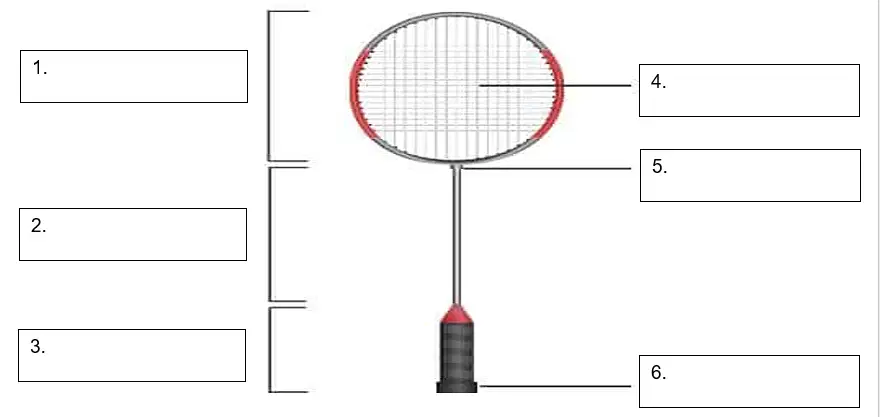
Write the correct labels of the Parts of a Badminton Racket.

What is number 1?

(a)  

16.

Write the correct labels of the Parts of a Badminton Racket.

What is number 2?

(a)  

17.

Write the correct labels of the Parts of a Badminton Racket.

What is number 3?

(a)  

18.

Write the correct labels of the Parts of a Badminton Racket.

What is number 4?

(a)  

19.

Write the correct labels of the Parts of a Badminton Racket.

What is number 5?

(a)  

20.

Write the correct labels of the Parts of a Badminton Racket.

What is number 6?

(a)
