
 Worksheets
Understanding Harmony in the Society & Human Goal 2
Total questions: 30
Worksheet time: 15mins

Which condition best defines a true society according to the material?
People living together with conflicting goals
People living together with differing goals
Families living together in a relationship of mutual fulfillment
People living separately, in opposition
In the sequence of harmony, what is identified as the base for harmony in society?
Harmony in nature
Harmony in family
Harmony in physical facilities
Harmony in governance
Which set correctly matches the four components of the Human Goal with their scope?
Right Understanding in society; Prosperity in every individual; Fearlessness in nature; Co-existence in every family
Right Understanding in every individual; Prosperity in every family; Fearlessness (trust) in society; Co-existence (mutual fulfillment) in nature/existence
Right Understanding in every family; Prosperity in nature; Fearlessness in every individual; Co-existence in society
Right Understanding in governance; Prosperity in markets; Fearlessness in families; Co-existence in communities
According to the material, which of the following reflects a naturally acceptable choice for prosperity?
Prosperity in a few families with others dependent on them
Prosperity in every family
Prosperity only for those with higher education
Prosperity measured by national GDP alone
According to the primary links between systems and goals, Education-Sanskar primarily leads to which outcome?
Prosperity
Right understanding and right feeling (happiness)
Fearlessness and Co-existence
Prosperity and Fearlessness

In the context of the human goal, which misaligned societal trend corresponds to ‘Mastery & Exploitation’ over nature?
Resource depletion and pollution
Trust and mutual fulfillment
Right understanding and right feeling
Cyclic and enriching production
Sanskar is best defined in this material as which of the following?
Technical skill to increase production
Basic acceptances of the harmony at various levels
Accumulation of wealth for security
Legal enforcement of justice
Which statement best captures the role of Education-Sanskar?
It focuses only on physical training for work.
It provides commitment, preparation, and practice of living in harmony at all levels.
It is primarily about storing surplus goods for future use.
It centers on exchanging resources across families.
Right skills for prosperity include which idea?
Obsession for accumulation
Sustainable production of more than what is required
Maximizing profit by any means
Complete avoidance of technology
Health and Self-regulation is primarily described as which of the following?
Feeling of responsibility towards the Body for nurturing, protection, and right utilization
The legal system ensuring order in society
Exchange of physical facilities with profit motive
An approach to store resources for scarcity
Which criterion is stated for how to produce?
The process should be linear and extractive
The process should be cyclic and mutually enriching (eco-friendly)
Production should ignore social justice
Use of non-renewable resources only
Resource depletion is described as which situation?
Using a resource at the same rate it is produced in nature
Using a resource at a rate greater than it is produced in nature
Recycling resources back to original state
Eliminating all production processes
What two actions are suggested when someone is unable to develop competence to ensure justice and does injustice?
Ignore the situation and hope it resolves
Stop further injustice and help the person develop competence for ensuring justice
Punish with exploitation
Shift to accumulation and profit focus
Exchange is defined as which of the following?
Sharing or exchanging physical facility with a view of mutual fulfillment and not with the obsession for profit
A market transaction governed solely by price
Accumulating goods for status
Barter only within strangers
According to the "Natural Outcome of Right Understanding," what is foundational for ensuring prosperity in society?
Physical facility alone
Right understanding at the base, along with physical facility
Tradition of living with happiness
Nation-level governance

Based on the diagram contrasting environments, which pathway is associated with Relationship rather than Domination?
Imitate → Follow → Obedience/Discipline → Self-verifi → Right → Self-Discipline → Self-confidence → Next Generation
Imitate → Follow → Obedience/Discipline → Self-verifi → Wrong → Arbitrariness → Opposition → Revolt → Struggle → War → Next Generation
Skip imitation and directly enforce obedience to achieve compliance
Begin with opposition to build resilience
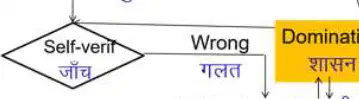
In the Domination environment pathway, what typically follows “Wrong”?
Self-confidence
Arbitrariness
Self-discipline
Right

According to the diagram, which sequence best represents escalation under Domination?
Opposition → Arbitrariness → Revolt → Struggle → War
Arbitrariness → Opposition → Revolt → Struggle → War
Revolt → War → Struggle → Opposition → Arbitrariness
Self-discipline → Self-confidence → Next Generation

Which concept is explicitly linked with the Relationship environment at the base of the diagram?
In an environment of Relationship with parents and teachers having right understanding and right feeling
In an environment of Domination with parents and teachers lacking right understanding and right feeling
A competitive classroom model focused on grading
A neutral environment without adult involvement

What is the stated characteristic of parents and teachers in a Domination environment?
They have right understanding and right feeling
They focus on self-regulation and trust
They lack right understanding and right feeling
They avoid discipline entirely
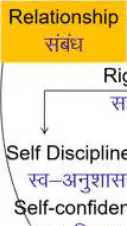
In the Relationship pathway, what comes immediately after “Right”?
Self-discipline
Opposition
Wrong
War
What overarching social goal is described in the Key Takeaways?
Maximizing competition among individuals
Right understanding and right feeling (happiness) in every individual, prosperity in every family, fearlessness (trust) in society, and co-existence in nature/existence
Achieving obedience through domination to ensure order
Reducing interactions between families and society
According to the Key Takeaways, which system set contributes to fulfilling the human goal?
Entertainment and leisure systems
Human order systems like education-sanskar, health-self regulation, production-work, justice-preservation, and exchange-storage
Only military defense systems
Random individual actions without systems
What broader outcome do interconnected systems from family to world level lead to?
Universal human order
Local competitive markets
Isolated family units
Temporary agreements
What competence is the child expected to gain when development occurs in the emphasized environment?
Compete aggressively in markets
Manipulate others to achieve goals
Participate in the universal human order
Avoid social interactions

Which pair best contrasts the two environments portrayed?
Trust vs. fear
Relationship vs. Domination
Silence vs. Noise
Growth vs. Stagnation
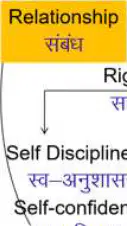
Under Relationship, which outcome supports the next generation positively?
War
Struggle
Self-confidence
Opposition
Which phrase in the Key Takeaways is used to describe co-existence?
Mutual fulfillment in nature/existence
Competitive advantage in markets
Individual survival tactics
Hierarchical control dynamics

Which chain represents a constructive verification process in development?
Imitate → Follow → Obedience/Discipline → Self-verifi → Right → Self-Discipline
Imitate → Opposition → Revolt → War
Wrong → Arbitrariness → War
War → Struggle → Next Generation

Which early-stage action is common but must be guided to avoid the Domination path?
Imitation and following without self-verification
Self-confidence
Justice-preservation
Exchange-storage

