
 Worksheets
Radio Wave Communication Quiz
Total questions: 73
Worksheet time: 37mins
Which of the following is NOT a basic medium used for information transfer in data transmission systems?
Copper cables
Optical fiber cables
Wooden beams
Radio waves
What is the main function of an antenna in a radio wave transmission system?
To store information
To convert electrical signals into electromagnetic waves and vice versa
To process received signals
To generate radio waves
Which step in radio wave transmission involves the receiver extracting information from the captured radio waves?
Generation
Transmission
Reception
Signal Processing
Radio wave communication enables wireless data transmission by generating and radiating radio waves through antennas. Which of the following are two applications where this technology is widely used?
Used in broadcasting and radar systems
Used in telephones and televisions
Used in remote controllers and printers
Used in internet and cable TV
A student wants to design a wireless communication system. What components must be included for successful radio wave transmission and why are they important?
Only a receiver, because it captures signals
Only a transmitter, because it sends signals
Both an antenna and a transmitter, because the antenna converts signals and the transmitter generates and modulates radio waves
Only copper cables, because they transfer information
Which device detects and demodulates the received radio waves to recover the original information?
Transmitter
Receiver
Antenna
Modulator
What is the process of superimposing information (audio, video, data) onto the radio wave at the transmitter called?
Demodulation
Transmission
Modulation
Reception
What is the process of extracting information from the received radio wave at the receiver known as?
Modulation
Demodulation
Transmission
Amplification
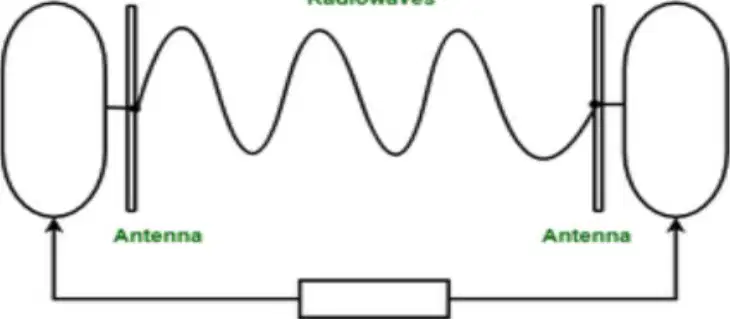
Based on the diagram, which component is responsible for sending out the radio waves?
Receiver
Antenna
Transmitter
Modulator
Which of the following is NOT typically a component of a cellular network diagram?
Base transceiver station (BTS)
Home location register (HLR)
Visitor location register (VLR)
Local area network (LAN)
Why is the connection to the public switched telephone network (PSTN) important in a cellular network diagram?
It allows mobile devices to access the internet.
It enables communication between cellular and traditional landline phones.
It provides power to the base station controllers.
It stores user location information.
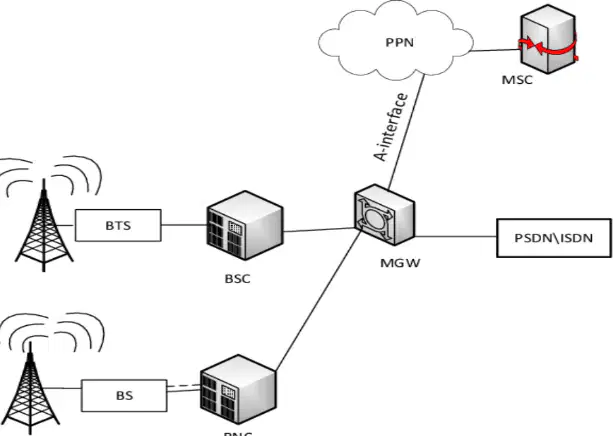
Which component of a mobile network is responsible for handling radio communication with mobile devices within a specific cell?
Base Transceiver Station (BTS)
Core Network
Base Station Controller (BSC)
Mobile Devices (User Equipment)
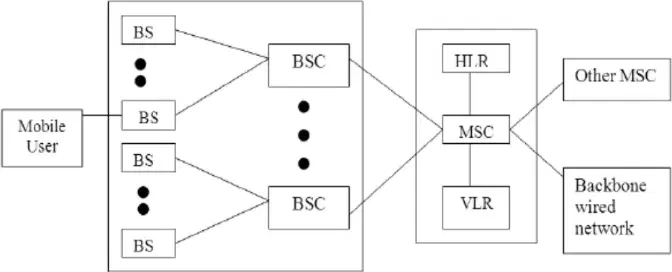
What is the main function of the Base Station Controller (BSC) in a mobile network?
Managing multiple BTS units and handling radio resource management
Authenticating subscribers
Routing calls between networks
Connecting wireless devices to the network
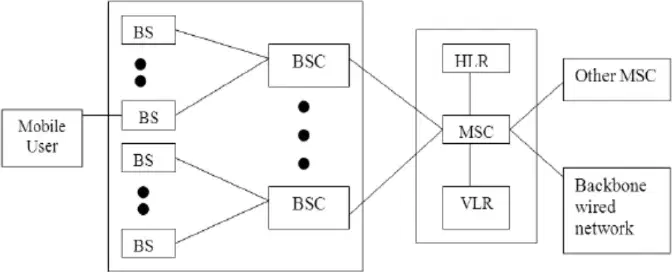
Which part of the mobile network is responsible for call routing, subscriber authentication, and managing network resources?
Core Network
Base Transceiver Station (BTS)
Base Station Controller (BSC)
Mobile Devices (User Equipment)
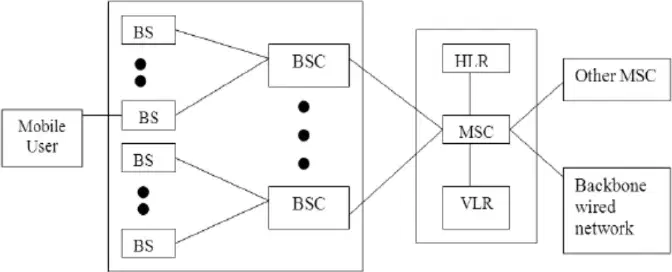
A mobile user moves from one cell to another while on a call. Which network component facilitates the handoff procedure to ensure the call is not dropped?
Base Station Controller (BSC)
Core Network
Base Transceiver Station (BTS)
Mobile Devices (User Equipment)
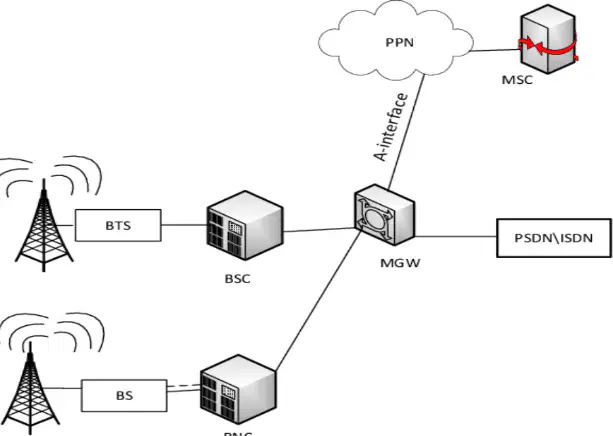
The Base Transceiver Station (BTS) and Base Station Controller (BSC) work together to maintain communication as a mobile device moves between cells by:
The BTS handles radio communication within a cell, while the BSC manages multiple BTS units and coordinates handoff procedures as devices move between cells.
The BTS authenticates subscribers, and the BSC routes calls.
The BTS manages network resources, and the BSC connects devices to the network.
The BTS and BSC both only transmit signals without managing handoffs.
Which component is responsible for switching calls, routing data, and managing user mobility in cellular networks?
Mobile Switching Center (MSC)
Home Location Register (HLR)
Visitor Location Register (VLR)
Public Switched Telephone Network (PSTN)
What is the primary function of the Home Location Register (HLR) in a cellular network?
Stores subscriber information including home network and location
Switches calls and routes data
Connects calls to landline phones
Manages temporary subscriber data in a specific area
Which database temporarily stores information about visiting subscribers in a specific area?
Visitor Location Register (VLR)
Home Location Register (HLR)
Mobile Switching Center (MSC)
Public Switched Telephone Network (PSTN)
What is the Public Switched Telephone Network (PSTN) primarily used for?
Connecting cellular networks to landline phones
Storing subscriber information
Switching calls and routing data
Managing user mobility
Which of the following is NOT a key component of satellite communication systems?
Database management system
Antennas
Transponders
Power systems
Ground stations in satellite communication systems are responsible for which of the following?
Housing transmitting and receiving equipment, antennas, and terrestrial networks
Storing subscriber information
Switching calls between cells
Providing propulsion to satellites
Explain how the uplink and downlink work in satellite communication systems, using the diagram as a reference.
Uplink sends signals from ground stations to the satellite, while downlink sends signals from the satellite to ground stations.
Uplink sends signals from the satellite to ground stations, while downlink sends signals from ground stations to the satellite.
Both uplink and downlink send signals only between ground stations.
Uplink and downlink are used only for terrestrial networks.
Which system provides the necessary energy to power all satellite systems?
Power System
Command and Control Systems
Terrestrial Networks
Stabilization/Propulsion System
What is the main function of the Stabilization/Propulsion System in a satellite?
To maintain the satellite's orbit and orientation
To send signals to the satellite
To provide energy to the satellite
To connect ground stations to users
Which equipment is responsible for sending signals to the satellite and receiving signals back?
Transmitting and Receiving Equipment
Antennas
Power System
Terrestrial Networks
What is the role of antennas in satellite communication?
To transmit and receive signals to and from the satellite
To provide energy to the satellite
To control the satellite's operations from Earth
To maintain the satellite's orbit
How do cellular and satellite communication primarily differ?
Infrastructure and coverage area
Color and shape of devices
Type of users
Amount of data stored
Satellite communication can cover a larger area than cellular communication because:
Satellite communication uses satellites orbiting the earth to relay signals, allowing coverage over a larger area than land-based cellular towers.
Cellular communication uses satellites, which cover more area than land-based towers.
Satellite communication is faster, so it covers more area.
Cellular communication is limited by the number of users.
Which type of communication relies on a network of cell towers to transmit and receive signals within a specific geographic area?
Cellular Communication
Satellite Communication
Fiber Optic Communication
Radio Communication
What is a key advantage of satellite communication in terms of coverage?
It offers connectivity even in remote areas where cellular networks are unavailable.
It is limited to urban areas only.
It requires cell towers in every location.
It cannot provide coverage in rural areas.
Which communication method generally offers faster data transfer speeds?
Cellular Communication
Satellite Communication
Morse Code Communication
Analog Communication
Why might satellite devices have longer battery life compared to cellular devices?
They only transmit when necessary.
They use more power for constant connection attempts.
They rely on cell towers for transmission.
They have smaller batteries.
Compare the cost of cellular communication and satellite communication. Which is generally more affordable and why?
Cellular communication is generally more affordable due to existing infrastructure and lower service fees.
Satellite communication is more affordable because it covers remote areas.
Both have the same cost due to similar technology.
Cellular communication is more expensive because it uses cell towers.
A researcher needs to set up a communication system in a remote area with no existing cell towers. Which type of communication should they choose and why?
Satellite communication, because it offers connectivity in remote areas without cellular coverage.
Cellular communication, because it is faster.
Cellular communication, because it is cheaper.
Fiber optic communication, because it is reliable.
Which of the following best describes the primary purpose of a VPN?
To protect your privacy online by creating a virtual private network
To increase your internet speed
To provide free internet access
To block all advertisements
What does a VPN do to your real IP address and location?
Makes them visible to advertisers
Masks them to make your online activity more private
Shares them with websites
Deletes them permanently
Which feature of a VPN helps protect sensitive information like passwords and credit card numbers when using public Wi-Fi?
Bandwidth throttling
Encrypted tunnel between device and VPN server
Access to home content from abroad
Censorship bypass
How can a VPN help if your ISP is throttling your internet speed based on your activity?
By increasing your data limit
By hiding your activity type and preventing targeted slowdown
By blocking all websites
By disconnecting your internet
Which of the following is a benefit of using a VPN for accessing content from abroad?
It allows you to connect to servers in different regions and access home content
It increases your download speed
It provides free subscriptions to online services
It blocks all international websites
How does a VPN help maintain internet freedom in countries with strict regulations?
By blocking all websites
By allowing access to websites and services that are blocked or restricted
By slowing down internet speed
By deleting browsing history
(VPN encryption is mentioned as a process that scrambles data into an incomprehensible mass of randomized code.) Based on this, why is VPN encryption important for online security?
It makes data unreadable to hackers even if intercepted
It increases the size of your files
It deletes all your data
It slows down your internet connection
Suppose you are traveling abroad and want to watch a TV show that is only available in your home country. How can a VPN help you in this situation?
By connecting you to a server in your home country to access the show
By increasing your internet speed
By blocking all streaming services
By deleting your browsing history
Which of the following is a primary benefit of using a VPN when connected to public Wi-Fi?
It increases your internet speed.
It protects your browsing traffic with encryption.
It allows you to access only local websites.
It disables your device’s firewall.
How can a VPN help you avoid price discrimination when shopping online?
By blocking advertisements on e-commerce sites.
By changing your IP address to access lower prices in other regions.
By automatically applying discount codes.
By speeding up your internet connection.
Which of the following is NOT a reason to use a VPN while abroad?
To access sites and services as if you were in your home country.
To avoid extensive security checks by online banking.
To increase the battery life of your device.
To use social media apps without restrictions.
What is one way a VPN can help prevent bandwidth throttling by your ISP?
By encrypting your data so your ISP cannot see your online activity.
By increasing your data usage.
By blocking all streaming services.
By reducing your internet speed.
Why is it important to use a VPN when shopping online, especially on unsecured Wi-Fi?
It automatically fills in your payment details.
It ensures all data to and from your device is encrypted.
It increases the number of products available.
It disables website encryption.
In 2023, what percentage of internet users worldwide used a VPN to protect privacy on public Wi-Fi?
10%
25%
51%
75%
Using a VPN can help you avoid cyber harassment such as doxxing by:
Making your browsing history public.
Sharing your personal information with websites.
Hiding your real IP address from online snoopers.
Disabling your device’s antivirus software.
To access their home country’s streaming services while abroad, what should a student do using a VPN?
Connect to a server in their home country using the VPN.
Disable the VPN and use public Wi-Fi.
Use a VPN server in the country they are visiting.
Only use mobile data without a VPN.
A VPN can help prevent an ISP from throttling internet speed while downloading large files by:
Encrypting the user’s data, making it difficult for the ISP to detect and throttle specific activities.
Increasing the ISP’s bandwidth limit.
Blocking all downloads.
Sharing the user’s activity with the ISP.
To keep your payment information secure while shopping online on an unsecured Wi-Fi network, which strategic step should you take using a VPN?
Disable the VPN and rely on the website’s encryption only.
Use a VPN to encrypt all data sent to and from your device, ensuring your card details remain protected.
Share your payment information over email.
Use public Wi-Fi without any security measures.
Which of the following is a benefit of using a VPN for online gaming?
It increases your internet speed.
It encrypts your internet traffic, making it harder for your ISP to throttle your data.
It allows you to play games without an internet connection.
It automatically improves your gaming skills.
What is a distributed denial of service (DDoS) attack?
An attack that steals passwords from users.
An attack that floods a network with artificially inflated traffic to force legitimate users offline.
An attack that installs malware on your device.
An attack that blocks access to social media websites.
Why might journalists and activists use VPN accounts in regions with low internet freedom?
To increase their internet speed.
To protect their privacy and access free media without exposing themselves to undue risk.
To download movies for free.
To avoid paying subscription costs.
Which of the following is a main disadvantage of using a VPN?
It always makes your internet connection faster.
It can slow down your internet connection due to encryption and routing through remote servers.
It guarantees complete anonymity online.
It is free for everyone.
How do free VPN services typically monetize their operations?
By charging high subscription fees.
By collecting user data and selling it to third parties or flooding users with ads.
By offering unlimited bandwidth.
By providing advanced security features for free.
Some VPNs are considered insecure. What is a common reason for this insecurity?
They use strong encryption protocols.
They do not track or sell browsing data.
They have weak encryption algorithms and more security holes.
They are only available for journalists.
(DoK Level 2) If a student is choosing a VPN service, what factors should they consider to avoid the disadvantages mentioned in the text?
Only the price of the VPN.
The strength of encryption protocols, server infrastructure, and privacy policies.
The color of the VPN’s logo.
Whether the VPN is popular among gamers.
(DoK Level 2) How does the use of a VPN help protect users in regions with low internet freedom?
By making their internet connection faster.
By allowing them to access free media and communicate online without exposing themselves to undue risk.
By blocking all government websites.
By providing free online games.
(DoK Level 3) Using a VPN in a country with low internet freedom can help activists communicate and access information safely. What is an important risk to consider when choosing a VPN?
You should be cautious of insecure or free VPNs that may sell your data or have weak encryption.
All VPNs are equally safe and make your internet connection faster.
VPNs automatically block all government surveillance and have no risks.
VPNs allow you to download movies for free without worrying about security.
Which strategy best balances speed, security, and cost when selecting a VPN service?
Choose the cheapest VPN available, regardless of its security features.
Select a VPN with strong encryption protocols, a reliable server infrastructure, and reasonable subscription costs, while avoiding free VPNs that may compromise privacy and speed.
Pick a VPN based only on user reviews.
Use multiple free VPNs at the same time for better security.
Which of the following is a reason why VPNs may not be available in some countries?
VPNs are banned or heavily restricted in certain countries
VPNs are too expensive for most people
VPNs do not work with mobile devices
VPNs are only available for businesses
What is one thing a VPN does NOT protect you from?
Voluntarily giving your data to online service providers
Masking your IP address
Securing your browsing data
Improving your daily cybersecurity
Which of the following is a PRO of using a VPN?
Secures your browsing data
Slows down your internet speed
Incompatible with certain devices
Banned in certain countries
Why should you double-check local laws regarding VPNs when traveling abroad?
VPNs may be banned or restricted in some countries
VPNs are always free in foreign countries
VPNs automatically protect you from all threats
VPNs work better in other countries
Which VPN disadvantage could affect your internet experience the most?
Slows down your internet speed
Masks your IP address
Offers a more secure gaming experience
Prevents bandwidth throttling
If you have already overshared personal information online, what service can help you remove it from data brokers?
Personal data removal service
VPN subscription
Antivirus software
Internet speed booster
Which of the following is NOT a benefit of using a VPN?
Does not protect you from voluntary data collection
Secures your browsing data
Masks your IP address
Improves your daily cybersecurity
A student wants to use a VPN for gaming. What advantage does a VPN offer in this scenario?
Offers a more secure gaming experience
Slows down your internet speed
Incompatible with certain devices
Collects your data for gaming companies
Which statement best explains why VPNs do not protect you from data hoarding on social media?
Social media platforms collect data voluntarily shared by users
VPNs encrypt all social media data
VPNs block access to social media
Social media is not accessible through VPNs
A company wants to prevent bandwidth throttling based on certain activities. How can a VPN help?
By preventing bandwidth throttling based on certain activities
By slowing down internet speed
By collecting company data
By banning VPN use in the company

