
 Worksheets
Ch 2 L1 Earth's Revolution and Seasons Quiz
Total questions: 15
Worksheet time: 8mins
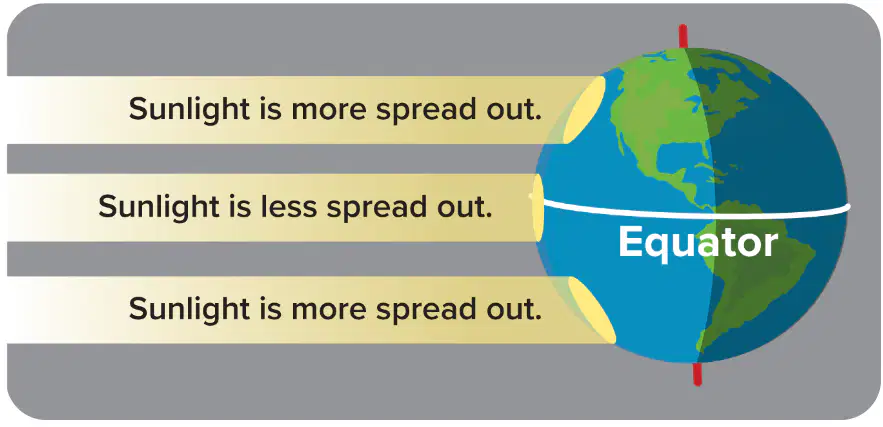
1. Imagine Benjamin, Abigail, and William are planning a global adventure! They want to find the sunniest spot on Earth. Based on the image below, which location do you think gets the most intense sunlight, and why?
A. The Northern Hemisphere location, because when the surface is tilted, the light spreads out, making it more intense.
B. The Equator location, because the light that hits this location is less spread out, making it more intense.
C. The Southern Hemisphere location, because when the surface is tilted, the light spreads out, making it more intense.
D. Both of the hemispheres, because when the surface is tilted, the light spreads out, making it more intense.
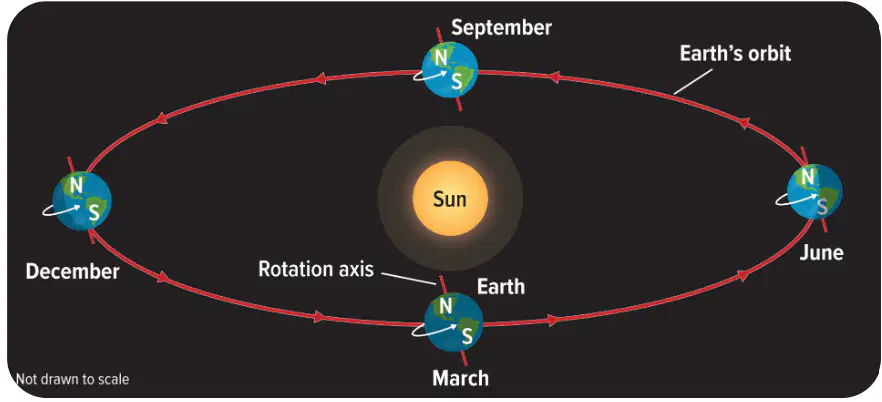
2. Scarlett, Oliver, and Mia are planning a global adventure, but they want to visit each hemisphere when it's the warmest! Using the image below, can you help them figure out which statement BEST describes when each hemisphere gets its hottest temperatures due to Earth's tilt and its position around the Sun?
A. Due to Earth’s tilted axis, the Western Hemisphere is warmest in June and the Eastern Hemisphere is warmest in December.
B. Due to Earth’s tilted axis, the Eastern Hemisphere is warmest in June and the Western Hemisphere is warmest in December.
C. Due to Earth’s tilted axis, the Southern Hemisphere is warmest in June and the Northern Hemisphere is warmest in December.
D. Due to Earth’s tilted axis, the Northern Hemisphere is warmest in June and the Southern Hemisphere is warmest in December.
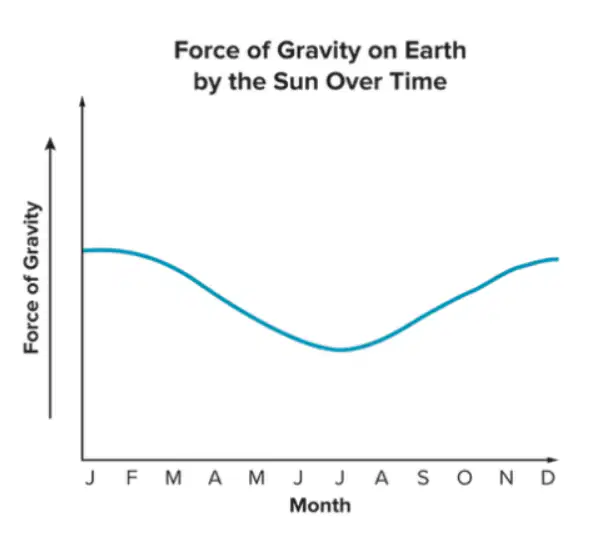
3. Michael, Sophia, and Abigail are curious about how the Sun’s gravitational pull on Earth changes throughout the year. Take a look at the graph below! Based on what you see, what clues does the graph give you about the path of Earth’s orbit, and why does this happen?
A. Earth’s orbit is circular because the distance between the Sun and Earth must change over time. Since distance impacts the strength of gravitational force between two objects, the graph shows a change in gravitational force.
B. Earth’s orbit is not quite circular because the distance between the Sun and Earth must change over time. Since distance impacts the strength of gravitational force between two objects, the graph shows a change in gravitational force.
C. Earth’s orbital path changes from year to year because the distance between the Sun and Earth must change over time. Since distance impacts the strength of gravitational force between two objects, the graph shows a change in gravitational force.
D. Earth’s orbital makes a different circle each month, because the distance between the moon and Earth must change over time. Since distance impacts the strength of gravitational force between two objects, the graph shows a change in gravitational force.
4. Imagine Aiden and Zoe are on a space adventure! According to the Law of Universal Gravitation, what two factors determine the pull of gravity between the Sun and Earth?
A. the mass of the larger object and the distance between them
B. the masses of the objects and the distance between them
C. the mass of the smaller object and their speed of travel
D. the masses of each object and their speed of travel
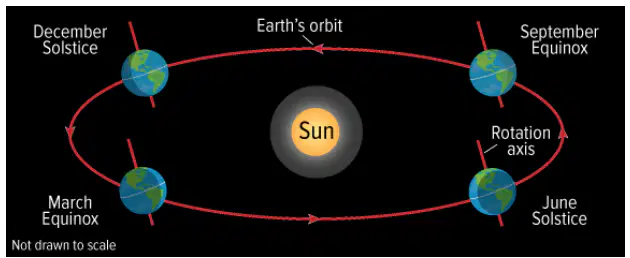
Maya, Jackson, and Evelyn are having a friendly debate about the December Solstice while looking at the image below. A solstice is when Earth’s rotation axis is tilted directly toward or away from the Sun. Which statement about the December Solstice is NOT true?
A. The north end of the rotation axis is away from the Sun.
B. The northern hemisphere receives less total solar energy.
C. The southern hemisphere receives more total solar energy.
D. At this time, summer begins in the northern hemisphere.
Noah and Emma are watching a globe spin in their classroom. When Earth spins around its axis, what type of movement are they observing?
A. orbit
B. revolution
C. rotation
D. tilt
7. William, Olivia, and Maya are on a space adventure, exploring how the Sun’s energy affects the temperatures of different planets! They notice that solar intensity is strongest where sunlight hits directly, and it spreads out more on tilted surfaces or as you move farther from the Sun. Besides the atmosphere, they wonder: How do you think temperatures compare on Earth, Mercury (closer to the Sun), and Neptune (farther from the Sun)?
Which statement is the BEST prediction of how temperature on these planets varies?
A. Temperature would be highest on Mercury and lowest on Earth.
B. Temperature would be highest on Neptune and lowest on Mercury.
C. Temperature would be highest on Mercury and lowest on Neptune.
D. Temperature would be highest on Earth and lowest on Neptune.
8. Oliver and Nora are curious about how the Sun’s influence on Earth changes as our planet orbits. Which statement best describes how Earth’s solar energy distribution differs between an Equinox and a Solstice?
A. During a solstice, the same amount of solar energy reaches the Northern and Southern Hemispheres, but during an equinox, either the Northern or Southern Hemisphere receives more energy than the other.
B. During an equinox, the same amount of solar energy reaches the Northern and Southern Hemispheres, but during a solstice, either the Northern or Southern Hemisphere receives more energy than the other.
C. During a solstice, the same amount of solar energy reaches Earth and the moon, but during an equinox, either Earth or the moon receives more energy than the other.
D. During an equinox, the same amount of solar energy reaches Earth and the Moon, but during a solstice, either Earth or the Moon receives more energy than the other.
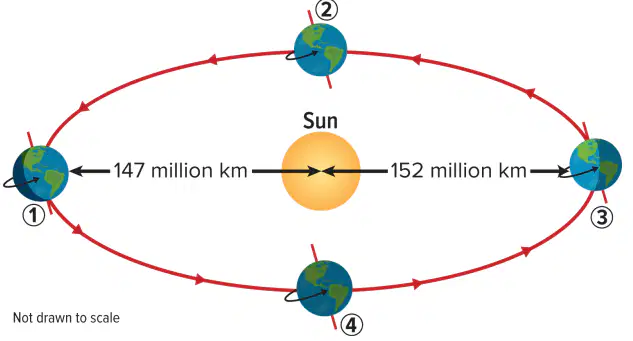
Abigail, Anika, and Olivia are planning a summer picnic in North America! The model shows Earth at different points in its orbit around the Sun. At which point should they pack their sunglasses because North America is experiencing summer?
A. Point 1 because North America is closer to the Sun.
B. Point 2 because North America is tilted along Earth’s orbit.
C. Point 3 because North America is tilted toward the Sun.
D. Point 4 because North America receives the most intense solar energy.
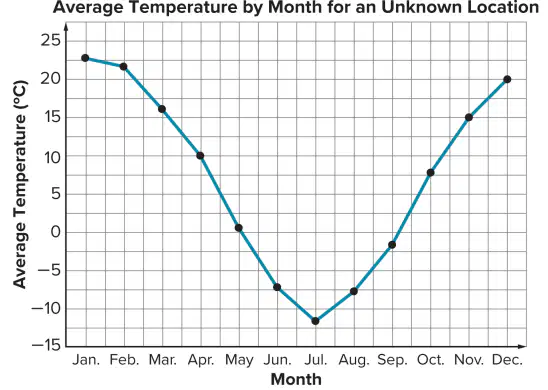
10. Oliver, Nora, and Daniel are trying to solve a mystery! They found a graph showing how the temperature changes throughout the year for a secret location as Earth revolves around the Sun. Can you help them figure out in which hemisphere this location is?
A. Northern Hemisphere because January has the highest temperature.
B. Southern Hemisphere because January has the highest temperature.
C. Southern Hemisphere because July has the highest temperature.
D. Northern Hemisphere because July has the highest temperature.
11. Benjamin, Elijah, and Abigail are curious about how gravity affects our planet. Gravity is an attractive force that exists between all objects that have mass. What role does gravity play in determining the motion of Earth?
A. Earth’s gravitational pull on the Sun causes Earth to orbit the Sun.
B. The Sun’s gravitational pull on Earth causes the Sun to orbit Earth.
C. Earth’s gravitational pull on the Sun causes the Sun to orbit Earth.
D. The Sun’s gravitational pull on Earth causes Earth to orbit the Sun.
12. Arjun, Ava, and Michael are stargazing one night. They wonder: Which object in the solar system orbits Earth because of Earth’s gravitational pull?
A. the Sun
B. the planets
C. Earth's moon
D. Mars
13. Evelyn, Abigail, and Aiden are curious about why Earth has seasons like summer and winter. They notice that the temperature changes in a cycle every year. Which statement BEST describes how the Sun’s impact on Earth creates these seasons?
A. Seasons occur because Earth orbits the Sun in a path that is not a perfect circle, so different regions of Earth get more daylight and are closest to the Sun in different parts of the orbital path.
B. Seasons occur because Earth’s axis is tilted, so as it orbits the Sun, different regions of Earth get more daylight and the highest solar intensity in different parts of the orbital path.
C. Seasons occur because the Sun’s axis is tilted, so as Earth orbits the Sun, different regions of Earth get more daylight and are closest to the Sun in different parts of the orbital path.
D. Seasons occur because the Sun’s axis is tilted, so as the Sun orbits Earth, different regions of Earth get more daylight and are closest to the Sun in different parts of the orbital path.
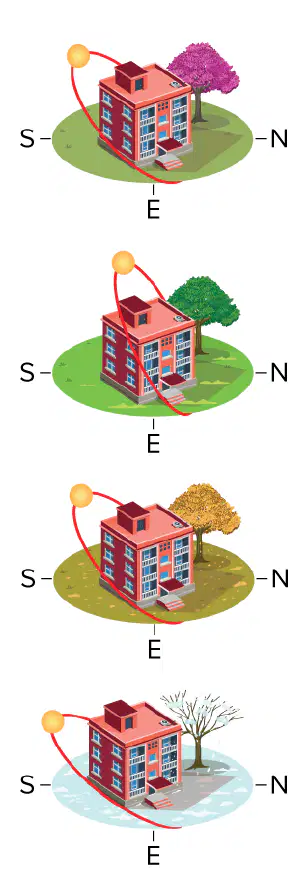
14. William, Ethan, and Priya are curious about how the Sun’s path changes throughout the year. Take a look at the images below showing the Sun’s position in different seasons. Which statement BEST describes how the height of the Sun’s path, as seen from Earth’s surface, changes over time?
A. The height of the Sun’s path changes from season to season such that in both hemispheres, the path is lowest in the summer and highest in the spring.
B. The height of the Sun’s path changes from season to season such that in both hemispheres, the path is lowest in the winter and highest in the summer.
C. The height of the Sun’s path changes from season to season such that in both hemispheres, the path is lowest in the summer and highest in the winter.
D. The height of the Sun’s path changes from season to season such that in both hemispheres, the path is lowest in the fall and highest in the spring.
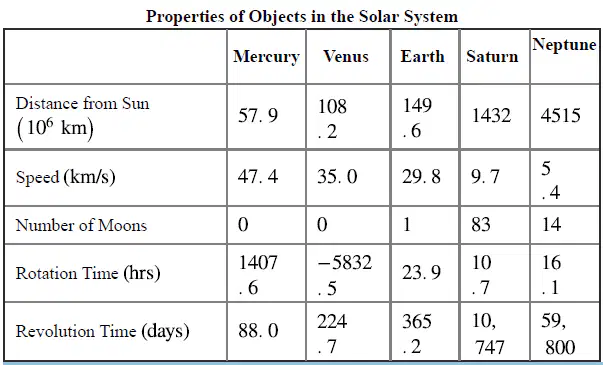
Ava, Arjun, and Noah are curious about the planets in our solar system! They’re looking at the table of planetary properties above and wondering: Can you figure out if planets other than Earth would have seasonal temperature patterns like Earth does, just by using the data in the table? Why or why not?
A. Yes; the presence of seasonal temperature patterns depends on the planet’s rotation and revolution around the sun.
B. No; the presence of seasonal temperature patterns depends on the planet’s rotation and revolution around the sun.
C. Yes; the presence of seasonal temperature patterns depends on the tilt of a planet’s rotation axis.
D. No; the presence of seasonal temperature patterns depends on the tilt of a planet’s rotation axis.

