
NEW
Font size
 Worksheets
Torsion and Moment Quiz
Total questions: 10
Worksheet time: 5mins
When analyzing stresses on inclined planes in pure shear, which additional type of stress is considered along with shear stress?
Normal stress
Bending stress
Torsional stress
Thermal stress
Given a shaft with segments of different diameters and materials, which property must remain constant within each segment for the procedures illustrated to be valid?
Dimensions and properties
Only the diameter
Only the material
Only the length
The relationship among E, G, and ν (Poisson’s ratio) is
E = 3 G (1 − ν)
E = 2 G (1 + ν)
E = G / (1 + ν)
E = G (1 − 2 ν)
In the context of pure shear, what is the significance of the sign convention for shear stresses?
It helps determine the direction and positivity/negativity of shear stresses
It defines the material properties
It sets the length of the bar
It determines the temperature effects
How does the strain in the perpendicular direction to the 45° direction compare to the strain in the 45° direction under pure shear?
It is twice as large
It is a negative strain of the same amount
It is zero
It is a positive strain of the same amount
The numerically largest shear stresses occur on planes for which θ = 0 and 90°, as well as on the opposite faces (θ = 180° and 270°), because:
Because the orientation of the plane aligns with the direction of applied shear stress.
Because the normal stress is maximized at these angles.
Because the element is under pure compression at these angles.
Because the trigonometric identities do not apply at these angles.
When a bar is subjected to nonuniform torsion, how is the total strain energy (U) of the bar calculated?
By summing the strain energy of each segment
By multiplying the strain energy of each segment
By dividing the strain energy of each segment
By subtracting the strain energy of each segment
How are the unknown torques in the composite bar determined?
By solving simultaneous equations of equilibrium and compatibility.
By measuring the angles of twist directly.
By using only the equilibrium equation.
By ignoring the compatibility condition.
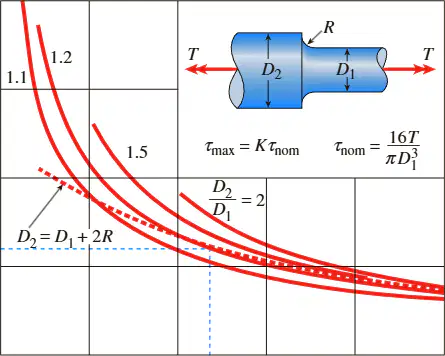
If the ratio D2/D1 is 2 and the fillet radius R is such that R/D1 = 0.10, what is the approximate value of K according to Figure 3-59?
1.5
1.0
2.0
1.1
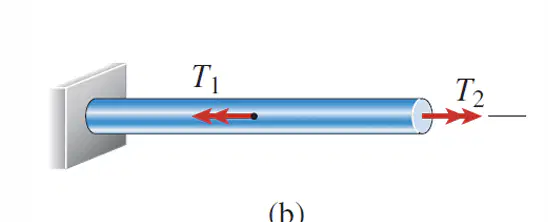
Refer to the diagram below (Fig. 3-2 in the textbook):
(Illustration: a circular bar with torques T₁ and T₂ applied at each end)
Which statement is true about this system?
T₁ and T₂ produce equal and opposite twisting moments
The bar is in pure bending
The net torque on the bar is zero only if T₁ = 0
Both T₁ and T₂ act in the same direction of rotation

