
 Worksheets
Unit 2A Review - Mesopotamia
Total questions: 20
Worksheet time: 20mins
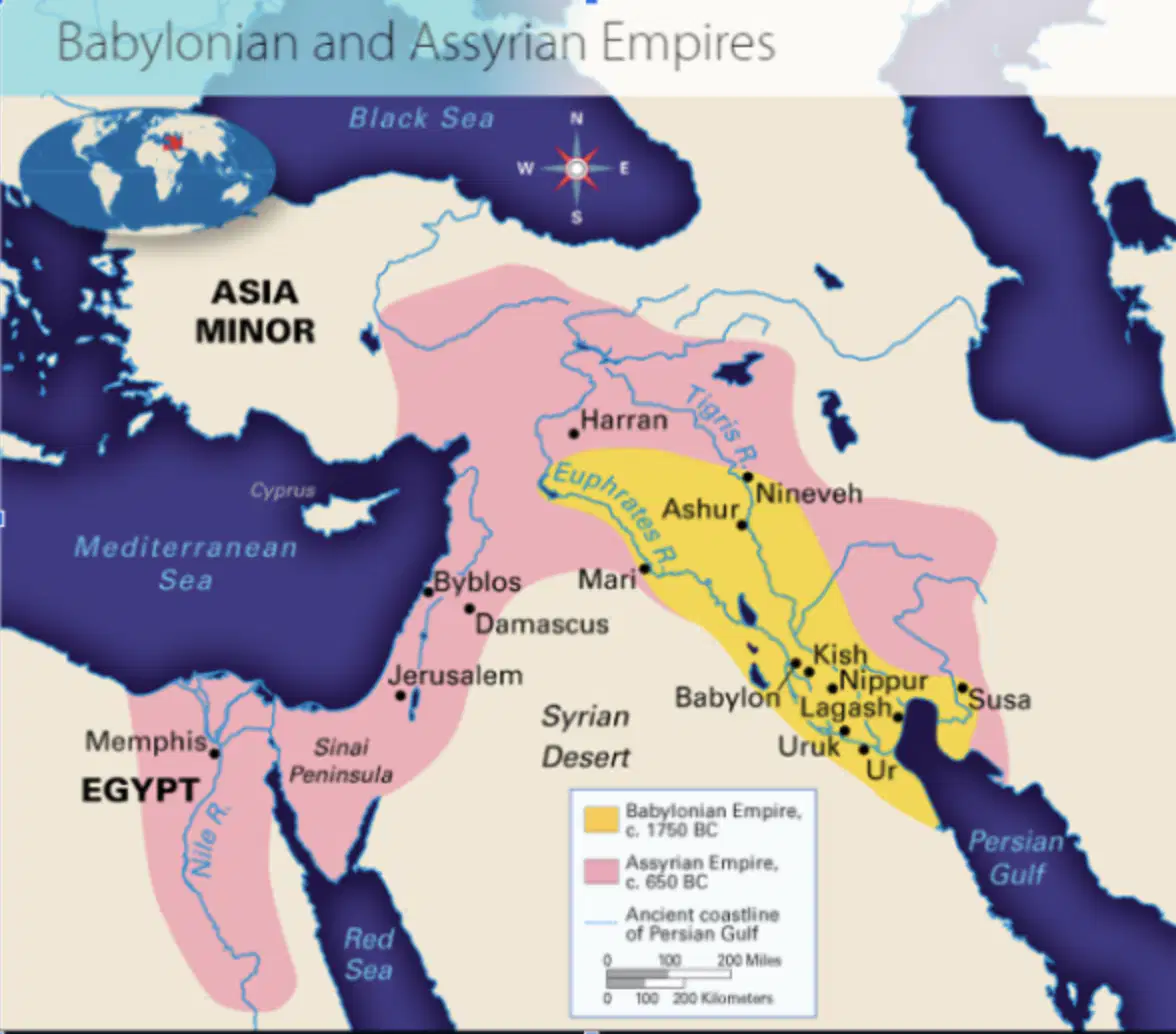
What can you determine from the map about the expansion and decline of Mesopotamian civilizations?
The Babylonian Empire declined to the land between the Tigris and Euphrates rivers.
The Babylonian Empire was able to extend the territory of the Assyrian Empire into Asia Minor and Egypt.
The Assyrian Empire was able to extend the territory of the Babylonian Empire into Asia Minor and Egypt.
The Assyrian Empire declined to the land between the Tigris and Euphrates rivers.
What is the main significance writing had on Sumerian civilization?
As it enabled the Sumerians to teach people to hunt.
As it enabled the Sumerians to conquer other areas.
As it enabled the Sumerians to express complex ideas.
As it enabled the Sumerians to create art.
How did the available physical features influence the development of Mesopotamia?
They settled in mountain ranges to protect themselves from invaders.
They settled near rivers for water and farming needs
They settled wherever the opportunity to hunt and gather presented itself.
They settled on islands to isolate themselves from outside invaders.
What is the main significance of the Tigris and Euphrates rivers flooding?
Floods brought massive destruction, forcing the Mesopotamians to constantly move.
Floods brought surplus water, allowing the Mesopotamians to survive droughts.
Floods brought silt and water, allowing the Mesopotamians to grow crops.
Floods brought trade, allowing the Mesopotamians to gather the resources they needed.
Which of the following facts serve as evidence that the Mesopotamians were polytheists?
The city of Ur had temples dedicated to worshipping the goddess Ishtar and the god Enki.
Goods made in India and Egypt were brought to Mesopotamia by traders
Mesopotamian government was centered on the city‐state.
The Sumerian story of the Great Flood is similar to the Bible story about Noah’s Ark
In ancient Mesopotamia, a land of blazing sun and very little rainfall, irrigation was vital for farming. Centuries before the beginning of known history, the Sumerians undertook the stupendous task of building embankments to control the floodwaters of the Euphrates River. Gradually they drained the marshes and dug irrigation canals and ditches. Largescale cooperation was needed to build the irrigation works, keep them in repair, and apportion the water.
Due to the need for “large-scale cooperation” to build the irrigation works, what feature of civilization was necessary?
Art and Social Hierarchy
Trade and long distance communication
Culture and Religion
Government, Laws, and Public Works
The people of Mesopotamia believed that their world was controlled by gods and goddesses, demons and monsters. There were hundreds of gods who were responsible for everything in the world, from rivers and trees to making bread and pottery.
Using the reading above, which word below describes Mesopotamian religion?
Abrahamic
Monotheistic
Polytheistic
Nativistic
Code of Hammurabi
Note: In 1754 B.C.E., Hammurabi conquered and united all the cities of Mesopotamia under his rule. Although he was a brutal warrior, his greatest achievement was his code of laws, which he had engraved on a towering stone monument. Hammurabi’s Code was not the first, but it was the most complete set of laws that has survived. It is important because it created a set of rules that helped to govern a civilization while trying to protect people even if they had little political power. It called for different punishments based on the class of the lawbreaker and the victim of the crime. In the Code, punishments often fit the crime by demanding and “eye for and eye” or a “tooth for a tooth”.
The following are three of the 282 laws in the Code of Hammurabi
229. If a builder builds a house for some one, and does not construct it properly, and the house which he built falls in and kills its owner, then that builder shall be put to death.
230. If it kills the son of the owner the son of that builder shall be put to death.
231. If it kills a slave of the owner, then he shall pay slave for a slave to the owner of the house.
According to the document, which answer choice identifies the significance of Hammurabi writing down his set of laws?
The laws were not enforced or followed by the citizens
Writing down laws took time away from other jobs
Unable to read, most citizens ignored the set of laws
Written laws remained constant and visible for all citizens
Hammurabi's Code: Laws 53-56
53. If any one be too lazy to keep his dam in proper condition, and does not so keep it; if then the dam break and all the fields be flooded, then shall he in whose dam the break occurred be sold for money, and the money shall replace the corn which he has caused to be ruined.
54. If he be not able to replace the corn, then he and his possessions shall be divided among the farmers whose corn he has flooded.
55. If any one open his ditches to water his crop, but is careless, and the water flood the field of his neighbor, then he shall pay his neighbor corn for his loss.
56. If a man let in the water, and the water overflow the plantation of his neighbor, he shall pay ten gur of corn for every ten gan of land.
How did Hammurabi's Codes reflect the importance of agriculture?
Corn was not valued in Ancient Mesopotamia
Farmer had to replace the value of the corn that he destroyed.
The city was responsible if a farmers crops were destroyed.
If a person causes crop damage, he is not responsible.
Nebuchadnezzar oversaw huge building projects in Babylon. Workers built a double wall around the city to protect it from outside armies. They also rebuilt the city’s ziggurat, a temple tower where they believed the gods lived. They built the famous Hanging Gardens of Babylon, too. Here, plants grew on rooftops and hung down over the sides of walls. Nebuchadnezzar’s rebuilding of the ziggurat shows the important role that religion played in all empires.
According to the passage, how did the architecture of the Mesopotamians reflect the values of society?
The double wall built around the city reflected the importance of welcoming outsiders to trade.
The Ziggurats reflected the important role of religion in Mesopotamian society.
Religion did not play a large role in Mesopotamian society.
The Hanging Gardens of Babylon reflected the important role of religion in Mesopotamian society.
The Sumerians practiced polytheism, the worship of many gods. They believed that their gods had enormous powers. Gods could bring a good harvest or a disastrous flood. They could bring illness, or they could bring good health and wealth. The Sumerians believed that success in every area of life depended on pleasing the gods. Every Sumerian had a duty to serve and to worship the gods.
According to the passage, how did polytheism transform Mesopotamian society?
Mesopotamians believed in one god and were the first monotheistic society.
Mesopotamians believed that success in life depended on pleasing the gods.
Mesopotamians believed that the gods could only bring bad things upon them.
Mesopotamians believed that they were in control of everything and did not believe in gods.
In the 2300s BC a leader named Sargon extended Akkadian territory. He built a new capital, Akkad, on the Euphrates River, near what is now the city of Baghdad. Sargon’s soldiers defeated all the city-states of Sumer. They also conquered northern Mesopotamia, finally bringing the region under his rule. With these conquests, Sargon established the world’s first empire, or land with different territories and peoples under a single rule. The Akkadian Empire stretched from the Persian Gulf to the Mediterranean Sea, and Sargon ruled for more than 50 years. According to the passage, how did the first empire originate?
The first empire originated when King Hammurabi conquered all the regions of Mesopotamia.
The first empire originated when King Sargon conquered all the regions of Mesopotamia.
The first empire originated when King Sargon made peace and traded with the city-states of Sumer.
The first empire originated when King Hammurabi made peace and traded with the city-states of Sumer.
The Assyrians were fierce in battle and built an empire by conquering areas throughout the Fertile Crescent. Assyrian kings ruled their large empire through local leaders. Each governed a small area, collected taxes, enforced laws, and raised troops for the army. Roads were built to link distant parts of the empire. Messengers on horseback were sent to deliver orders to faraway officials.
According to the passage, how were Assyrian kings able to successfully rule over the empire?
They hired paid workers to watch over small areas of the empire.
They built roads so that they could travel through the empire and check on all of the areas.
They used local leaders to help rule small areas of the empire.
They used troops to enforce all of the laws and rule small areas.
Hammurabi’s Code
196. If a man put out the eye of a nobleman, his eye shall be put out. [An eye for an eye ]
198. If he puts out the eye of a freed man, or breaks the bone of a freed man, he shall pay one gold mina.
199. If he puts out the eye of a man's slave, or breaks the bone of a man's slave, he shall pay one-half of its value.
What can you determine about social class in Mesopotamia from Hammurabi's Codes?
Slaves’ were valued the most and received less harsh punishment than others.
All people were given equal punishments
People in higher social classes were valued more than lower social classes
Social class did not determine punishment
Trade and commerce developed in Mesopotamia because the farmers learned how to irrigate their land. They could now grow more food than they could eat. They used the surplus to trade for goods and services. Ur, a city-state in Sumer, was a major center for commerce and trade. Temples were the chief employer and location for commercial activity. The system of trade developed from people's need. People in the mountains needed wheat and barley. Mountain people could give timber, limestone, gold, silver, and copper. Flax was grown in the river valley and then woven into cloth. Linen garments were worn by priests and holy men. Wool and wool cloth was also important for trade. Wood was used for ships and furniture.
According to the passage, what led to the development of trade and commerce in Mesopotamia?
Conquest of territories in Egypt allowed Mesopotamia to gain wealth.
Priest and holy men needed linen garments so they came to the temple for commercial activity.
New innovations in farming techniques led to a surplus of food which led to trade.
People who lived in the mountains flooded Mesopotamia's economy with timber, limestone, gold, and silver.
King Hammurabi was a brilliant war leader. His armies fought many battles to expand his power. Eventually, he brought all of Mesopotamia into his empire, called the Babylonian Empire. Hammurabi’s skills were not limited to the battlefield. He was also a ruler who could govern a huge empire. He oversaw many building and irrigation projects, and improved Babylon’s tax collection system to help pay for them. He also brought a lot of prosperity by increasing trade throughout his vast empire.
According to the passage, how did conflict in Babylon impact their economic development?
King Hammurabi refused to trade with the outside world.
As the Babylonian empire decreased in size, Hammurabi began to tax citizens more for his building projects and to fund his army.
As the Babylonian empire expanded, Hammurabi increased trade throughout his empire which brought a lot of wealth.
Although Hammurabi was a successful military commander, he was not a good ruler and did not manage building and irrigation systems well.
The Phoenicians grew wealthy from trade. Besides timber, the Phoenicians traded silverwork, ivory carvings, and slaves. Beautiful glass objects also became valuable trade items and the Phoenicians made purple cloth that was very popular with rich people. Phoenicians used their goods to trade for other resources that were not readily available to them, such as ivory, gold, copper, tin, and iron.
According to the passage, why did the Phoenicians trade with other cultures throughout Mesopotamia?
Phoenicians traded so that they could become rich.
Phoenicians wanted to meet other people in Mesopotamia.
Phoenicians traded for purple dye to make their famous cloth.
Phoenicians traded for resources that were not readily available to them.
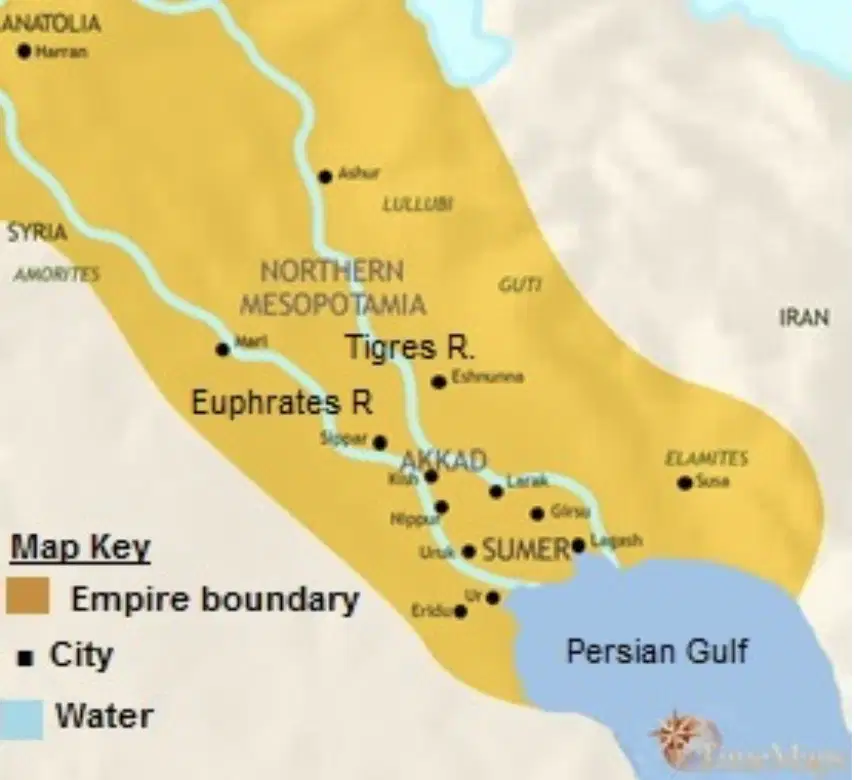
According to the map, how did the physical features influence the development of Mesopotamia?
They settled near rivers for water and farming needs.
They settled in a mountain ranges to protect themselves from invaders.
They settled on Islands to isolate themselves from outside invaders.
They moved from place to place and did not settle in cities.
The Sumerians made one of the greatest cultural advances in history. They developed cuneiform, the world’s first system of writing. They used sharp tools called styluses to make wedge-shaped symbols on clay tablets. Earlier written communication had used pictographs, or picture symbols. But in cuneiform, symbols represented not only pictures, but also syllables, or basic parts of words. As a result, Sumerian writers could combine symbols to express more complex ideas. At first, writing was used to keep business records, but later they wrote works on history, law, grammar, and math.
According to the passage, how did writing transform Sumerian civilization?
Sumerians were able to express complex ideas using writing.
Sumerians were able to teach future generations how to hunt by using pictures on cave walls
Sumerians were able to create art by carving wedge-shaped pictures into clay tablets.
Sumerians were able to communicate using only picture symbols.
The Phoenicians were not a great military power and were often ruled by foreign governments. However, they created a wealthy society through trade. Phoenician trading activity led to important innovations as they encountered different cultures. They made significant contributions to navigation, manufacturing, and written language. Motivated by trade, they became expert sailors and sailed to ports all around the Mediterranean Sea. This helped with cultural diffusion as different cultures throughout the region came to know one another better as they exchanged goods.
They gained power through trade and transformed society with new innovations and cultural diffusion as they encountered different cultures.
They gained power through military might and transformed society by conquering many foreign governments in ports all along the Mediterranean Sea.
They gained power through military might and transformed society with new innovations and cultural diffusion as they encountered different cultures.
They gained power through trade and transformed society by conquering many foreign governments in ports all along the Mediterranean Sea.

