
 Worksheets
Dance Skills
Total questions: 63
Worksheet time: 32mins
Dancers develop their skills by:
practicing regularly
avoiding practice
ignoring feedback
skipping rehearsals
Dancers develop their skills through which of the following? What are dance techniques?
By practicing dance techniques, which are specific ways of moving the body in dance.
By only watching dance performances.
By reading about dance history.
By listening to music without moving.
Physical skills/technical skills in dance are best described as:
The abilities that allow dancers to perform movements accurately and efficiently.
The emotional expression shown by dancers during a performance.
The costumes and makeup used by dancers on stage.
The music and lighting used in a dance performance.
Stylistic skills/key features in dance include:
Expression, musicality, and interpretation
Mathematical calculations and formulas
Scientific experiments and hypotheses
Historical dates and events
Interpretative/performance skills in dance refer to:
the ability to express emotions and meaning through movement
memorizing dance steps only
wearing the correct costume
dancing to the fastest music
Rehearsal skills in dance are:
the techniques and practices used to improve and perfect a dance performance
the costumes worn during a dance show
the music chosen for a dance routine
the lighting effects used on stage
Reviewing skills in dance are:
The ability to critically evaluate and provide feedback on dance performances.
The ability to memorize dance routines quickly.
The skill of performing complex dance moves flawlessly.
The talent for creating original dance choreography.
Developing your dance skills can be achieved by:
Practicing regularly
Avoiding practice
Ignoring feedback
Skipping warm-ups
Dancers need to warm up because:
it helps prevent injuries and prepares the body for movement.
it makes them tired before dancing.
it is a tradition in dance classes.
it helps them remember choreography better.
Not warming up can lead to which of the following outcomes?
Increased risk of injury
Improved flexibility
Faster muscle recovery
Enhanced performance

Warming up causes which of the following changes in your body?
Increases blood flow and prepares muscles for activity
Decreases body temperature and slows heart rate
Reduces flexibility and increases risk of injury
Prevents oxygen from reaching muscles
A warm-up needs which of the following types of things?
Activities that gradually increase heart rate
Sudden intense exercise
Skipping any physical activity
Only stretching without movement
Warming yourself up can be done by:
Putting on a warm jacket
Standing in the rain
Eating ice cream
Sitting in front of a fan
Dancers need to cool down because:
it helps their bodies recover after intense activity.
it increases their heart rate rapidly.
it causes muscle cramps.
it makes them more tired.
Cooling down is done:
after exercise
before exercise
during exercise
instead of exercise
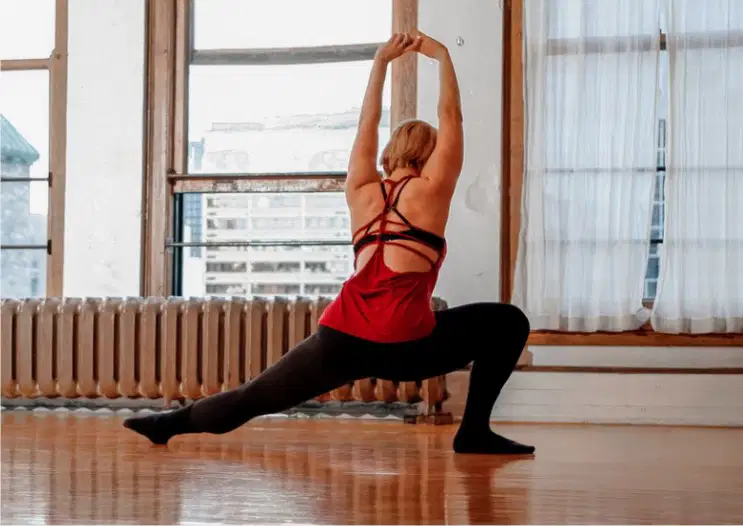
Why is it vital for each member of the dance class to warm up before practice and performance?
To guard against injury and prepare the performer mentally and physically for the task ahead.
To make the dance class longer and more tiring.
To impress the instructor with flexibility.
To avoid learning new dance steps.
What does the acronym R I P stand for in the context of warming up for dancers?
Rest, Inspire, Perform
Reduce, Improve, Prepare
Run, Increase, Practice
Relax, Initiate, Play
List one psychological benefit of warming up before a dance performance.
It prepares you psychologically so your mind is focused.
It increases your physical strength instantly.
It guarantees you will not make any mistakes.
It makes you immune to stage fright.
Warm-ups are only important for physical preparation and do not affect mental readiness.
True
False
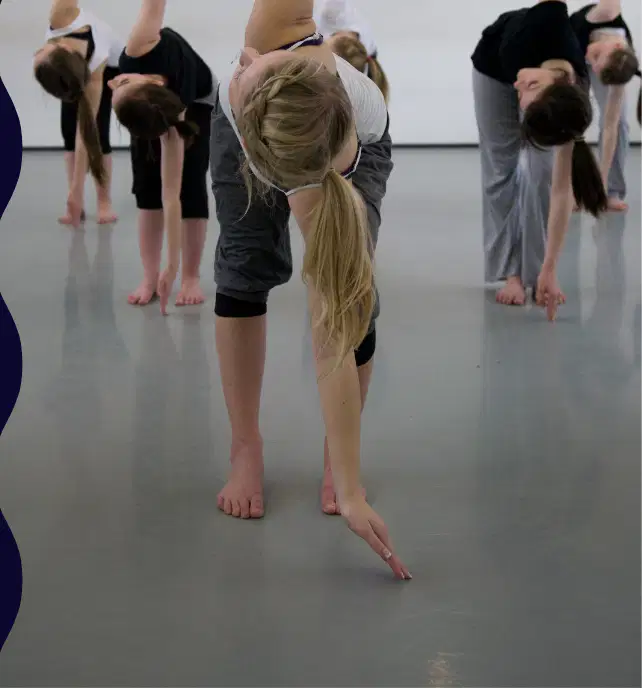
To prevent stiffness and soreness the next day, what should you include in a cool down?
Stretching exercises
High-intensity sprints
Heavy weight lifting
Skipping the cool down
What is a cool down? Fill in the blank: A cool down is a recovery time gradually restoring the ______ and ______ back to normal.
body and mind
muscles and bones
lungs and heart
arms and legs
Cooling down allows the gradual cooling of the major muscle groups involved in the exercise and allows blood vessels to contract gradually, thus decreasing the likelihood of ______ or ______. Fill in the blanks.
dizziness or fainting
muscle gain or fat loss
dehydration or hunger
soreness or flexibility
When should a cool down ideally be carried out? Choose the correct option.
At the beginning of a class
In the middle of a performance
At the end of a class/rehearsal/performance
Before drinking water.
Name one dance rehearsal skill that should be included: Warming _____
up
down
side
over
Name one dance rehearsal skill that should be included: Wearing the correct _____
attire
music
shoes
makeup
Name one dance rehearsal skill that should be included: Learning _____
choreography
mathematics
geography
cooking
Name one dance rehearsal skill that should be included: Responding to correction and absorbing taught _____
material
music
costume
lighting
Name one dance rehearsal skill that should be included: Receiving and giving constructive and positive _____
feedback
criticism
music
costumes
Name one dance rehearsal skill that should be included: _____ and Recall.
Repetition
Improvisation
Expression
Coordination
Name one dance rehearsal skill that should be included: Professional/_____
Personal
Technical
Creative
Expressive
Name one dance rehearsal skill that should be included: _____.
Attendance
Costume Design
Stage Lighting
Ticket Sales
Name one dance rehearsal skill that should be included: Time _____
management
travel
music
costume
Name one dance rehearsal skill that should be included: Readiness to _____
work
rest
sing
watch
Name one dance rehearsal skill that should be included: Listening to instruction/_____
direction
music
costume
lighting
Name one dance rehearsal skill that should be included: Observing and applying _____ practices.
safe
musical
expensive
random
Name one dance rehearsal skill that should be included: Willingness to try things _____
out
in
up
down
Name one dance rehearsal skill that should be included: Concentration/_____
determination
relaxation
improvisation
flexibility
Name one dance rehearsal skill that should be included: Ability to work with _____
others
mirrors
music sheets
costumes
Name one dance rehearsal skill that should be included: Rehearsal _____
discipline
music
costume
stage
Name one dance rehearsal skill that should be included: Supporting _____
peers
music
costumes
props
How to remember choreography: What should you do to help you remember?
Forget it
Write it down
Ignore it
Watch TV
How to remember choreography: You could do this in pairs. If you can say it, you can do it. What is this tip?
Talk it through
Dance alone
Stay silent
Watch others
Contemporary Dance is:
a style of dance that combines elements of several dance genres including modern, jazz, lyrical, and ballet
a traditional folk dance from the 18th century
a form of dance that only uses classical ballet techniques
a dance style that strictly follows ancient rituals
Fill in the blank: ________ is the ability to maintain a position or move in a controlled way.
Posture
Speed
Strength
Agility
Fill in the blank: ________ refers to the correct positioning of body parts in relation to each other.
Alignment
Flexion
Rotation
Extension
Fill in the blank: ________ is the ability to maintain equilibrium while stationary or moving.
Balance
Speed
Flexibility
Strength
Fill in the blank: ________ is the ability to use different parts of the body together smoothly and efficiently.
Coordination
Flexibility
Endurance
Strength
Fill in the blank: ________ is the range of movement in the joints or the ability to move joints effectively.
Flexibility
Strength
Endurance
Agility
Fill in the blank: ________ is the physical power and energy that makes someone strong.
Strength
Wisdom
Patience
Kindness
Fill in the blank: ________ is the ability to sustain prolonged physical or mental effort.
Stamina
Velocity
Flexibility
Agility
Fill in the blank: ________ is the act of stretching or extending a part of the body to its full length.
Extension
Flexion
Rotation
Abduction
Fill in the blank: The ________ is the tightening of muscles to create movement or hold a position.
Use of contraction
Release of tension
Expansion of fibers
Relaxation of muscles
Fill in the blank: ________ is the ability to reproduce movements accurately.
The ability to be able to reproduce movements accurately
Flexibility
Strength
Endurance
Fill in the blank: ________ means involving the entire body in movement.
Whole body participation
Partial movement
Hand-eye coordination
Isolated muscle use
Fill in the blank: ________ is the ability to move a single part of the body independently from others.
Isolation
Coordination
Flexibility
Endurance
Fill in the blank: ________ refers to the accuracy or quality of movements in a stylistic way.
Accuracy / quality of movements / stylistic way
Speed / power of movements / energetic way
Endurance / repetition of movements / consistent way
Flexibility / range of movements / dynamic way
Fill in the blank: ________ is the ability to remember and repeat movements.
Movement memory
Muscle strength
Flexibility
Coordination
Fill in the blank: ________ is the action of moving to a higher position or level.
Elevation
Reduction
Stagnation
Descent
Fill in the blank: ________ is the correct positioning of the body or its parts during movement.
Placement
Rotation
Flexion
Extension
Fill in the blank: ________ is the application of force to move or support the body.
Use of weight
Use of sound
Use of light
Use of color
Fill in the blank: ________ is the control and use of breathing during movement.
Use of breath
Use of posture
Use of sound
Use of vision
Fill in the blank: ________ is the use of varying energy and speed in movement.
Application of dynamics
Application of statics
Application of kinematics
Application of equilibrium
Fill in the blank: ________ is the awareness of the space around the body and its position within it.
Spatial Awareness
Temporal Awareness
Emotional Awareness
Auditory Awareness

