
 Worksheets
Gen. Physics 1
Total questions: 50
Worksheet time: 51mins
What is a free-body diagram?
A diagram of the human body
A picture or sketch used to show the vectors acting on an object, with arrows representing them
A picture or sketch used to show the fields near an object, with arrows representing the fields
A picture or sketch used to show the forces acting on an object, with arrows representing the forces
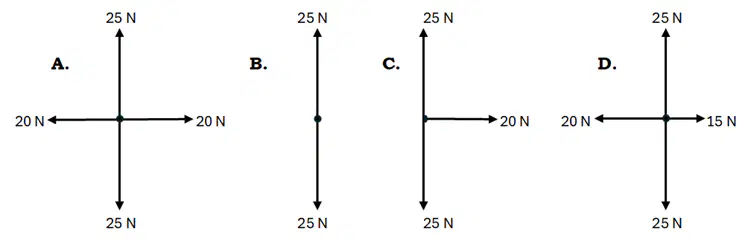
Which one of the following free-body diagrams depicts an object accelerating to the right?
Diagram A
Diagram B
Diagram C
Diagram D
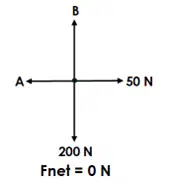
The free-body diagram (FBD) shown illustrates the forces acting on an object and the resulting net force. Which set of forces would correctly produce the net force indicated in the diagram?
A = 0 N; B = 0 N
A = 50 N; B = 200 N
A = 100 N; B = 100 N
A = 200 N; B = 200 N
What is inertia?
The force of gravity on an object.
The amount of matter in an object.
The amount of force acting on each kilogram of mass.
The tendency of an object to resist changes in its state of motion.
Which of the following is a statement of Newton's First Law of Motion?
Acceleration varies directly with the unbalanced force.
If no net force acts on an object, the object maintains its state of motion.
For every action force, there exists a reactive force that is equal in magnitude but opposite in direction.
If no unbalanced force acts on an object, the object accelerates in the direction of the single greatest force acting on the object.
A student pushes a heavy cabinet, but it does not move. Which statement is most accurate?
The applied push is balanced by the opposing forces, so the net force is zero.
The cabinet has no inertia at rest; inertia only appears when the object is already moving.
Friction is completely absent in this situation, so only gravity prevents motion of the cabinet.
Newton’s Second Law is violated because an applied force should always cause motion in real situations.
A person tries to slide a chair, but it doesn’t move. Then he pushes harder and the chair suddenly starts sliding. Which force was overcome?
Gravity
Kinetic friction
Normal force
Static friction
You push a crate across a rough floor at constant speed. Which statement must be true?
No horizontal forces act once the crate has already started to slide across the floor
Your applied push is less than friction because acceleration is zero during steady motion
Your applied push equals the opposing kinetic friction in magnitude but in the opposite direction
Your applied push is greater than friction, creating a nonzero net force that still yields constant speed
Which of the following is a non-contact force?
Friction
Tension
Gravity
Normal force
A student pushes a 5 kg box with a force of 40 N horizontally. If friction is 20 N, what is the net force?
0 N
2 N
20 N
60 N
In a game of Tug-of-War, Team A defeats Team B. If the winning team pulls on the rope with a force of 10,000 N, what can be said about the force exerted by the losing team?
Less than 10,000 N
Exactly 10,000 N
More than 10,000 N
Cannot be determined without more information
A runner pushes backward on the ground with a horizontal force of 400 N. What is the reaction force?
Friction disappears temporarily so the runner cannot be propelled forward as expected
The ground exerts an equal 400 N forward (and normal upward) force on the runner’s foot
Gravity increases its effect to match the horizontal push applied by the runner on the surface
The runner accelerates backward because the ground removes an equal amount of momentum
A rocket lifts off primarily because
Gravity becomes weaker with altitude and eventually stops acting during ascent
Inertia keeps the rocket moving upward after an initial push regardless of other forces
Decreasing mass alone causes the rocket to rise without any significant reaction force
Hot exhaust gases are expelled downward, and an equal opposite force pushes the rocket upward
Which statement best defines work in physics?
Work is the energy stored in an object due to its position.
Work is the product of force and the time it acts on an object.
Work is the total force applied to an object regardless of motion.
Work is done when a force causes a displacement in the direction of that force.
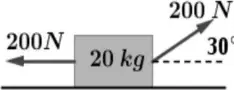
Work will be done on the crate shown in the diagram below because the crate will
be lifted off the surface
accelerate to the right
accelerate to the left
remain at rest
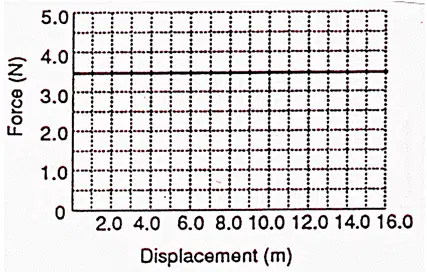
What is the work done in the force-displacement graph below?
0 J
4.6 J
56 J
80 J
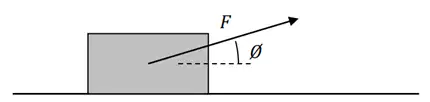
A force F is exerted at an angle Ø on a box of mass m as it is dragged across the floor at constant velocity. If the box travels a distance x, then the work done by the force F on the box is
Fx
Fx cos Ø
F/x cos Ø
Fx sin Ø
Which of the following has gravitational potential energy?
A book on a shelf
A girl sprinting
A stretched spring
None of the above
A child on a swing is pulled back and held at rest before being released. Which statement best explains the system’s gravitational potential energy at that moment?
It is zero because the swing is momentarily not in motion.
It is minimum because the swing is about to start moving forward.
It is maximum because the child is elevated at the highest position.
It is constant because the child’s weight does not change with position.
Two identical springs are attached to a wall. Spring A is stretched by 10 cm, while Spring B is compressed by 10 cm. Which statement best describes their elastic potential energies?
Spring A stores more energy because it is stretched, not compressed.
Spring B stores more energy because compression increases density.
Both springs store the same amount of elastic potential energy.
Neither spring stores energy since they are stationary.
Two students debate about gravity: Student A: “Gravity is a conservative force because the work it does depends only on the starting and ending points.” Student B: “Gravity is not conservative because work depends on the object’s path.” Which evaluation of their statements is correct?
Student A is correct because work done by gravity is path-independent.
Student B is correct because gravity does more work on longer paths.
Both students are correct because gravity can act differently on each path.
Both students are wrong because gravity does no work on objects in motion.
If you lift a box upward, you do
Positive work
Negative work
No work
Constant work
A swing held at its highest point has
Maximum potential energy
Minimum potential energy
No energy
Only kinetic energy
An egg dropped onto a soft cloth doesn’t break, but it breaks when dropped onto concrete. Which explanation correctly relates force, impulse, and time of contact?
The cloth decreases the time of contact, increasing the force on the egg.
The cloth increases the time of contact, reducing the force on the egg.
The concrete and cloth apply the same force since gravity is constant.
The concrete increases the time of contact, reducing the force.
Why do you land with your knees bent when you jump off a tall chair?
To reduce the change in velocity of your body during landing.
To increase the time of impact acting on your legs and bones.
To increase the stopping force exerted on your lower body.
To decrease the total impulse received during the collision.
In an elastic collision, what feature clearly distinguishes it from an inelastic collision?
Both the momentum and the kinetic energy are conserved together.
Only the momentum of the system is conserved during the event.
The total energy is completely lost to heat and sound afterward.
No external forces act on any object during the interaction.
Two carts collide on a smooth track. Before the collision, the total kinetic energy is 40 J. After the collision, it is 25 J. Which statement best describes this collision?
It is perfectly elastic because the objects did not stick together.
It is perfectly inelastic because no energy was conserved at all.
It is elastic because the total energy of the system is still the same.
It is inelastic because some kinetic energy was lost to other forms.
Two steel spheres collide head-on and rebound with nearly the same speeds they had before impact. Which statement best describes this collision?
The coefficient of restitution is near 1, meaning the collision is almost elastic.
The coefficient of restitution is near 0, meaning the collision is mostly inelastic.
The coefficient of restitution is above 1, meaning energy was somehow gained.
The coefficient of restitution varies randomly, meaning no clear pattern occurs.
Two cars collide head-on and lock together after impact. Which physical principle allows the final velocity of the wreck to be calculated?
The conservation of momentum, because total system momentum is maintained.
The conservation of kinetic energy, because no energy is lost to deformation.
The conservation of acceleration, because both cars slow at the same constant rate.
The conservation of mass, because the total vehicle mass remains unchanged.
Airbags in vehicles are designed to extend the time of impact during collisions. According to the impulse–momentum theorem, why does this reduce passenger injuries?
Increasing impact time increases the impulse and causes higher acceleration.
Increasing impact time decreases the average force acting on the passenger.
Increasing impact time increases the change in total system momentum.
Increasing impact time prevents any change in passenger momentum.
Longer time means
Smaller force
Larger force
No force
Same force
Total momentum before and after collision is
Equal
Zero
Lost
Doubled
When cars stick together, it’s
Perfectly inelastic
Elastic
Explosion
Static
Which quantity is the product of an object’s mass and velocity?
Momentum
Force
Impulse
Acceleration
The SI unit of momentum is:
kg·m/s
N·m
m/s²
J
Which one of the following statements is the definition of amplitude for a pendulum?
The time required for one complete cycle.
The amount of mass at the end of the string.
The length of string from the top to the center of mass.
The maximum sideways displacement of the mass from its rest position.
A pendulum and a mass–spring system oscillate with the same amplitude. If the pendulum is taken to the Moon, which statement best evaluates the change in their periods?
The pendulum’s period increases while the spring’s period remains the same.
Both periods increase equally because gravity is weaker on the Moon.
The pendulum’s period decreases while the spring’s period increases.
Both periods remain unchanged because amplitude and mass are constant.
Which of the following correctly describes the conditions for an object to undergo simple harmonic motion?
The acceleration is constant in magnitude and direction during every oscillation.
The restoring force is constant in magnitude and directed away from equilibrium.
The acceleration is directly proportional to displacement and directed toward equilibrium.
The velocity is directly proportional to displacement and directed away from equilibrium.
Which of the following systems satisfies the necessary conditions for simple harmonic motion?
A block sliding down a rough inclined plane with constant acceleration.
A pendulum swinging at small angles from its equilibrium position.
A car accelerating in a straight horizontal road without friction.
A ball rolling freely on a flat horizontal surface with constant speed.
If the length of a pendulum is increased, what happens to its period and frequency?
The period decreases and the frequency increases as the pendulum gets longer.
The period increases and the frequency decreases as the pendulum gets longer.
Both the period and frequency remain unchanged for any pendulum length.
Both the period and frequency increase equally as the pendulum gets longer.
Two identical spring–mass systems are set to oscillate. System A has a stiffer spring, while System B has a weaker spring. Which statement correctly compares their periods of oscillation?
System A has a shorter period because a stiffer spring causes faster oscillation.
System B has a shorter period because a weaker spring increases time of motion.
Both have the same period because the masses are equal in both systems.
Both have the same period because spring stiffness does not affect motion.
When a pendulum bob moves from its highest point to the lowest point in its swing, what energy transformation occurs?
Potential energy converts to kinetic energy.
Kinetic energy converts to potential energy.
Mechanical energy is completely lost as heat.
Both kinetic and potential energy remain constant.
Particles in a longitudinal wave vibrate
180° out of phase with the direction of travel of the wave
at a supplementary angle to the direction of the wave
at right angles to the direction of travel of the wave
parallel to the direction of travel of the wave
The time required for one complete oscillation of a vibrating object is called
frequency
periodic rate
period
Hertz
When you move twice as far from a loudspeaker, how does the intensity of the sound change?
The intensity becomes one-fourth as large because sound spreads over a larger area.
The intensity becomes one-half as large because distance reduces amplitude directly.
The intensity remains the same because sound energy is conserved in space.
The intensity becomes twice as large because the wavefronts overlap more closely.
Two identical speakers play the same song at equal power. If you stand 2 meters from Speaker A and 4 meters from Speaker B, how do their intensities compare?
Speaker A’s sound is four times as intense as Speaker B’s.
Speaker A’s sound is twice as intense as Speaker B’s.
Speaker A’s sound is half as intense as Speaker B’s.
Both speakers produce equal intensity because they have equal power.
The time for one complete oscillation of a pendulum is called its:
Period
Frequency
Amplitude
Velocity
The back-and-forth motion of a spring is called:
Vibration or oscillation
Rotation
Revolution
Translation
The unit of frequency is:
Hertz (Hz)
Second (s)
Newton (N)
Meter (m)
The SI unit of spring constant is:
N/m
kg
s
Hz

