
 Worksheets
Bioman Photosynthesis Quiz
Total questions: 33
Worksheet time: 19mins
Where does photosynthesis occur?
Mitochondria
Chloroplast
Nucleus
Ribosome
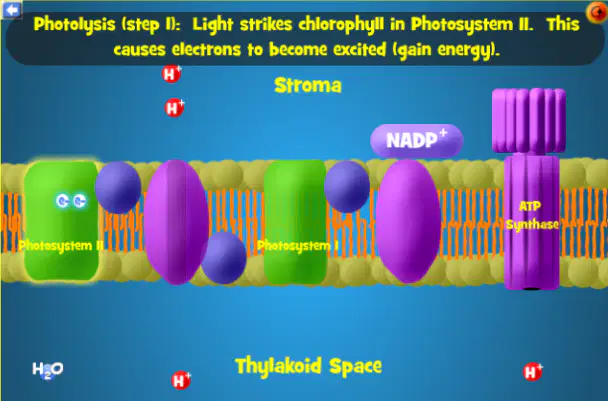
What does light do when it strikes the chlorophyll molecules of photosystems 1 & 2?
Causes electrons to become excited (gain energy)
Causes chlorophyll to break down
Produces oxygen directly
Absorbs water molecules
How are the electrons replaced by Photosystem 2 after they leave to travel down the electron transport chain?
By absorbing sunlight directly
By water splitting
By ATP synthesis
By NADP+ reduction
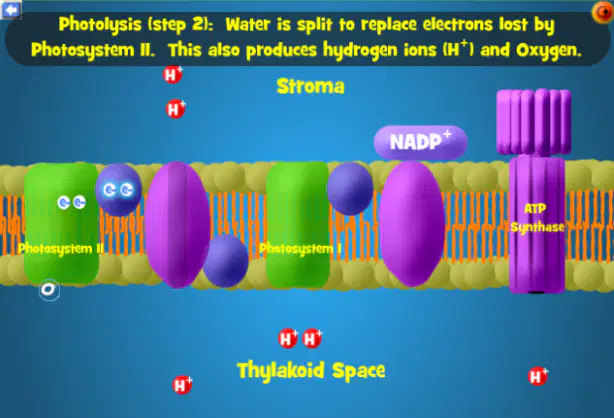
What is the process called where water is split at Photosystem 2, resulting in the production of hydrogen ions and oxygen?
Photolysis
Hydrolysis
Oxidation
Respiration
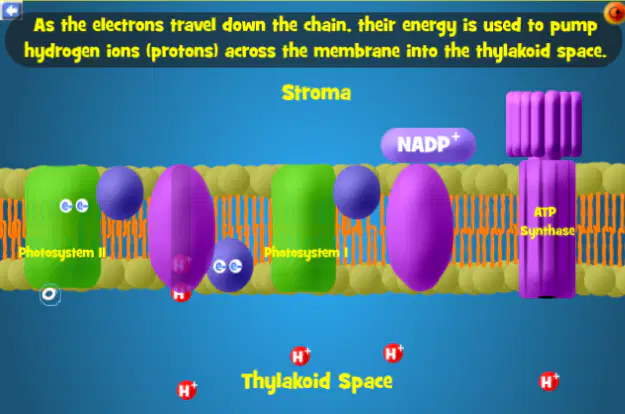
As electrons travel from Photosystem 2 down the first electron transport chain, what is their energy used for?
To produce glucose directly
To pump hydrogen ions into the thylakoid space, creating a concentration gradient for ATP synthesis
To generate oxygen molecules
To break down ATP into ADP and phosphate
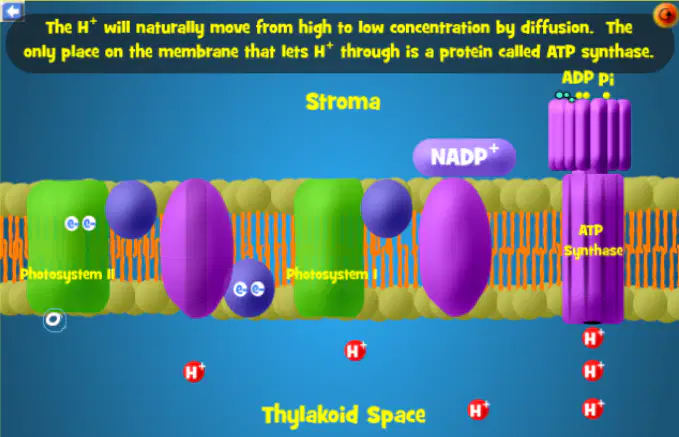
Why do hydrogen ions flow from the thylakoid space to the stroma through ATP synthase?
They flow passively from high to low concentration via facilitated diffusion. As they flow through ATP synthase, the enzyme spins and produces ATP.
They flow actively from low to high concentration, requiring energy input from ATP.
They flow passively from low to high concentration via facilitated diffusion, producing NADPH instead of ATP.
They flow actively from high to low concentration, requiring energy input from NADPH.
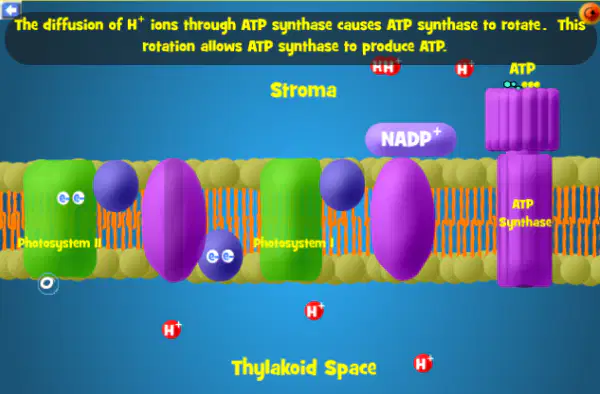
What is the role of ATP synthase in the production of ATP during the movement of hydrogen ions?
ATP synthase rotates as hydrogen ions pass through it, facilitating the production of ATP.
ATP synthase breaks down ATP into ADP and Pi as hydrogen ions pass through it.
ATP synthase prevents the movement of hydrogen ions to maintain concentration gradients.
ATP synthase converts NADPH into ATP during the movement of hydrogen ions.
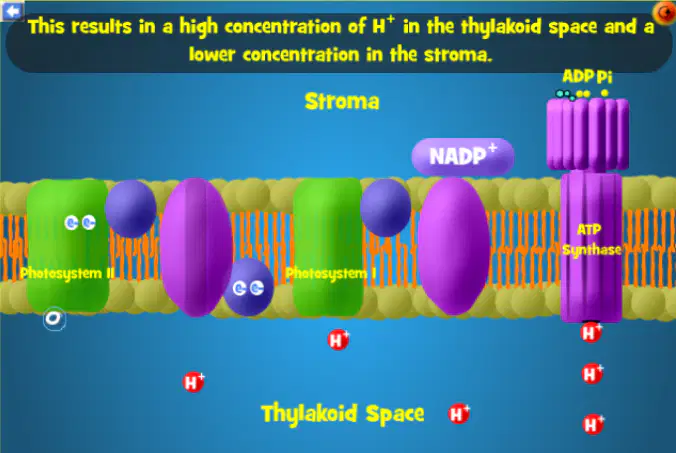
What causes the movement of hydrogen ions from the thylakoid space to the stroma?
The high concentration of hydrogen ions in the thylakoid space compared to the stroma.
The active transport of hydrogen ions using ATP energy.
The breakdown of NADPH in the stroma.
The low concentration of hydrogen ions in the thylakoid space compared to the stroma.
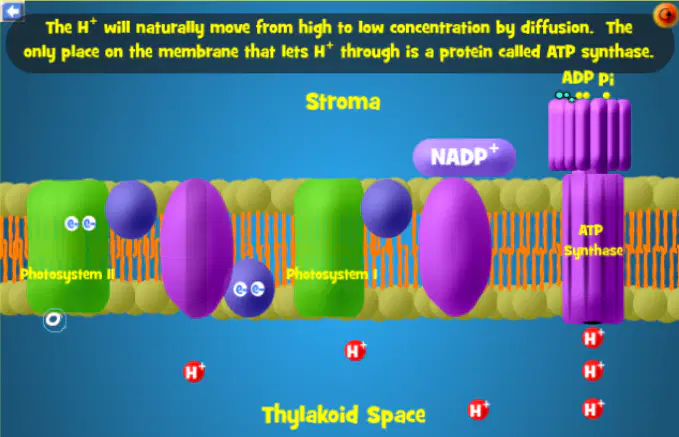
What is the primary function of facilitated diffusion in the process shown?
To allow hydrogen ions to move from high to low concentration and produce ATP.
To actively transport hydrogen ions from low to high concentration.
To convert ATP into ADP and Pi during the movement of hydrogen ions.
To prevent the movement of hydrogen ions across the membrane.
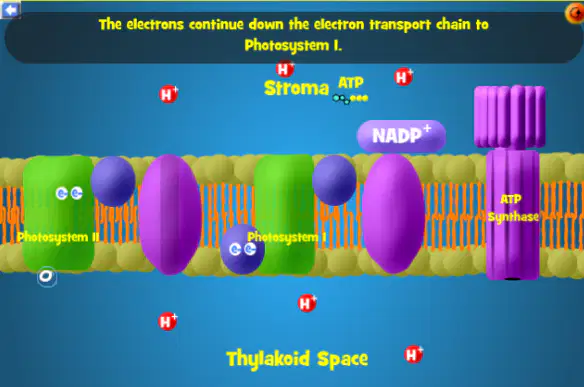
After electrons get excited by light a second time (at photosystem 1), where do they go?
They travel down a second electron transport chain and are donated to NADP+, which becomes NADPH (an electron carrier).
They are stored in the thylakoid space for later use.
They are used directly to produce ATP.
They are absorbed by the stroma for sugar production.
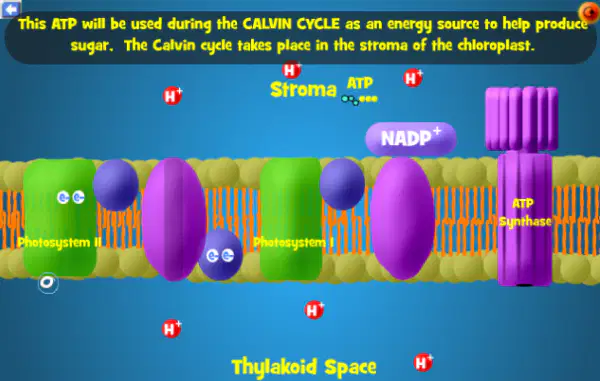
What is the role of ATP in the Calvin Cycle?
ATP acts as an energy source to help produce sugar during the Calvin Cycle.
ATP is used to excite electrons in photosystem I.
ATP is stored in the thylakoid space for future use.
ATP is converted into NADPH during the Calvin Cycle.
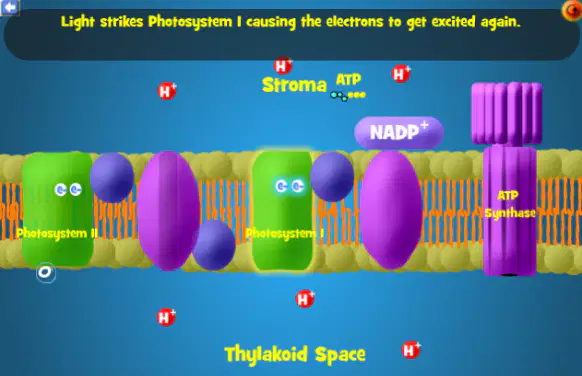
What happens when light strikes photosystem I?
Electrons get excited again.
ATP is directly produced.
NADPH is immediately formed.
Electrons are stored in the stroma.
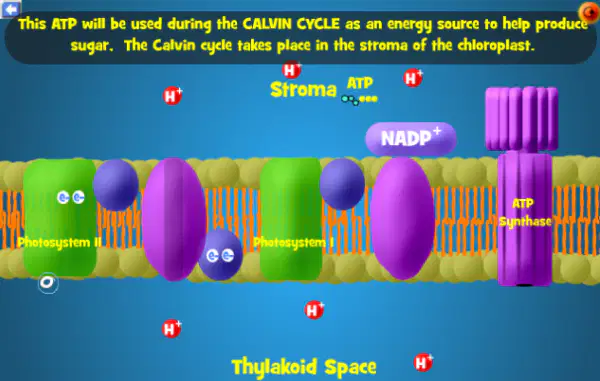
Where does the Calvin Cycle take place in the chloroplast?
In the stroma.
In the thylakoid space.
In photosystem I.
In the ATP synthase.
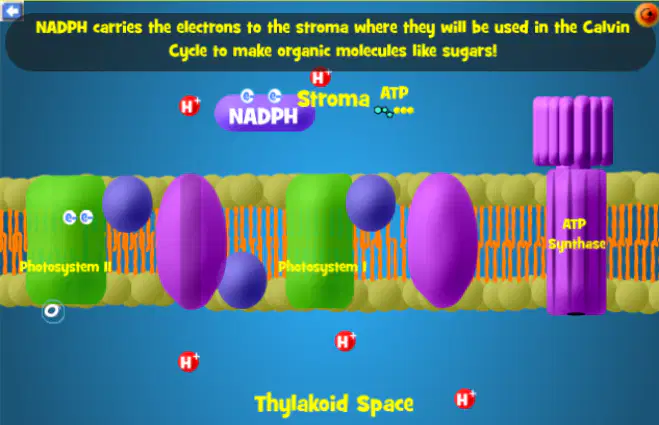
What are the products of the light-dependent reactions used in the Calvin cycle to help form reduced organic compounds?
NADPH and ATP
Oxygen and Glucose
Carbon Dioxide and Water
NADH and FADH2

What happens during the reduction stage of the Calvin cycle?
The energy from ATP and electrons from NADPH are used to reduce 3-phosphoglycerate to form G3P molecules which can be used to form organic molecules like glucose
CO2 is attached to RuBP to form 3-phosphoglycerate
RuBP is regenerated to continue the cycle
Oxygen is released as a byproduct of the cycle
What happens during the regeneration stage of the Calvin cycle?
The remaining G3P molecules that have not exited the cycle are used to reform RuBP through a series of chemical reactions, so that the Calvin cycle can continue
ATP is used to convert G3P into glucose molecules
NADPH donates electrons to regenerate RuBP
CO2 is released to restart the cycle

What are the inputs of photosynthesis?

"B" is step two in (a) and is called the (b)
What is the chemical formula for photosynthesis?
6CO2 + 6O2 -> C6H12O6 + 6H2O + ATP
C6H12O6 + 6O2 -> 6CO2 + 6H2O + Light
6CO2 + 6H2O + light energy -> C6H12O6 + 6O2
True or False. The stroma is located within the thylakoid membrane.
True
False
Where does the Calvin cycle (light independent reaction) take place?
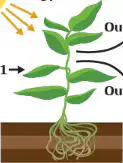
Which chemical equation is correct for photosynthesis?
6CO₂ + 6H₂O → C₆H₁₂O₆ + 6O₂ + energy
6CO₂ + 6H₂O + energy → C₆H₁₂O₆ + 6O₂
C₆H₁₂O₆ + 6O₂ → 6CO₂ + 6H₂O + energy
C₆H₁₂O₆ + 6O₂ + energy → 6CO₂ + 6H₂O
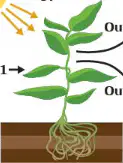
Based on the model, which is the BEST description for the process of photosynthesis?
Photosynthesis is the transfer of matter and flow of energy between the plant and its environment.
Photosynthesis requires an input of matter but not an input of energy.
Photosynthesis requires an input of energy but not an input of matter.
Photosynthesis is the transfer of matter and flow of energy between the plant and the Sun.

Which chart BEST identifies the inputs and outputs of the system shown in the photosynthesis model?
Inputs: Carbon dioxide and glucose; Outputs: Water and oxygen
Inputs: Sunlight, water, and carbon dioxide; Outputs: Glucose and oxygen
Inputs: Sunlight, water, and glucose; Outputs: Oxygen and carbon dioxide
Inputs: Carbon dioxide and oxygen; Outputs: Glucose and water
What is the chemical equation for photosynthesis?
C₆H₁₂O₆ + 6O₂ → 6CO₂ + 6H₂O + ATP and Heat
6CO₂ + 6H₂O + Sunlight → C₆H₁₂O₆ + 6O₂
C₆H₁₂O₆ + 6O₂ → 6CO₂ + 6H₂O + Sunlight
6CO₂ + 6H₂O → C₆H₁₂O₆ + ATP and Heat
A student wants to add additional information to the model to describe what happens to the products that are formed in photosynthesis. Which TWO statements can the student add to the model?
Oxygen is broken down by sunlight and released.
Carbon containing compounds are stored for the growth of the plant.
Carbon containing compounds combine with water to produce sugars.
Carbon containing compounds are released into the atmosphere during photosynthesis.
Oxygen is combined with carbon-containing compounds to produce energy in cellular respiration.
A student wants to add an arrow between the reactions shown to model how the two systems work together to cycle carbon among Earth's systems. Which change could be made to the model to BEST represent the flow of carbon between photosynthesis and cellular respiration?
Add an arrow pointing from the reactant side of the photosynthesis reaction to the product side of cellular respiration.
Add an arrow pointing from the reactant side of the photosynthesis reaction to the reactant side of cellular respiration.
Add an arrow pointing from the product side of the photosynthesis reaction to the reactant side of cellular respiration.
Add an arrow pointing from the product side of the photosynthesis reaction to the product side of cellular respiration.
What carbon molecule is produced by the plant in order for it to grow?
oxygen
carbon dioxide
glucose
water
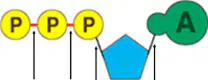
Which bond is broken in an ATP molecule when it releases energy, forming ADP?
Bond between ribose and phosphate
Bond between 2nd and 3rd phosphate
Bond between 1st and 2nd phosphate
Bond between adenine and ribose.
Which of the following are correct inputs of photosynthesis?
Oxygen, glucose, and sunlight
Water, carbon dioxide, and light energy (sunlight)
ATP, water, and carbon dioxide
Oxygen, carbon dioxide, and glucose

