
 Worksheets
25/26-WC U2-Mesoamerica & the Age of Exploration
Total questions: 25
Worksheet time: 13mins
Name
Class
Date
1.
Which Spanish system of colonial governance compelled American Indians to work fields and mines for no wages?
a)
mission
b)
plantation
c)
encomienda
d)
hacienda
2.

Which development led to the change shown in this table?
a)
Drought caused a mass migration to North Africa.
b)
Conflicts in the Middle East made certain routes too dangerous.
c)
Growing cash crops in the Americas increased the demand for labor.
d)
Famine in Asia led to increased need for food cultivation.
3.
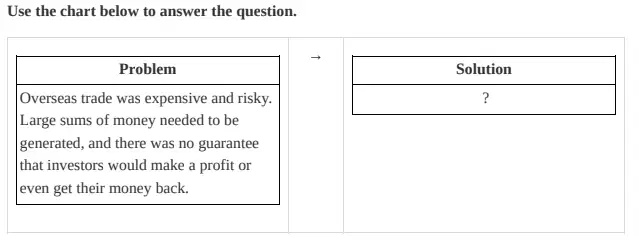
Which solution to this problem emerged in the Age of Exploration?
a)
government-owned enterprises
b)
employee-owned businesses
c)
joint-stock companies
d)
non-profit organizations
4.
What was one major effect of the Columbian Exchange?
a)
It created a new source of revenue for European farmers.
b)
It enhanced the technology used in the Industrial Revolution.
c)
It led to the widespread adoption of the institution of slavery.
d)
It improved political relations between competing countries.
5.
This list identifies several of the motives behind whose voyages?
- Find a direct route by sea to Asia
- increase the power of Spain
- Spread Christianity
- Gain personal wealth and prestige
a)
Henry Hudson
b)
Christopher Columbus
c)
Leif Ericson
d)
Samuel de Champlain
6.
Why did the Spanish monarchs Ferdinand and Isabella support Christopher Columbus’s voyage in 1492?
a)
They wanted to find a direct route by sea to Asia.
b)
They wanted to create settlements in new territories.
c)
They wanted to discover lands previously unknown to Europeans.
d)
They wanted to test new navigational tools that had been developed.
7.
Which economic policy required a colony’s natural resources to be used to benefit the ruling country?
a)
laissez faire
b)
feudalism
c)
salutary neglect
d)
mercantilism
8.
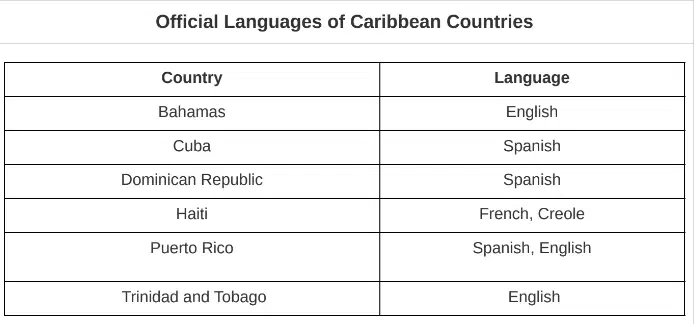
Which factor best explains this pattern of official languages?
a)
type of government
b)
cooperation with developed countries
c)
major trading partners
d)
influence of colonial settlements
9.
What was one effect of the Columbian Exchange on the Americas during the colonial era?
a)
improvement in industrial practices
b)
creation of a confederacy of native peoples
c)
introduction of the African slave trade
d)
extinction of native livestock
10.
The importation of slaves affected the Caribbean Islands by
a)
reducing resistance from the indigenous population.
b)
encouraging the expansion of native peoples’ territories.
c)
preventing the creation of independent governments.
d)
supporting the development of the plantation system.
11.
The Columbian Exchange affected Native Americans by
a)
improving tribal relations.
b)
decreasing the transmission of disease.
c)
increasing the diversity of goods.
d)
decreasing religious conflict.
12.

Which change completes this diagram?
a)
Confiscation of private property
b)
Reduction of tax collections
c)
Creation of joint-stock companies
d)
Increase of foreign investment
13.
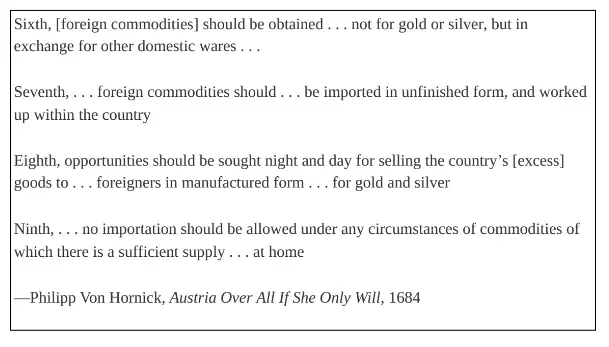
According to mercantilists like Von Hornick, what should a country strive to achieve?
a)
income equality
b)
industrial specialization
c)
limited trade barriers
d)
a positive balance of trade
14.
Innovations like the caravel, astrolabe, and magnetic compass contributed most to which age?
a)
Exploration
b)
Reformation
c)
Industrial Revolution
d)
Agricultural Revolution
15.
What effect did the arrival of Europeans have on both the Aztec and Inca civilizations?
a)
It led to democratic reforms in both civilizations.
b)
It led to the destruction of the Aztec and Inca civilizations.
c)
It led to the migration of Aztec and Inca civilizations to Europe.
d)
It led to improved healthcare and education systems in both civilizations.
16.
Which of these describes a result of the Columbian Exchange?
a)
The introduction of the horse to Europe caused an increase in agricultural output.
b)
The introduction of smallpox to the Americas caused the Native American population to decrease.
c)
The introduction of gunpowder to Europe caused war fatalities to increase in Europe.
d)
The introduction of the potato and corn to the Americas caused the life expectancy of Native Americans to increase
17.
How did European countries attempt to achieve goals such as acquiring resources for trade, obtaining raw materials for industry, and create markets for manufactured goods during the 16th-18th century?
a)
by colonizing territories
b)
by adopting isolationist policies
c)
by introducing democratic government
d)
by promoting communist economic goals
18.
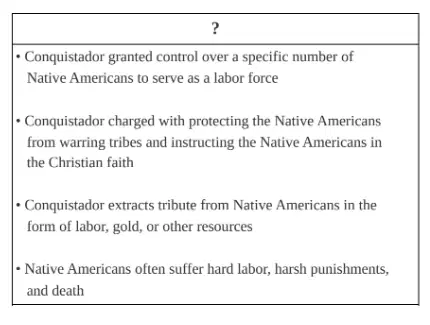
Which of these would be the best title of this chart?
a)
Trans-Atlantic Slave Trade
b)
Indentured Servitude
c)
Encomienda System
d)
Salutary Neglect
19.
Which phrase best explains a reason for the beginning of European exploration of the Americas?
a)
pressures from foreign invaders
b)
demands for economic resources
c)
shortages of skilled labor
d)
lack of agricultural diversity
20.
How did the expansion of sugar plantations in the Americas change the transatlantic economy?
a)
by improving the efficiency of manufacturing processes
b)
by increasing the need for market competition
c)
by improving the design of farming equipment
d)
by increasing the demand for slave labor
21.
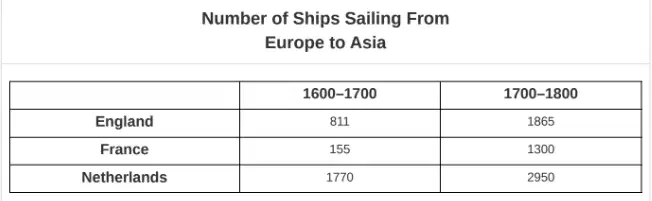
Which factor best explains the change shown in this table?
a)
favorable climate
b)
access to valuable resources
c)
insufficient infrastructure
d)
lack of agricultural goods
22.
Which new pattern of cultural diffusion between Europe and the Americas was initiated with the Spanish exploration in 1492?
a)
Silk Road
b)
Columbian Exchange
c)
Incense Route
d)
Trans-Sahara Trade
23.
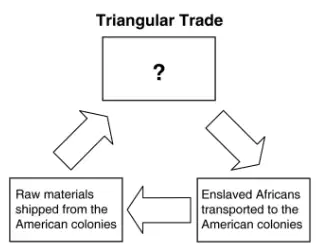
Which step in the diagram is missing?
a)
Silk shipped from China
b)
Spices shipped from India
c)
Manufactured goods shipped from Europe
d)
Gold shipped from South America
24.

What was the primary cause of this situation?
a)
health issues caused by famine
b)
illness due to lack of shelters
c)
the loss of knowledge about traditional medicine
d)
the introduction of foreign diseases
25.
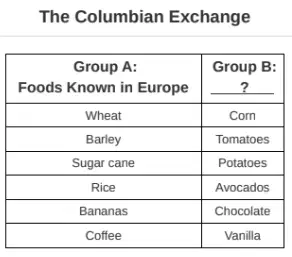
What is the best title for Group B in the table?
a)
Foods known in Asia
b)
Foods known in the Pacific Islands
c)
Foods known in Africa
d)
Foods known in the Americas
100 %

