
Font size
 Worksheets
Quiz - Limits to Growth
Total questions: 10
Worksheet time: 7mins
Which of the following statements describes density-independent limiting factors?
Competition is an example.
Parasitism and disease are examples.
Environmental extremes, such as a hurricane or drought, are examples
Their effects increase as the population increases in an area.
A scientist is developing a computer model to determine the maximum population size, or (a) , of eagles and other birds of prey in a forest ecosystem. The model should represent all of the (b) that affect the populations.
A population of mountain lions lives in an alpine forest. The mountain lions hunt deer, rabbits, and other prey. As the population increases, which of these events becomes more likely to occur?
Female mountain lions raise an increasing number of pups per litter, and a greater percentage of pups survive to adulthood.
Competition for territory and other resources acts to slow the growth rate of the population.
A wildfire, drought, or other natural disaster acts to decrease the mountain lion population by at least 50 percent.
A decrease in competition acts to increase the growth rate of the population
A team of scientists visits an island in the Caribbean Sea. They find a diverse community of turtles, lizards, birds, and a variety of trees, shrubs, and grasses. No humans live on the island.
Several years later, the scientists return to the island. They find a much smaller community, with reduced populations of all of the species they had identified earlier. Some of the animals now appear to be absent from the island.
Which is the most likely explanation for the changes that the scientists observed?
Competition for resources caused all of the island populations to decrease at the same time.
A disease or parasite affected all of the island populations.
A natural disaster, such as a hurricane, struck the island.
Stress from overcrowding affected all of the island populations.
Gibbons are small apes that live in the trees of southeast Asia. A scientist predicts that at the current rate of deforestation in southeast Asia, the region’s carrying capacity for gibbons will decrease by 10 percent every year. The scientist’s prediction provides the strongest support for which of these conclusions?
The gibbon population will decrease by 5 percent every year until reaching a certain minimum size, which it will maintain
The gibbon population will decrease by 10 percent every year until reaching a certain minimum size, which it will maintain.
Gibbons will maintain their current population size as they adapt to new environments.
Gibbons will eventually become extinct in the wild.
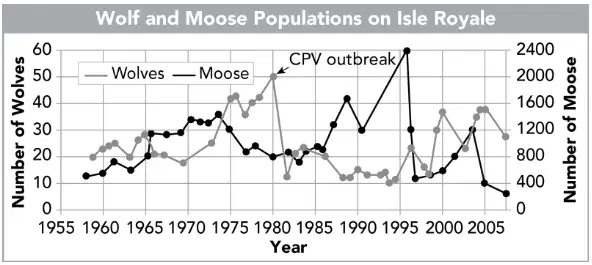
On Isle Royale, wolves are the main predators of moose. The graph shows the changing wolf and moose populations on the island over a 50-year time span.
Which statement provides the strongest explanation for the trends in the two populations?
The populations of predators and prey are limited by abiotic factors only.
Predation acts a density-dependent limiting factor on prey, but not on predators.
Predation acts as a density-independent limiting factor on predators, but not on prey.
Predator-prey relationships act as density-dependent limiting factors on both predators and prey.
A hurricane blows across a Caribbean island. The storm flattens trees, and it drowns or washes away a large number of plants and animals. As a result of the storm, the carrying capacity of the island is temporarily reduced for many of the island species.
The storm is a density-independent limiting factor, because population size and density do not alter the storm's effect.
The storm is a density-independent limiting factor, because its effect depends on the size and density of a population.
The storm is a density-dependent limiting factor, because its effect depends on the size and density of a population.
The storm is a density-dependent limiting factor, because its effect depends on the strengths of its wind and rainfall.
A rabbit population is affected by parasitism and disease, both of which are density-dependent limiting factors. Which statement describes the effects of parasitism and disease on the rabbits?
Parasites and disease weaken or kill a constant percentage of the rabbit population, regardless of its density.
As the density of the rabbit population increases, parasites and disease weaken or kill a greater percentage of rabbits.
As the density of the rabbit population increases, parasites and disease weaken or kill a lesser percentage of rabbits.
Parasites and disease weaken or kill mostly the youngest and oldest rabbits, and not the rabbits of average age.
Bamboo is a type of grass. In the wild, pandas eat bamboo almost exclusively. For this reason, the availability of bamboo is a significant limiting factor on the panda population.
Which statement describes how pandas could become extinct in the wild?
The bamboo population decreases so low that other limiting factors begin to affect the panda population.
The bamboo population decreases so low that the carrying capacity for pandas becomes zero.
The populations of bamboo and pandas follow a cyclical pattern of increasing and decreasing, until one of them becomes extinct.
The populations of bamboo and pandas both follow a pattern of exponential growth, and then both become extinct.
Scientists have observed the (a) growth of lionfish in the Caribbean Sea. A limiting factor will cause the growth of the lionfish population to (b) , forming a pattern of (c) growth.

