
 Worksheets
LCS Common Assessment 4th grade SS Government #1 4H2a, b; 4CG1b, c, d
Total questions: 18
Worksheet time: 9mins
Name
Class
Date
1.
1. What was the first American government based upon?
a)
Bill of Rights
b)
Articles of Confederation
c)
Constitution
d)
Amendments to the Constitution
2.
2. Why was the first government unsuccessful?
a)
It was too weak.
b)
It couldn't collect taxes to fund itself.
c)
It gave the states too much independence and power.
d)
All of the above.
3.
3. What was the second (final) document that the American government was based upon?
a)
Declaration of Independence
b)
Articles of Confederation
c)
Constitution
d)
Bill of Rights
4.
4. What is the name given to the introduction to the Constitution?
a)
amendments
b)
Bill of Rights
c)
Constitution
d)
Preamble
5.
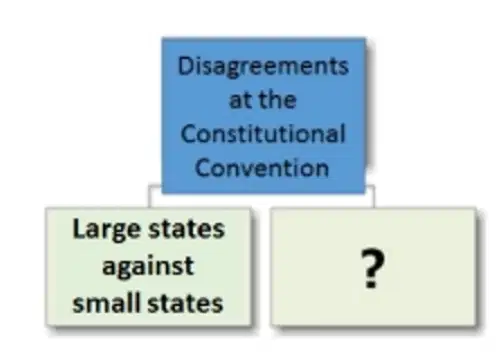
5. Which of the following BEST completes the diagram?
a)
Industrial states against agricultural states
b)
Slave states against free states
c)
Older states against newer states
d)
Eastern states against western states
6.
6. Which of the following BEST explains the significance of the phrase "We the People" at the beginning of the U.S. Constitution?
a)
The people are able to rewrite the Constitution whenever they want.
b)
The Constitution only applies to people living in certain states.
c)
The people are able to choose the parts of the Constitution they want to follow.
d)
The powers of the government listed in the Constitution come from the people.
7.
7. Who am I?
*politician from Virginia who was at the Constitutional Convention *came up with the Virginia Plan and the three-branch federal system *wrote some of the Federalist Papers to convince people to ratify the Constitution
a)
Thomas Jefferson
b)
George Washington
c)
James Madison
d)
Benjamin Franklin
8.
8. In the United States, there is a federal system of government. This means that:
a)
some of the more powerful states tell the other states what to do.
b)
the power of the government is shared by the national government and the states.
c)
national laws must be approved by all of the state governments.
d)
the fifty states have more power than the national government.
9.
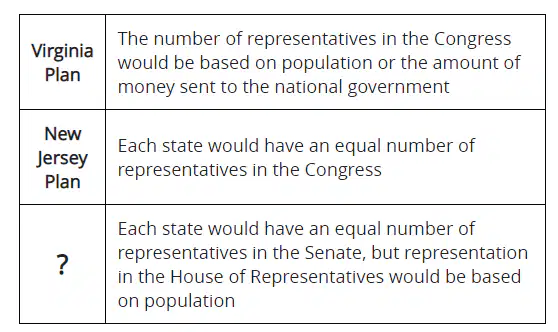
9. Which of the following BEST completes the diagram?
a)
South Carolina Plan
b)
Great Compromise
c)
Massachusetts Plan
d)
Three-Fifths Compromise
10.
10. Who am I?
*was a member of the committee who wrote the Declaration of Independence *served as the ambassador to France from 1776 until 1785 *at age 81, was the oldest delegate at the convention
a)
Alexander Hamilton
b)
George Washington
c)
James Madison
d)
Benjamin Franklin
11.

11. Which of the following BEST completes the diagram? (Choose 2 answers!)
a)
It was unable to pay for expenses.
b)
It was unable to provide many services.
c)
It formed a strong army.
d)
It had a stable economy.
12.
12. Why were the Articles of Confederation replaced by the U.S. Constitution?
a)
The Supreme Court ruled that they were unfair.
b)
The Articles were set to expire after ten years.
c)
The government was too weak to rule effectively.
d)
The American people voted to get rid of them.
13.
13. What was one way that the Constitution addressed the issue of how slaves would be counted in a state's population?
a)
Slaves counted the same as free people in the population.
b)
States could choose whether of not to count enslaved people.
c)
Every five slaves would be counted as three people.
d)
Slaves were not counted as part of a state's population.
14.
14. Which of the following is true of the Articles of Confederation?
a)
The Americans used it to declare their independence from Great Britain.
b)
It was an agreement between the United States and the Native Americans.
c)
It was a treaty between the United States and Great Britain.
d)
It formed the first central government in the United States.
15.
15. Who am I?
*served as the leader of the Continental Army during the Revolutionary War *owned a plantation in Virginia called Mount Vernon *was chosen to lead the Constitutional Convention
a)
George Washington
b)
Benjamin Franklin
c)
Alexander Hamilton
d)
James Madison
16.
16. Which of the following statements is true of the Articles of Confederation?
a)
The wealthiest states had the most power.
b)
Large states had more power than small states.
c)
Slave states had more power than free states.
d)
All states had equal power in Congress.
17.
17. Why did the Articles of Confederation give more powers to the states than to the central government?
a)
Many people felt that a central government was not needed.
b)
Many Americans feared a strong central government.
c)
The central government did not want to be involved in too many things.
d)
Great Britain did not approve of a strong central government.
18.
18. Why did the representatives at the Constitutional Convention divide the powers of the national government among three different branches?
a)
They did not want to copy the French system of two branches of government.
b)
They were trying to copy the British form of government.
c)
They were trying to keep the form of the state governments.
d)
They did not want any one branch of government to become too powerful.
100 %

